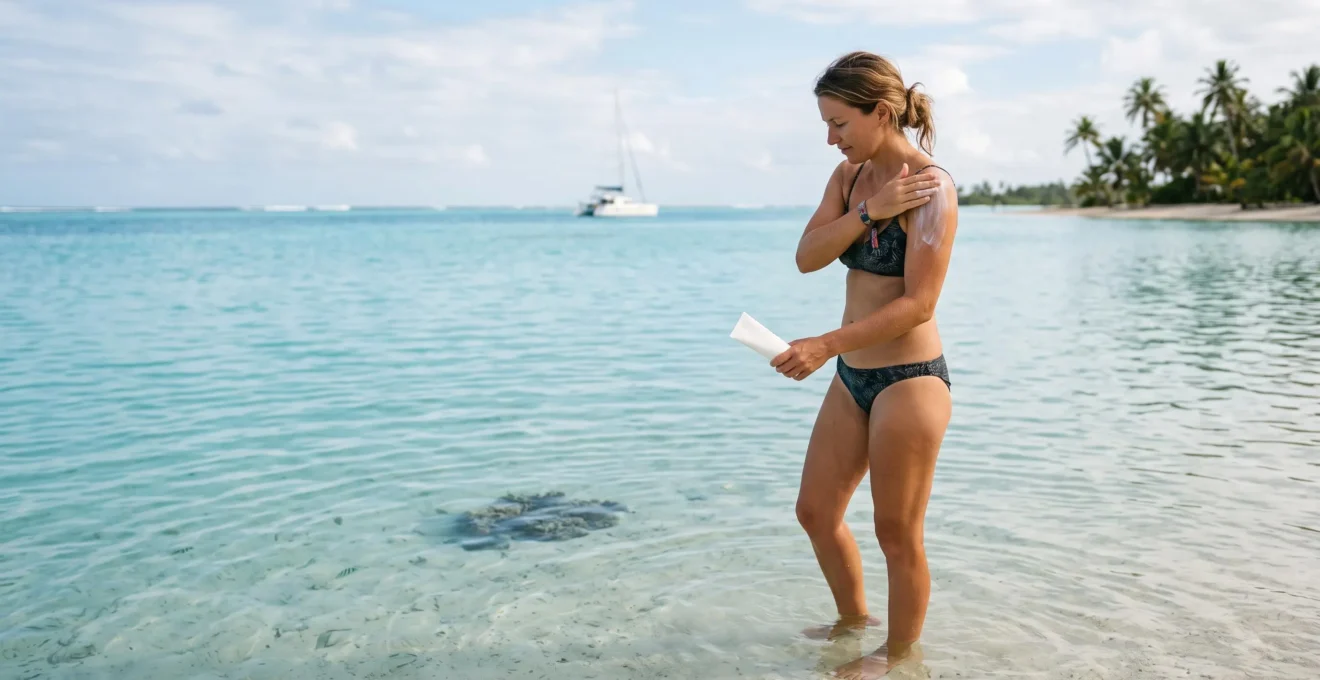
Most « reef-safe » sunscreens are a marketing lie; true coral protection depends on scrutinising the full ingredient list for specific mineral filters and a list of hidden toxins.
- Your sunscreen is not truly reef-safe unless its only active ingredients are non-nano Zinc Oxide or non-nano Titanium Dioxide.
- Terms like « reef-friendly » are unregulated. The only reliable trust signal is a third-party certification like the ‘Protect Land + Sea’ seal.
Recommendation: Prioritise covering your skin with UPF-rated clothing. For exposed skin, apply a verified non-nano mineral sunscreen at least 20 minutes before entering the water.
As a UK diver or snorkeller planning a trip to the Dominican Republic, you are already conscious of the need to protect its vibrant marine ecosystems. You’ve likely searched for « reef-safe » sunscreen, only to be met with a bewildering array of eco-friendly claims. As a marine conservation chemist, I can tell you that your confusion is justified. The majority of these claims are « greenwashing »—marketing designed to prey on your good intentions. The truth is, protecting the coral off the shores of Bayahibe or Punta Cana requires a more forensic, ingredient-focused approach.
This guide moves beyond the slogans. We will dissect sunscreen labels at a chemical level, exposing the unregulated nature of « reef-safe » terminology and arming you with the knowledge to identify genuinely harmless formulations. However, chemical pollutants from sunscreen are just one piece of the puzzle. A truly responsible traveller understands the interconnected pressures on the Dominican marine environment. Therefore, we will also examine other critical, often-overlooked issues: the ecological challenge posed by sargassum seaweed and the essential safety protocols for exploring the country’s breathtaking underwater caves. This is your complete brief for interacting with the Dominican Republic’s marine world safely and sustainably.
This article provides a detailed, science-based framework for making responsible choices during your trip. Discover the specific chemical culprits, learn to identify genuinely safe products, and understand the wider environmental context for a truly conscientious Caribbean adventure.
Contents: A Chemist’s Guide to Dominican Marine Protection
- Why Do Oxybenzone and Octinoxate Harm Dominican Coral Reefs?
- Zinc Oxide or Titanium Dioxide: Which Reef-Safe Ingredient Protects Skin Better?
- How to Spot Fake « Reef-Safe » Claims on Sunscreen Labels?
- The Sunscreen Mistake That Costs UK Travellers £25 at Dominican Resorts
- When Should You Apply Reef-Safe Sunscreen Before Entering the Ocean?
- How to Verify Bayahibe Dive Shops Have Certified Cave Instructors?
- The Seaweed Problem That Ruins 40% of Dominican Beach Photos
- Do You Need Advanced Certification to Dive Bayahibe’s Underwater Caves?
Why Do Oxybenzone and Octinoxate Harm Dominican Coral Reefs?
The term « harm » is an understatement; chemicals like oxybenzone and octinoxate are potent endocrine disruptors for coral. When you swim with a sunscreen containing these compounds, they leach into the water and interfere with coral’s reproductive and growth cycles. The chemical mechanism is insidious: it can induce bleaching even at low temperatures, damage coral DNA, and, most alarmingly, deform juvenile coral, preventing the reef from regenerating. This is not a hypothetical threat. The Caribbean has already suffered a loss of up to 97% of its key reef-building corals since the 1980s due to a combination of stressors, including chemical pollution.
These chemicals don’t just disappear. They are lipophilic, meaning they accumulate in the fatty tissues of marine organisms, leading to bioaccumulation up the food chain. So, a small amount of sunscreen worn by thousands of tourists daily creates a chronic, toxic soup in the very ecosystems they came to admire. For species like the endangered staghorn coral (Acropora cervicornis), this chemical assault is a critical threat, pushing already vulnerable populations closer to extinction.
Case Study: FUNDEMAR’s Local Restoration Efforts
In the Dominican Republic itself, the Dominican Foundation for Marine Studies (FUNDEMAR) is actively working to restore populations of the endangered staghorn coral in Bayahibe. For over two decades, their work has been a crucial conservation tool. However, their coral nurseries and transplant sites are located in the exact areas most exposed to sunscreen runoff from nearby tourist beaches and snorkelling routes, highlighting the direct conflict between irresponsible tourism and local conservation efforts.
Therefore, avoiding oxybenzone and octinoxate isn’t just a « nice thing to do »; it is the absolute minimum requirement for responsible marine tourism. It is a direct action to prevent further degradation of the fragile coral ecosystems that are the lifeblood of the Dominican Republic’s coastal environment.
Zinc Oxide or Titanium Dioxide: Which Reef-Safe Ingredient Protects Skin Better?
When you eliminate chemical sunscreens, you are left with two primary options: mineral filters. Both Zinc Oxide (ZnO) and Titanium Dioxide (TiO2) work by forming a physical barrier on the skin that reflects and scatters UVA and UVB rays, rather than a chemical reaction. From a purely marine-safe perspective, both are vastly superior to their chemical counterparts. However, they are not created equal in terms of skin protection and cosmetic elegance.
Titanium Dioxide is excellent at blocking UVB rays (the ones that cause sunburn) but is less effective against the full spectrum of UVA rays (which cause premature ageing and deep skin damage). Zinc Oxide, on the other hand, offers broad-spectrum protection across the full range of both UVA and UVB rays. For comprehensive skin health, a formula based on Zinc Oxide is scientifically superior. This is why most high-quality, dermatologist-recommended mineral sunscreens for sensitive skin are zinc-based.
The critical caveat for both minerals is particle size. To be truly reef-safe, they must be « non-nano ». Nanoparticles are so small they can be ingested by coral and other marine life, causing internal damage. As Euronews Travel correctly advises, « You should therefore opt for ‘micro-sized’ or ‘non-nano’ mineral sunscreens. » This larger particle size is what creates the thicker, more visible white paste, a trade-off many conscious travellers are willing to make. This texture is the visual proof that the product is staying on your skin’s surface and not penetrating it, or the coral.
Furthermore, independent testing confirms the efficacy of these formulas. For instance, ocean-testing of a non-nano zinc oxide formula shows it can provide SPF 30+, broad-spectrum protection and be water-resistant for 80 minutes—a duration that perfectly matches a typical snorkelling excursion. When choosing between the two, Zinc Oxide provides more complete protection for your skin, making it the clear winner for the health-conscious and eco-conscious traveller.
How to Spot Fake « Reef-Safe » Claims on Sunscreen Labels?
This is the most important lesson for any eco-conscious traveller: the term « reef-safe » on a sunscreen bottle is, at present, completely meaningless from a regulatory standpoint. It is a marketing term, not a scientific certification. As the SkinSort editorial team bluntly states, « The term ‘reef-safe’ is unregulated in the skincare industry. » Brands can, and do, put this claim on their packaging while still including ingredients known to be toxic to marine life. Relying on this label is the fastest way to inadvertently harm the very environment you want to protect.
To truly verify a product, you must become a label detective and ignore the front of the bottle entirely. Your focus should be exclusively on the ‘Active Ingredients’ and ‘Inactive Ingredients’ lists printed on the back. A truly reef-safe product will have non-nano Zinc Oxide or Titanium Dioxide as its only active ingredients. Then, you must scan the full ingredient list for a « hall of shame » of other harmful chemicals that are often hidden in the inactive list.
Your Action Plan: The 5-Step Sunscreen Label Audit
- Ignore the Front Claim: Completely disregard any « Reef-Safe, » « Reef-Friendly, » or « Marine-Safe » logo or text on the front of the packaging. These terms are not legally defined or enforced.
- Isolate Active Ingredients: Turn to the back and find the « Active Ingredients » box. The ONLY acceptable ingredients here are Zinc Oxide or Titanium Dioxide. If you see anything else (e.g., Avobenzone, Homosalate), the product is not reef-safe.
- Cross-Reference the « Hall of Shame »: Scrutinise the full « Inactive Ingredients » list. You must ensure the formula is free from Oxybenzone, Octinoxate, Octocrylene, 4-methylbenzylidene camphor, Parabens, and Triclosan. Any of these disqualifies the product.
- Seek Third-Party Verification: The gold standard is an independent certification. Look for the ‘Protect Land + Sea’ seal from the Haereticus Environmental Laboratory. This lab offers a certification to brands that have passed rigorous testing, making it the most reliable trust signal available.
- Confirm Particle Size: Scan the packaging or brand website for the term « non-nano » or « micro-sized. » If the particle size isn’t specified, assume the worst and avoid it, as nano-particles can be ingested by coral.
In essence, you must shift your mindset from trusting brand marketing to verifying chemical formulations. The ‘Protect Land + Sea’ seal is the closest thing to a guarantee, but learning to read an ingredient list is a skill that empowers you to make the right choice every time, regardless of the packaging claims.
The Sunscreen Mistake That Costs UK Travellers £25 at Dominican Resorts
The most common and costly mistake is simple: packing the wrong sunscreen and assuming you can buy a « reef-safe » alternative upon arrival. This assumption frequently backfires, leaving you trapped. Dominican tour operators for protected areas like Saona Island or Catalina Island are increasingly (and correctly) enforcing « no chemical sunscreen » rules. They will inspect your bottle, and if it contains prohibited chemicals, you will be forced to either go without protection or buy a compliant bottle from the resort gift shop or tour provider at a vastly inflated price.
A small, 100ml bottle of genuinely certified, non-nano mineral sunscreen can easily cost you US$30 (£25+) in a resort setting. This is a classic case of scarcity pricing. The shops know you have no other choice. This isn’t just about the money; it’s about the quality. The products available are often from obscure brands with questionable efficacy and are rarely the well-regarded, independently tested formulas you would choose at home.
The Resort Scarcity Trap
Eco-conscious companies like Stream2Sea and Badger Balm have invested heavily in rigorous testing to ensure their products are both effective for humans and harmless to marine life. However, these are precisely the brands you are unlikely to find on the shelves of a typical Dominican resort gift shop. Instead, you’ll find a limited selection of whatever brand the resort has a supply deal with, forcing you into a ‘scarcity trap’ where you pay a premium for a potentially inferior product simply to be allowed on your pre-paid excursion.
A genuinely certified, high-performance mineral sunscreen is a specialised product, and its price reflects the quality of its ingredients and research. Independent analysis shows the real market price of a certified reef-safe formula is closer to $6.00 per fluid ounce (around £1.60 per 10ml), meaning a standard 100ml travel-size bottle should cost you around £16 in the UK. By purchasing your verified sunscreen before you travel, you not only save money but also guarantee you have a high-quality product you can trust on your skin and in the water.
When Should You Apply Reef-Safe Sunscreen Before Entering the Ocean?
The timing of your sunscreen application is as important as the formula itself. The common practice of applying sunscreen on the boat just moments before jumping in for a snorkel is the worst possible approach. It guarantees that a significant portion of the product will wash off immediately, forming an oil slick on the surface and contributing to pollution without ever having protected your skin. This is a major factor in how, with an estimated 14,000 tons of sunscreen entering reef waters each year, the cumulative impact becomes so devastating.
Mineral sunscreens, unlike their chemical counterparts, do not need to be absorbed by the skin to be effective. They work by forming a physical barrier on the surface. However, for this barrier to be effective and durable, it needs time to set. The general rule is to apply your non-nano zinc or titanium dioxide sunscreen at least 15-20 minutes before sun exposure and entering the water. This allows the formula to dry and adhere properly to your skin, creating a more water-resistant layer.
However, the most effective strategy, from both a skin protection and an environmental standpoint, is to minimise the amount of sunscreen you need in the first place. This is where a « protection hierarchy » comes into play:
- Coverage First: The best sunblock is fabric. Invest in a long-sleeved UPF (Ultraviolet Protection Factor) rash guard and leggings. This physically blocks over 98% of UV rays and dramatically reduces the surface area of skin that needs sunscreen.
- Hat Second: A wide-brimmed hat is essential for protecting your face, neck, and ears, areas that are highly susceptible to sun damage.
- Sunscreen Last: Apply your verified reef-safe sunscreen only to the small, remaining areas of exposed skin, such as your hands, neck, and face.
By adopting this « fabric first » approach, you not only provide your skin with superior, more reliable protection but also significantly decrease the chemical load you introduce into the fragile marine environment. It is the most responsible and effective method of sun safety.
How to Verify Bayahibe Dive Shops Have Certified Cave Instructors?
The stunning freshwater cenotes and cave systems around Bayahibe, like Padre Nuestro, offer an incredible diving experience, but they are an overhead environment that demands specialised training and uncompromising safety standards. Simply having an advanced open-water certification is not enough. Verifying that your guide is a legitimately certified cavern or cave instructor from a recognised technical agency like TDI (Technical Diving International) is non-negotiable.
Do not be afraid to ask for proof. A reputable instructor will be proud to show you their certification card and logbook. Your verification process should go beyond just seeing a card; you should also gauge their professionalism and adherence to safety protocols during the briefing and equipment setup. A genuine professional will volunteer information about safety procedures, gas management, and environmental protocols without being prompted. Their pre-dive briefing should explicitly mention a no-touch policy for the delicate limestone formations (stalactites and stalagmites) and rules regarding sunscreen (ideally, zero sunscreen for freshwater cave dives).
Checklist: Vetting a Cave Dive Instructor in Bayahibe
- Request Physical Certification: Ask to see their instructor-level certification card from a recognised agency (e.g., TDI, PADI, GUE). Specifically look for « Cavern Instructor » or « Intro to Cave Instructor » or higher.
- Enquire About Emergency Drills: Ask them to explain the procedure for a lost-line or air-sharing emergency. A certified instructor can demonstrate how to share air with a buddy with lights off and eyes closed, using only touch while following the guideline.
- Observe Mask Skills: During any in-water checks, verify they can remove and replace their mask underwater in a calm, controlled manner, a fundamental skill for overhead environments.
- Audit the Environmental Briefing: Confirm that the pre-dive briefing explicitly includes environmental rules, such as strict no-touch policies for cave formations and protocols for reef-safe (or zero) sunscreen to protect the fragile ecosystem.
- Confirm Adherence to Limits: A key sign of a safe operator is their respect for certification limits. As one diver recounted of a properly guided dive at Padre Nuestro, « Hans kept the dive well within the cavern zone, » demonstrating the disciplined guidance you should seek.
This diligence is your primary safety mechanism. The beauty of the Dominican caves can quickly become a dangerous trap with an unqualified or complacent guide. Your life depends on their expertise, so take the time to verify it thoroughly before you get in the water.
The Seaweed Problem That Ruins 40% of Dominican Beach Photos
While you are focused on the microscopic threat of chemicals, a massive macroscopic challenge is washing up on Dominican shores: sargassum. This floating brown seaweed has always been part of the Atlantic ecosystem, but in recent years, massive blooms fuelled by rising sea temperatures and nutrient runoff have created an ecological crisis. The sheer volume is staggering, with millions of tons of sargassum washing ashore annually in the Dominican Republic. It clogs beaches, releases hydrogen sulfide gas (with its rotten-egg smell) as it decomposes, and poses a threat to marine life.
For coral reefs already weakened by bleaching and chemical pollution, these massive influxes of sargassum are an additional major stressor. As the seaweed decomposes in the water, it consumes vast amounts of oxygen, creating hypoxic « dead zones » that can suffocate coral and other marine organisms. It also blocks sunlight from reaching the reef, further inhibiting coral growth. So, while it may present as a photobombing nuisance for tourists, it is a serious ecological problem for the coastal environment.
Case Study: SOS Biotech’s Sargassum Solution
There is a silver lining. Innovative local companies are turning this problem into a solution. SOS Biotech, the first blue biotech company in the Dominican Republic, was co-founded by CTO Elena Martínez Martínez. Based in Santo Domingo, her company collects the sargassum from beaches before it can decompose and upcycles it into products like biostimulants. SOS Biotech estimates its work has already prevented 30,000 tons of CO2 from being released, transforming a beach nuisance into a powerful tool for climate action and a local economic opportunity.
As a visitor, while you cannot solve the sargassum problem, understanding it provides context. It reinforces the fact that the Dominican Republic’s marine ecosystems are under pressure from multiple angles. It shifts the perspective from just « my sunscreen » to a broader appreciation of the fragility of the entire coastal zone.
Key takeaways
- Your primary responsibility is ingredient scrutiny; ignore marketing terms like « reef-safe » and focus on the full chemical list on the back of the bottle.
- The best sun protection is physical: UPF-rated clothing and a wide-brimmed hat minimise the need for sunscreen and thus reduce chemical load on the environment.
- True responsible travel extends beyond sunscreen. It involves verifying the certifications of your guides and understanding broader environmental issues like sargassum.
Do You Need Advanced Certification to Dive Bayahibe’s Underwater Caves?
Absolutely. Let’s be unequivocally clear: entering an overhead environment like a cave or cavern without proper training and certification is one of the most dangerous actions a diver can take. The skills required to navigate, manage emergencies, and maintain buoyancy in a cave are fundamentally different from those used in open water. There is no direct access to the surface, light can fail, and silt-outs can cause total loss of visibility in seconds.
It is critical to understand the distinction between « cavern » and « cave » diving. Recreational cavern diving is the entry-level certification. It allows you to explore the mouth of a cave, always remaining within the « daylight zone » and with a direct, visible path to the open water exit. Full cave diving involves penetrating the cave system beyond the reach of natural light, requiring advanced techniques, redundant equipment, and extensive training. A basic open water or even an advanced open water certification does not qualify you for either.
Pursuing these certifications is a serious commitment. To even begin an Intro to Cave course with an agency like TDI, the prerequisites are demanding: you must already be a certified Cavern Diver and have a minimum of 25 logged dives. The financial investment is also significant. These are not weekend courses; they are intensive training programmes that build life-saving skills. Attempting to dive in these environments without this formal training is not adventurous; it is reckless.
Therefore, if you wish to experience the incredible beauty of the Dominican cenotes, your path is clear. Either book a guided cavern tour with an operator whose instructors you have rigorously verified, and stay strictly within the limits of the tour, or commit to the proper training and certification process before your trip. There is no middle ground where safety is concerned.
By shifting your mindset from that of a passive tourist to an active, informed participant, you do more than just protect the reef. You elevate your entire travel experience, engaging with the Dominican Republic on a deeper, more respectful, and ultimately more rewarding level. Begin today by auditing the products you plan to pack and researching the certifications of the operators you plan to use.