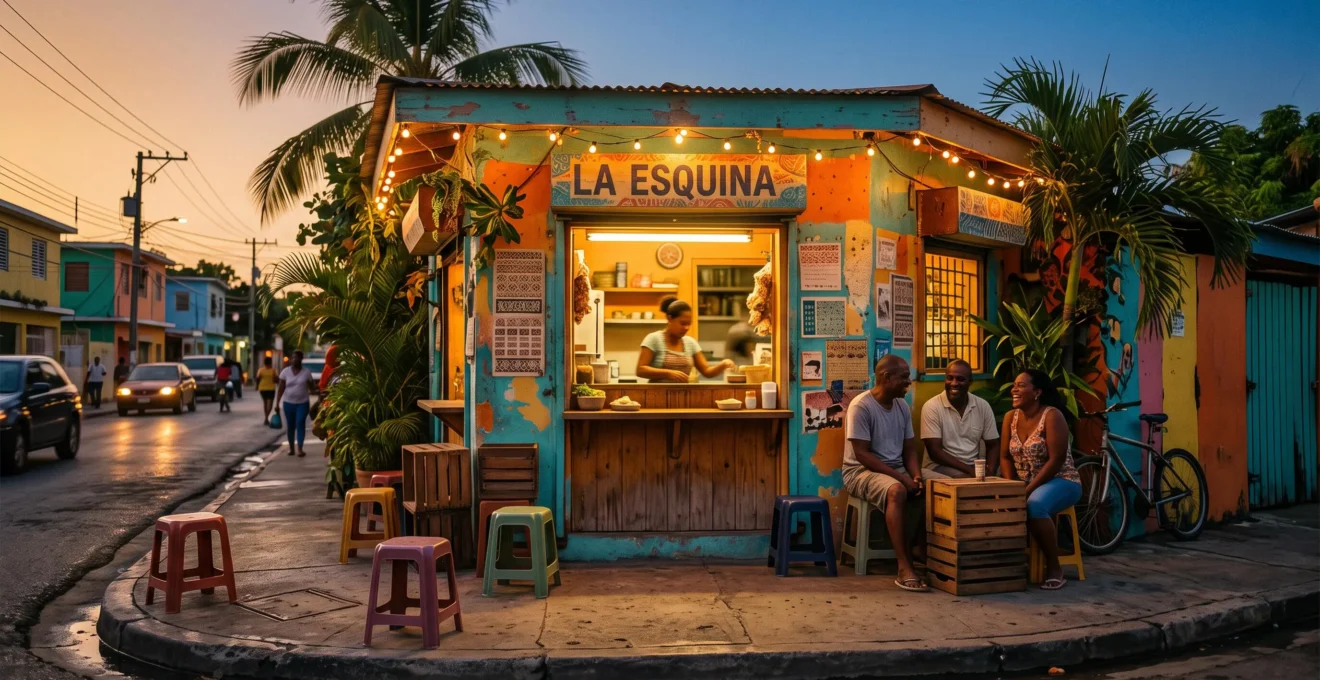
The Dominican colmado is not a retail store with a social side; it’s a fundamental community institution that uses micro-commerce as its operating model.
- It functions as a « third place, » an informal social hub that operates on a trust-based, cash-flow micro-economy.
- Its value lies not in competing with supermarket prices, but in providing hyperlocal convenience, credit, and community connection.
Recommendation: To truly understand a Dominican neighbourhood, observe the colmado not as a customer, but as a guest in a public living room.
As a cultural observer in the Dominican Republic, you quickly notice a recurring pattern. The large, air-conditioned supermarkets are for weekly stock-ups, but the daily pulse of life is found elsewhere. It emanates from the open-fronted, brightly painted corner shops known as colmados. You see people lingering, chairs spilling onto the pavement, and music setting a rhythm. It’s easy to conclude that colmados are simply convenient stores that happen to be social. Many will tell you they are just places to buy a cold Presidente beer or play a game of dominoes.
This common view, however, mistakes the symptom for the cause. Analysing the colmado merely as a retail outlet is like studying a church solely by its architecture; it misses the entire point. The colmado’s true significance lies in its function as a piece of essential social infrastructure. It is the neighbourhood’s public living room, its informal bank, its news-and-gossip exchange, and its last-mile delivery service all rolled into one. It is the physical manifestation of a community’s informal economy and social safety net.
But if this is true, what are the underlying mechanics that allow it to fulfill this role? The key is to stop seeing the colmado through a retail lens and start seeing it through an anthropological one. We must deconstruct its operations to understand how its economic model and social function are inextricably linked. This is not a guide to what a colmado sells, but an analysis of why it exists and what it truly provides.
This analysis will explore the distinct operational and social mechanics of the colmado. We will examine its unique operating hours, the specific etiquette required for interaction, its pricing logic, and its role as a social gathering space, providing you with a framework to understand this cornerstone of Dominican life.
Summary: The Colmado: Understanding the Social and Economic Fabric of a Dominican Institution
- Why Do Dominican Colmados Operate Until Midnight When Supermarkets Close at 8 PM?
- How Should Foreign Visitors Behave When Shopping at Dominican Colmados?
- Are Dominican Colmados More Expensive Than Supermarkets for Basic Goods?
- The Colmado Mistake of Expecting Beer Sales at Every Corner Shop
- When Do Dominican Men Gather at Colmados to Play Dominoes?
- Why Should You Always Keep 100-Peso Notes for Dominican Local Shops?
- When Do Dominican Chimichurri Stands Serve the Freshest Food?
- Why Do Dominicans Call Their Island « Quisqueya » Instead of Its Colonial Name?
Why Do Dominican Colmados Operate Until Midnight When Supermarkets Close at 8 PM?
The extended operating hours of a colmado are not a retail strategy; they are a direct consequence of its social function. While a supermarket is a place of transaction, a colmado is a destination. It serves as what urban sociologists call a « third place »—a crucial social environment separate from the two usual environments of home and the workplace. As one observer noted, in many Dominican public spaces, “people gather without an agenda.” The colmado provides a low-cost, accessible venue for this unstructured socializing, which naturally extends from the late afternoon well into the night, long after formal commerce has ceased.
This model is economically viable precisely because the colmado is often part of the informal sector. It operates on a lean, low-overhead model that is fundamentally different from a formal retailer. With over 54.7 percent of employment in the Dominican Republic being informal, many colmados are family-run businesses operating from a ground-floor extension of a home. They don’t have the same labour costs, utility burdens, or regulatory constraints as a supermarket chain. Their primary cost is inventory, not operating hours.
Therefore, staying open late isn’t a cost but a benefit. The evening is when the colmado’s social function peaks. After the workday, residents gather for a cold drink, to listen to music, or simply to chat with neighbours. The colmado is not just « open » for business; it is « active » as the neighbourhood’s social heart. Its late hours are a direct reflection of its community role, which formal, transaction-based businesses cannot and do not aim to replicate. The lights stay on because the social life of the barrio is still in full swing.
How Should Foreign Visitors Behave When Shopping at Dominican Colmados?
Approaching a colmado as a foreign visitor requires a mental shift: you are entering a semi-private social space, not a public commercial one. The transaction is secondary to the interaction. The primary rule is to acknowledge the human element first. Before stating what you want to buy, offer a warm and genuine greeting: « Buenas » is the all-purpose, friendly standard. Making eye contact with the colmadero (shopkeeper) and other patrons acknowledges their presence and shows respect.
This is a place built on relationships and trust, often running on an informal credit system known as the libreta. As one analysis highlights, “They even run a tab. The notebook (libreta) is the unofficial paper credit system of the Dominican Republic. There is no interest charge, either.” While you as a visitor won’t use the libreta, its existence underscores the deep trust you are stepping into. Your behaviour should reflect an understanding that you are a guest in this high-trust environment.
Instead of being an efficient, silent shopper, be prepared to engage. This is your chance to connect with the local culture in a way a resort or a supermarket will never allow. The environment is one of conversation and community, and your participation, even if minimal, will be appreciated. Politeness, patience, and a friendly disposition are your most valuable currencies here.
Action Plan: Respectful Engagement at a Colmado
- Initiate Contact: Always greet the colmadero and other customers with a friendly « Buenas » before starting your transaction. Acknowledge you are entering their space.
- Engage Curiously: If appropriate, strike up a conversation. Ask about the neighborhood, the music playing, or where to find the best local food. Show genuine interest.
- Observe and Adapt: Be mindful of the social dynamics. If a domino game is in progress or a serious conversation is happening, conduct your purchase quietly and respectfully. It’s all part of the colmado experience.
- Be Patient: The colmadero may be in the middle of a conversation or serving multiple people at once. Do not rush the process; embrace the slower, more social pace.
- Express Gratitude: End the interaction as you began it, with politeness. A simple « Gracias » and another « Buenas » upon leaving reinforces the mutual respect.
Are Dominican Colmados More Expensive Than Supermarkets for Basic Goods?
Judging a colmado’s prices against a supermarket’s is a category error. While a direct comparison might show a higher per-unit cost for some items, the colmado’s value proposition is not based on bulk-discounting. It is based on micro-convenience and providing goods in the exact quantity needed, at the exact moment they are needed. This is a fundamentally different service.
Supermarkets sell a dozen eggs; a colmado will sell you two. Supermarkets sell a litre of oil; a colmado will sell a small cup’s worth. This micro-retailing is a critical service in a cash-flow economy where a family might only have enough money for that day’s meal. The perceived « higher price » is actually payment for the service of breaking down bulk items into affordable, single-use units. As one case study on micro-enterprise notes, people can stop by for “fresh bread, a bag of chips, a soda, seasoning mix, eggs, candy.” The value is in this hyper-specific, immediate access.
Furthermore, the price often includes services a supermarket could never offer. The same case study highlights that some colmados “have bikes and deliver–for free!–to your door, which is especially convenient when you need another 5-gallon water jug.” The price you pay is not just for the product but for this entire ecosystem of convenience. There’s also a cultural element of negotiation and relationship. As author Dania Santana recalls, part of the experience is learning to ask the colmadero for « un chin »—the little extra that is a cultural staple of any transaction. This turns a simple purchase into a relational exchange, something a barcode scanner can never replicate.
The Colmado Mistake of Expecting Beer Sales at Every Corner Shop
A common misconception among visitors is that every colmado is a lively, open-air bar. The image of men playing dominoes while drinking bottles of Presidente beer is iconic, but it is not universal. From an anthropological perspective, it’s crucial to distinguish between the different archetypes of the colmado. Not all are created equal, and their primary function can vary significantly from one corner to the next.
You can broadly classify them into two types. The first is the family-run neighbourhood staple. This is a quieter, more domestic operation, often run out of the front of a family home. Its main purpose is to serve the immediate daily needs of the surrounding households: cooking oil, a single onion, sugar, coffee, and cleaning supplies. While it might sell a few beers, its atmosphere is not geared towards public drinking and socializing. The focus is on groceries and essential goods.
The second type is the « colmadón » or the social colmado. This is the establishment that more closely matches the popular image. It’s often larger, with powerful speakers blasting bachata or merengue, and its business model is heavily skewed towards the sale of alcoholic beverages for on-site consumption. Here, you’ll find the plastic tables and chairs, the crowds, and the vibrant nightlife. These are deliberately designed as social hubs. Mistaking one for the other can lead to confusion. Walking into a quiet family colmado and expecting a party is like walking into a library and asking for a dance floor. Recognizing the visual cues—stacks of beer crates, large speakers, groups of people lingering—is key to understanding which type of establishment you are approaching.
When Do Dominican Men Gather at Colmados to Play Dominoes?
The clatter of dominoes on a folding table is one of the defining soundscapes of the Dominican colmado. This gathering is not random; it follows a distinct daily rhythm. The games typically begin in the late afternoon, as the workday winds down and the intense Caribbean sun begins to relent. This is the transitional period between work and home, and the colmado’s outdoor space becomes the de facto social club for many neighbourhood men.
The activity peaks in the early evening and can continue for several hours, often accompanied by lively music and conversation. As one source notes, “Merengue and bachata frequently play while friends sit outside playing dominoes.” This is more than just a pastime; it’s a social ritual. The domino table acts as an informal boardroom, a therapy couch, and a newsroom all in one. It’s a space where community bonds are strengthened and information is exchanged.
The Colmado as an Informal Information Hub
The function of the colmado’s domino table mirrors observations of similar spaces in the Dominican diaspora. In Washington Heights, NYC, the local bodegas (the diasporic equivalent of colmados) serve a vital role beyond commerce. As one study from The Gotham Center for NYC History explains, “Like the colmado, patrons consistently visit their nearby bodegas and become familiar with the employees or owners… As virtual extensions of their home, the bodega becomes a place where Dominicans share information and news about their lives, topics of common interest, and mutual acquaintances.” The domino table in the Dominican Republic is the focal point for this same informal, yet crucial, exchange of social information, solidifying the colmado’s role as a vital piece of community infrastructure.
While weekends, especially Sunday afternoons, are prime time for more extended domino sessions, the ritual is a daily feature in many neighbourhoods. It’s not an event scheduled for a specific day, but rather a constant, flowing part of the community’s social life that ebbs and flows with the daily routines of its participants. For the men of the barrio, the domino table at the colmado is a fundamental part of their social world.
Why Should You Always Keep 100-Peso Notes for Dominican Local Shops?
In the Dominican Republic’s street-level economy, cash is king, but not all cash is created equal. Carrying a wallet full of large bills (like 1,000 or 2,000-peso notes) is a classic visitor mistake. For small local businesses like colmados, making change for a large note isn’t just an inconvenience; it can be a genuine disruption to their delicate cash-flow ecosystem.
This reality is rooted in the informal nature of the economy. Many of these businesses operate with a very small amount of physical cash on hand for the day’s operations. As an AMCHAM DR report on the informal economy points out, “Many informal businesses rely solely on their own cash flow to operate, making them more vulnerable to economic crises or demand fluctuations.” When you pay for a 25-peso sandwich with a 2,000-peso bill, you might be asking the colmadero to hand over a significant portion of their entire day’s working capital just to provide your change. This can leave them unable to make change for subsequent customers or even to pay a supplier who might stop by.
The scale of daily transactions underscores this point. Real-world prices for everyday items are small. A testimony on a local forum mentions that “ham and cheese sandwiches with a fried egg sell for about 25 pesos, and a glass of fresh orange juice goes for around 10 pesos.” When the vast majority of transactions are in these low denominations, a large bill is a logistical and financial hurdle. While the national level of informality, at 54.7%, is lower than some regional peers, it’s still high enough to dictate that most small shops operate on these very thin, cash-based margins. Always breaking larger notes at supermarkets, banks, or hotels and keeping a supply of 100- and 200-peso notes is not just a convenience for you; it’s a sign of respect for the local economic reality.
When Do Dominican Chimichurri Stands Serve the Freshest Food?
While the colmado is the daytime heart of the neighbourhood, as night falls, another key player in the Dominican street food ecosystem emerges: the chimichurri stand. The « chimi, » as it’s universally known, is the nation’s signature street sandwich, and understanding its rhythm is key to experiencing it at its best. The answer to when you get the freshest food is simple: at night, specifically when the stands first open or during their peak hours.
These are overwhelmingly nocturnal operations. The food trucks, known as chimicarros, typically begin to appear on busy street corners and in city centers around 7 PM. As one guide explains, “The chimichurri burger… is the Dominican Republic’s signature street sandwich, sold from food trucks… that typically appear on busy street corners after 7 PM and operate through the early morning hours.” The freshest ingredients are laid out at the beginning of the service. The meat is sizzling on the griddle, the shredded cabbage is crisp, and the bread is soft. This is when you are guaranteed the highest quality experience.
The chimi is deeply ingrained in the culture as a late-night food. It is the go-to meal after a night of dancing, a baseball game, or a social gathering. It’s best enjoyed, as one local expert puts it, “Late at night near city centers or after clubs.” This is when the stands are busiest, and a high turnover of customers means the food is constantly being cooked fresh to order. A busy chimi stand is a sign of quality. The personal connection is also strong, as one writer fondly recalls, linking the chimi to family outings in the evening to Santiago’s iconic monument. This food is not just sustenance; it’s part of the social fabric of the Dominican night, a culinary ritual best experienced after dark.
Key Takeaways
- The colmado is not a store but a « third place, » a social institution whose late hours reflect its community role, not a retail strategy.
- Value is measured in micro-convenience (single-use items, free delivery), not bulk pricing, making direct supermarket comparisons misleading.
- Respectful interaction involves greeting, patience, and using small bills, acknowledging you are a guest in a trust-based micro-economy.
Why Do Dominicans Call Their Island ‘Quisqueya’ Instead of Its Colonial Name?
The use of « Quisqueya » by Dominicans is a profound act of cultural and historical reclamation. While the official name of the country is the Dominican Republic and the island is Hispaniola, « Quisqueya » is the name that resonates with national identity and pride. It is the name that connects the present-day nation to its pre-Columbian, indigenous roots. The name comes directly from the Taíno people, the original inhabitants of the island before the arrival of Christopher Columbus.
According to Taíno dictionaries, Quisqueya (or Kiskeya) means « Mother of all Lands. » It was one of the original names used by the indigenous population to refer to their home. To use the name « Quisqueya » is to consciously choose an indigenous term over a colonial one (Hispaniola, meaning « Spanish Isle, » or Santo Domingo, named for a Catholic saint). This choice is a subtle but powerful statement about identity, affirming a connection to the land itself, rather than to the European powers that later conquered it.
This preference is woven into the very fabric of national expression. As one person reflecting on their heritage noted, “I realized that not even the national anthem had the words ‘Dominican Republic’ in it… I learned that Quisqueya is a Taíno word meaning Mother of all Lands.” The anthem begins « Quisqueyanos valientes… » (« Valiant Quisqueyans… »), cementing the name in the heart of patriotic sentiment. This historical layer adds even more complexity, as the Taíno themselves had multiple names for their home. In addition to Quisqueya, they also called it Haiti (« Land of Mountains »), and the island was divided into five distinct regions or chiefdoms. Choosing « Quisqueya » is embracing a specific, poetic, and maternal aspect of that rich indigenous heritage, a symbolic way of grounding Dominican identity in the soil of the « Mother of all Lands. »