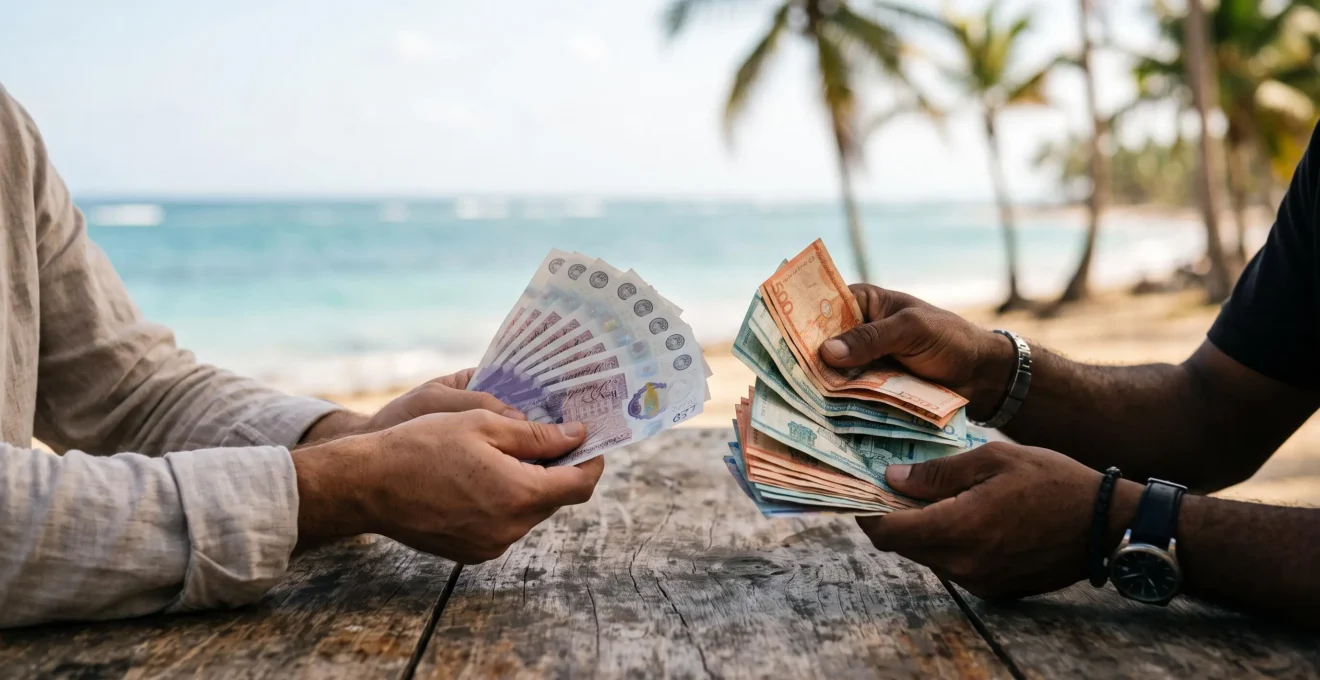
The most cost-effective currency strategy is not bringing USD from the UK, but withdrawing Dominican Pesos (DOP) from local bank ATMs upon arrival.
- Exchanging pounds in the UK or at Dominican airports results in poor rates and high fees, often costing 10% or more.
- Paying in USD within the Dominican Republic, while possible in tourist zones, exposes you to unfavourable merchant exchange rates and potential card fees.
Recommendation: Use a fee-free travel card (like Revolut or Wise) to withdraw larger sums of DOP from reputable bank ATMs (e.g., Banreservas, Banco Popular) and always pay in local currency.
For any UK traveller planning a trip to the Dominican Republic, the currency question looms large. Do you exchange your pounds for US dollars before you leave? Or is it better to get Dominican Pesos (DOP) on arrival? The internet is filled with conflicting advice, often leading to confusion and costly mistakes. Many will tell you to simply bring a stack of dollars, citing their wide acceptance in tourist hotspots like Punta Cana. Others warn against the terrible rates at airport exchange counters.
While these tips have a grain of truth, they lack a strategic, cost-focused analysis. They don’t break down the hidden fees, the stacked charges, and the poor conversion rates that quietly eat into your holiday budget. The reality is that different situations call for different currencies, a concept we can call « currency zoning. » The optimal choice at an all-inclusive resort bar is different from the best way to pay at a local ‘colmado’ or for a taxi ride in Santo Domingo.
This guide moves beyond generic advice. We will adopt the mindset of a currency strategist, dissecting each option to calculate its true cost. Forget guesswork; this is about a clear, analytical approach to managing your money. We will analyze the fee-stacking on ATM withdrawals, calculate the premium you pay for convenience at hotel exchange desks, and establish a clear framework for when to use pesos, dollars, or your card.
By understanding the mechanics behind the exchange, you’ll be empowered to make the smartest financial decisions throughout your trip, ensuring your money is spent on experiences, not unnecessary fees.
This article provides a complete cost-benefit analysis of your currency options in the Dominican Republic. Below is a summary of the key strategies we will cover to help you save money and travel smarter.
Summary: A Strategic Guide to Currency in the Dominican Republic
- Why Do Some Dominican Shops Quote Prices in Dollars Not Pesos?
- ATM Withdrawals or Currency Exchange Offices: Which Gives Better Peso Rates?
- Why Should You Always Keep 100-Peso Notes for Dominican Local Shops?
- The Resort Currency Exchange Trap That Costs 15% More Than Fair Rates
- How to Verify You’re Getting the Correct Amount of Dominican Pesos?
- The E-Ticket Mistake That Causes 30-Minute Airport Delays
- Why Do Dominican Colmados Operate Until Midnight When Supermarkets Close at 8 PM?
- How to Fill Out the Dominican E-Ticket Form Without Errors or Airport Delays?
Why Do Some Dominican Shops Quote Prices in Dollars Not Pesos?
When you first arrive, particularly in tourist-heavy areas, you’ll notice many prices quoted in US dollars (USD). This practice, known as price dollarization, is a convenience aimed at North American tourists who form a large portion of visitors. For a UK traveller, this can be misleading and costly. While hotels, tour operators, and some high-end restaurants accept USD, paying this way often means you’re subject to the merchant’s own, typically unfavourable, exchange rate—first from GBP to USD, and then effectively from USD to DOP in the pricing.
The core principle is simple: when a business prices in USD, it’s a signal that they cater to tourists and are building a profit margin into the currency conversion. If you pay with a card for a USD-priced item, you can be hit with multiple charges. On top of your home bank’s foreign transaction fee, some businesses pass on their own processing costs. In fact, using a credit card at a restaurant or hotel can incur a processing fee of up to 18%. This is why it’s almost always better to insist on paying in the local currency, Dominican Pesos (DOP).
Understanding this « currency zoning » is key to saving money. A strategic approach involves using different currencies in different environments:
- Use USD (if you must): For pre-booked hotel payments or major organised excursions where the price is fixed in dollars.
- Switch to Pesos (DOP): For everything else. This includes local shops (colmados), supermarkets, restaurants outside the main tourist strip, taxis, and public transport.
- Expect Change in Pesos: Even if you pay for a small item in USD, you will almost certainly receive your change in DOP. This further complicates tracking your spending and often at a poor rate.
- Always Ask for the Peso Price: Whenever possible, ask to be charged in Dominican Pesos. This ensures you get the real price and can benefit from a much fairer exchange rate provided by your card network or a local ‘casa de cambio’.
By actively choosing to transact in the local currency, you take control away from merchants and avoid their built-in conversion margins, which is the first step to smarter spending.
ATM Withdrawals or Currency Exchange Offices: Which Gives Better Peso Rates?
Once you decide to use Dominican Pesos, the next question is how to get them. Your two main options are withdrawing from an ATM or exchanging cash at a currency exchange office (‘casa de cambio’). A cost-benefit analysis reveals that ATMs are consistently superior, provided you follow a few key rules. The exchange rate you get from a Visa or Mastercard network via an ATM is typically very close to the mid-market or interbank rate, which is the fairest rate possible. The costs come from fees, not the rate itself.
This is where « fee stacking » occurs. A single ATM withdrawal can incur: a local ATM fee (around $3-6 USD), a foreign transaction fee from your UK bank (often 2-3%), and a potential markup if you accept the ATM’s offer to convert the transaction into pounds (Dynamic Currency Conversion or DCC). Always decline DCC and choose to be charged in DOP. In contrast, ‘casas de cambio’ and especially airport kiosks build their profit into a poor exchange rate. For instance, exchange rate margins have been observed as high as 10% at airports, representing an immediate and significant loss.
Here is a breakdown of the true cost of each method:
| Method | Typical Cost | Best For |
|---|---|---|
| Bank ATM (Banreservas, Popular, Scotiabank) | Local fee ~$3-6 USD + home bank fee | Withdrawals over £200; near-interbank rate |
| Casa de Cambio (e.g., Caribe Express, Vimenca) | Spread built into the rate, passport required | Smaller amounts, immediate cash without ATM limits |
| Airport kiosks / hotel desks | Exchange margins as high as 10% | Avoid unless absolutely necessary |
| Fintech cards (Revolut, Wise, Monzo) | Near-interbank rate but non-waivable local ATM fee still applies | Frequent small withdrawals with a low-fee card |
For maximum savings and security, prioritize using ATMs attached to major, reputable bank branches. Not only are they more secure against skimming, but they also tend to have the most transparent fees.
- Prioritise Bank ATMs: Stick to machines at Banreservas, Banco Popular, BHD León, and Scotiabank branches.
- Avoid Standalone Machines: Use ATMs in malls, pharmacies, or hotels only as a last resort, as they may have higher fees and lower security.
- Decline Dynamic Currency Conversion (DCC): When the ATM asks « Convert to GBP? », always select « No » or « Continue without conversion » to be charged in DOP and get the better Visa/Mastercard rate.
Why Should You Always Keep 100-Peso Notes for Dominican Local Shops?
While cards are useful in resorts and cities, the Dominican Republic remains a heavily cash-based economy, especially once you step outside the main tourist zones. Having a supply of small-denomination peso notes is not just a convenience; it’s a fundamental part of smooth and fair transactions. Trying to pay for a taxi, a bottle of water at a ‘colmado’, or a souvenir at a local market with a large RD$2,000 note—or worse, a US$50 bill—creates « transactional friction. » Vendors may not have enough change, leading to delays or forcing you to accept an unfavourable ad-hoc exchange rate.
Carrying small notes demonstrates respect for local commerce and empowers you as a buyer. It allows for quick, simple purchases and is essential for tipping service staff, where a small note of RD$100 or RD$200 is greatly appreciated. For most daily activities, a small float of cash is indispensable. The key is to have the right denominations.
- Cash is King Locally: It is essential in smaller towns, rural areas, beach bars, local eateries, taxis, and markets where card machines are non-existent.
- Carry a Daily Float: Always have some pesos on you, even if it’s just RD$1,000-RD$2,000 (approx. £13-£26) for incidentals and backup.
- Pay in Pesos to Avoid Confusion: Using the local currency eliminates any ambiguity over the price and prevents you from being overcharged.
A study of local currency usage shows that a specific mix of banknotes is most effective for travellers. For daily spending, for most travelers, carrying a mix of these smaller banknotes is the most convenient for everything from a coffee to a short taxi ride. Focus on keeping a healthy supply of RD$50, RD$100, RD$200, and RD$500 notes. When you withdraw a large sum from an ATM, make a small purchase at a supermarket or bank to break the large notes down immediately.
The Resort Currency Exchange Trap That Costs 15% More Than Fair Rates
For many travellers staying in all-inclusive resorts, the most convenient place to exchange money appears to be the hotel front desk or the on-site exchange kiosk. This convenience, however, comes at a steep, often hidden, price. Resorts and hotels are not in the business of offering competitive financial services; they are selling convenience. Their exchange rates are among the worst you will find in the country, with spreads and margins that can easily reach or even exceed 15% compared to the mid-market rate.
While the H2 title warns of a 15% cost, even conservative estimates show the price of this convenience is significant. Research indicates that this convenience actually costs travelers 3-7% more than using a proper exchange bureau just outside the resort. This is a minimum; for smaller amounts or less common currencies like GBP, the margin is often much wider. The hotel is counting on you valuing your time and comfort over your money, creating a classic « convenience trap. »
As the image above illustrates, the difference between exchanging inside the resort gates and stepping out to a local, reputable ‘casa de cambio’ is substantial. For every £100 you exchange at a hotel, you could be losing £7 to £15 that could have been spent on an extra meal, a tour, or souvenirs. This loss is entirely avoidable with a small amount of planning. The best strategy is to view your resort as a place to sleep and relax, not as your bank. Take a short taxi ride into the nearest town and visit a recommended ‘casa de cambio’ like Caribe Express or Vimenca, or better yet, a major bank ATM.
The few minutes it takes to leave the resort can translate into significant savings over the course of your trip. Never exchange large amounts of money at your hotel; it is, from a strategic perspective, one of the most expensive ways to get local currency.
How to Verify You’re Getting the Correct Amount of Dominican Pesos?
Whether you’re withdrawing from an ATM or receiving change from a vendor, it’s wise to have a basic understanding of the local currency to protect yourself from short-changing and counterfeits. While counterfeiting is not a widespread problem for tourists, being able to quickly spot a genuine banknote builds confidence and deters potential opportunists. Dominican Peso banknotes are printed on a special cotton-based paper and incorporate several security features that are easy to check.
Familiarising yourself with the look and feel of real money is your best defence. The paper has a distinct texture, unlike regular printer paper, and the printing is raised. Don’t be rushed when receiving cash. Take a moment to count the notes and inspect the larger denominations before leaving the counter or walking away from the ATM. A quick glance at a few key features is usually enough to verify authenticity.
The texture and embedded security elements are the most reliable indicators of a genuine note. As seen in the close-up, the details are intricate and hard to replicate. You can build a quick mental checklist to validate the notes you receive.
Your 5-Step Plan to Verify Dominican Banknotes
- Check the Watermark: Hold the note up to a light source. A three-dimensional image of the patriot Juan Pablo Duarte should be clearly visible within the paper.
- Inspect the Security Thread: Look for the thin, metallic security thread woven into the paper. On higher-value notes, this thread has a colour-shifting, droplet-like effect when tilted.
- Feel the Texture: Genuine banknotes are made from a cotton-based paper that feels crisp and distinct. Gently run your finger over the portrait and text; you should feel the raised texture of the intaglio printing.
- Observe the Glossy Stripe: On the back of the note, there is a glossy, iridescent stripe. When you tilt the note, it should shimmer and appear golden when held flat.
- Compare with a Known Genuine Note: If you are unsure, compare the suspicious note to one you received from a bank ATM. Discrepancies in colour, size, or texture will become immediately apparent.
The E-Ticket Mistake That Causes 30-Minute Airport Delays
Beyond currency, another critical step that can cause significant delays is the mandatory Dominican Republic E-Ticket. This digital form combines your immigration, customs, and health declarations into a single online document. The single most common mistake travellers make is arriving at the airport without it, or with an incorrectly filled-out form. Airlines may deny boarding if you cannot present the QR code, and filling it out hastily at a crowded check-in desk can lead to errors and a 30-minute (or longer) delay while you try to get a stable Wi-Fi connection and re-submit.
The form is straightforward, but it requires specific information that you should have on hand before you begin. It’s best to complete it in a relaxed environment before you head to the airport. Officially, the form can be filled out since 72 hours before your flight, which gives you a comfortable window. Trying to do it last-minute is a recipe for stress.
To ensure a smooth airport experience, avoid these common errors:
- Vague Address Information: The most frequent error is entering a vague hotel address. Have the exact, full address of your accommodation ready before you start the form. « Hotel in Punta Cana » is not sufficient.
- Forgetting it’s Mandatory: Some travellers mistakenly believe it’s optional or can be done on arrival. It is absolutely mandatory, and you must show the QR code to airline staff and immigration officers.
- Filling it Out with Unconfirmed Details: Only complete the form once your flight details and accommodation are fully confirmed. Making changes often requires a new submission, which can create confusion.
Treat the E-Ticket with the same importance as your passport. A few minutes of preparation at home can save you a significant amount of stress and potential delays when you’re eager to start your holiday.
Why Do Dominican Colmados Operate Until Midnight When Supermarkets Close at 8 PM?
As you explore the Dominican Republic, you’ll quickly notice a cornerstone of local life: the ‘colmado’. These small, family-run corner stores are much more than just a place to buy groceries. While large supermarkets like Nacional or Jumbo close their doors around 8 or 9 PM, colmados often stay open until midnight or later, transforming into lively social hubs. This difference in operating hours speaks to their central role in the fabric of Dominican culture.
A supermarket is a place of transactional efficiency; a colmado is a place of social connection. After sunset, many colmados become ‘colmadóns’, setting out plastic chairs and tables on the sidewalk. The air fills with the sounds of merengue or bachata, and neighbours gather to chat, play dominoes, and share a cold Presidente beer, which is often sold by the large bottle and shared among friends. This cultural function is something a supermarket cannot replicate.
The Dominican colmado is far more than a corner store; it’s the vibrant heart of Dominican communities, a social hub, an economic engine, and a cultural institution all rolled into one.
– Island Hopper Guides, The Power of Dominican Colmados: More Than Just Corner Stores
For a traveller, visiting a colmadón in the evening offers a wonderfully authentic glimpse into local life, far removed from the curated experiences of resort bars.
Case Study: The Colmadón as an Authentic Nightlife Hub
A local nightlife guide in Bayahibe highlights the ‘colmadón’ as the true heart of the neighbourhood after dark. It describes how these corner stores transition into informal open-air bars, where a fridge full of cold beers is the main attraction. Drinks are sold on a cash-only basis, and the atmosphere is relaxed and communal. For visitors willing to step outside their resort, it provides a far more genuine and affordable social experience, offering a direct connection to the local community in a way no formal bar can.
Understanding the colmado is to understand a piece of the Dominican soul. It’s an economic and social lifeline that operates on community time, not corporate schedules, providing goods and good company long after the supermarkets have gone dark.
Key Takeaways
- The most cost-effective strategy is to withdraw Dominican Pesos (DOP) from reputable bank ATMs in-country using a low-fee card.
- Always decline « Dynamic Currency Conversion » (DCC) at ATMs and card machines to avoid poor exchange rates.
- Use DOP for all local transactions; limit USD usage to tourist-specific venues that price in dollars.
- Never exchange money at hotels or airport kiosks, where margins can cost you over 10% of your money.
How to Fill Out the Dominican E-Ticket Form Without Errors or Airport Delays?
Successfully completing the Dominican E-Ticket is a non-negotiable step for entering and exiting the country. Since its introduction, the e-ticket has been the only mandatory form of submitting travel details for immigration purposes since April 2021. The process is simple, but requires accuracy. To avoid any last-minute panic, the best approach is to prepare your information in advance and create a digital safety net for your QR code.
The official government portal is the only place to fill out the form. It is free of charge. Before you even open the website, it is crucial to gather all the necessary documents and information. This preparation turns a potentially stressful task into a simple, 10-minute process.
Follow this pre-form checklist to ensure a seamless submission:
- Gather Your Documents: Have your passport, full flight details (airline and flight number for both arrival and departure), the full address of your accommodation in the DR, and your home address ready.
- Complete the Form Truthfully: The E-Ticket serves both the General Directorate of Migration and the Directorate-General of Customs. All information must be accurate and truthful.
- Save the QR Code in Multiple Formats: Once you receive the QR code, save it immediately. Take a screenshot on your phone and also save it as a PDF. This ensures you can access it even without reliable airport Wi-Fi.
- Create a Backup: Email the QR code (both the screenshot and PDF) to yourself and a travel companion. This acts as a crucial backup in case your phone is lost, damaged, or runs out of battery.
By following these steps, you create multiple redundancies and ensure that a simple technical issue doesn’t disrupt the start of your journey. It’s a small investment of time that pays huge dividends in peace of mind at the airport.
Now that you have a comprehensive strategy for managing your currency and completing your entry requirements, you can approach your trip to the Dominican Republic with confidence and financial clarity. The next logical step is to apply this knowledge to your own travel plans by selecting a low-fee travel card and preparing your E-Ticket information.
Frequently Asked Questions About Currency and Forms in the Dominican Republic
Should I let a merchant charge me in USD instead of pesos?
No — some merchants offer to charge you in USD instead of pesos, but you should always decline and ask to pay in pesos to get a fairer rate from your card network.
Will my card charge extra fees if I pay in USD?
Yes, on top of the merchant’s poor rate, you should expect your bank to add a foreign transaction fee of 1–3% unless you are using a specific no-foreign-fee travel card.
What is the most common money scam travelers face?
Common money issues include short-changing when paying with large notes, receiving counterfeit currency, taxi overcharges for not agreeing on a price beforehand, and the « Dynamic Currency Conversion » trick at ATMs and card terminals.
How can I protect myself when receiving cash back?
Take the pesos handed to you, ignore any pressure to move along quickly, and recount the notes slowly and deliberately yourself before leaving the counter. This simple act deters most opportunistic attempts at short-changing.
Do I need a separate form for departure?
No — this unique form contains all the information required of passengers both entering and leaving the Dominican Republic. You will receive a QR code for both entry and exit.
If I travel as a family, does everyone need their own account?
If you are traveling as a family, you fill out the form with the data of all family members under a single submission. Only one user account needs to be created in the system to generate a QR code that covers the entire group.