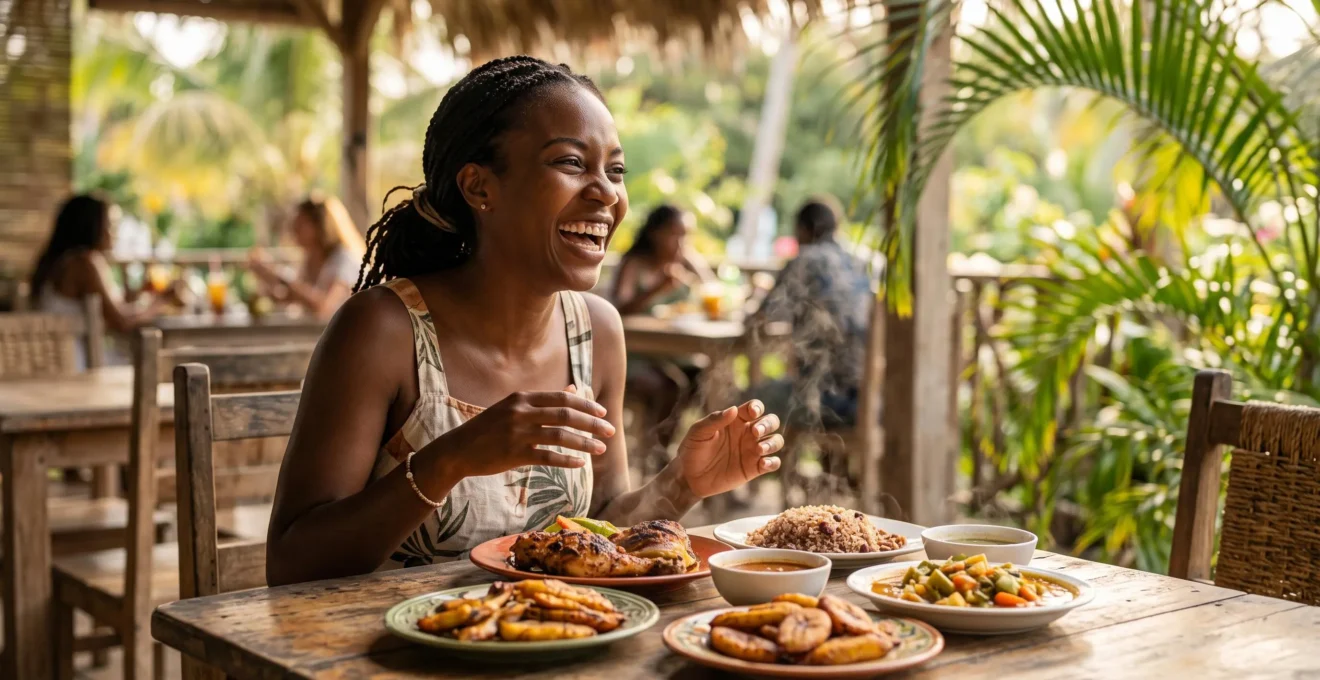
You don’t have to choose between experiencing authentic Dominican food and protecting your digestive health; the key is learning to read the environment.
- True food safety comes from spotting specific hygiene signals (like food being cooked fresh to order) and understanding the real risks, not from blanket avoidance.
- Mild stomach discomfort is often just temporary dietary adjustment; severe foodborne illness presents with clear red-flag symptoms like high fever or bloody stool.
Recommendation: Prioritise freshly cooked, hot foods, be strategic about water sources, and pack a smart digestive first-aid kit. This approach allows you to explore Dominican cuisine with confidence, not fear.
The thought of exploring the Dominican Republic conjures images of turquoise waters, swaying palm trees, and the irresistible aroma of sizzling street food. Yet, for many travellers, especially those from the UK with a sensitive stomach, this excitement is shadowed by a nagging fear: the dreaded « Dominican belly » or travellers’ diarrhoea. The common advice is often a restrictive list of « don’ts »: don’t drink the water, don’t eat from street stalls, don’t touch the salads. While well-intentioned, this approach forces a choice between authentic cultural experiences and personal well-being.
But what if that’s a false choice? What if the secret to a happy gut on holiday isn’t about building a wall around your plate, but about becoming a more observant, informed eater? The reality is that millions enjoy the vibrant Dominican food scene without issue. Their secret isn’t luck; it’s an intuitive understanding of the local food landscape—a skill that can be learned. This guide moves beyond the generic warnings to give you the practical, preventative knowledge of a travel health specialist.
We will deconstruct the risks, not to create fear, but to empower you. You will learn to differentiate between a simple dietary adjustment and the first signs of food poisoning, to identify the critical red flags at a food stall, and to understand the often-overlooked mistakes that can lead to trouble even in luxury resorts. The goal is not just to avoid getting sick, but to equip you with the confidence to safely enjoy that chimi burger or plate of La Bandera you’ve been dreaming of.
To help you navigate this culinary journey safely, this article breaks down the essential knowledge into clear, actionable sections. From understanding the root causes of digestive issues to knowing what to pack in your first-aid kit, this structure will guide you from cautious traveller to confident explorer.
Summary: A Practical Guide to Dominican Food Safety
- Why Do 40% of Tourists Experience Digestive Problems in the Dominican Republic?
- Which Dominican Street Foods Are Most Likely to Cause Stomach Problems?
- The Street Food Red Flag That Predicts Stomach Problems Within 6 Hours
- The Water Mistake That Causes Stomach Problems Even at Luxury Resorts
- How to Tell if Your Stomach Issue Is Dietary Adjustment or Food Poisoning?
- What Stomach Medications Should You Bring to the Dominican Republic?
- What Makes Dominican Creole Food Different From Other Caribbean Cuisines?
- How Long Can Homemade Dominican Sofrito Last in the Refrigerator?
Why Do 40% of Tourists Experience Digestive Problems in the Dominican Republic?
The statistics can seem alarming. Travellers’ diarrhoea (TD) is undeniably the most common health issue for visitors. In fact, a comprehensive 2025 systematic review found a TD incidence rate of 36.1% for travellers to the region. This isn’t a sign that Dominican food is inherently dangerous, but rather a reflection of several converging factors. The primary cause is exposure to bacteria, viruses, or parasites that your digestive system simply isn’t accustomed to. Pathogens like E. coli, Campylobacter, and Norovirus are the most frequent culprits.
Even with significant improvements in food hygiene at tourist locations, the risk persists. As the CDC’s own Yellow Book notes, while hygiene has improved, travellers’ diarrhoea remains a top health problem for visitors. A major contributing factor is the simple change in diet. The introduction of new spices, oils, and ingredients can cause mild bloating, gas, or loose stools, which is merely your gut adjusting, not a full-blown infection.
It’s also crucial to contextualise the numbers and online reviews you might see. Large all-inclusive resorts host thousands of guests each week. Even with excellent hygiene, a small, baseline rate of illness will result in a constant stream of reports. This creates a perception of higher risk than actually exists for any individual traveller making smart choices. The key takeaway is not to fear the statistic, but to understand the mechanisms behind it so you can actively mitigate the risk.
Which Dominican Street Foods Are Most Likely to Cause Stomach Problems?
The vibrant, sizzling world of Dominican street food is a core part of the cultural experience. From chimi burgers to pica pollo, avoiding it entirely means missing out. The key isn’t avoidance, but selective engagement. The risk isn’t in the *type* of food, but in its *preparation and handling*. Foods that are pre-cooked and left to sit at lukewarm temperatures are the most significant threat, as this « danger zone » allows bacteria to multiply rapidly.
Conversely, many street food practices are inherently safe. As local food guides often point out, deep-frying is a powerful steriliser. The high heat of the oil kills most harmful pathogens. Therefore, food that is fried right in front of you is generally a very safe bet. The single most important rule is to eat what is cooked thoroughly and served piping hot. If you can see it come off a searing hot grill or out of a bubbling fryer directly onto your plate, the risk is dramatically reduced. This is a critical hygiene signal to look for.
When it comes to fresh produce, the rule is equally simple: « boil it, cook it, peel it, or forget it. » A fruit that you see the vendor peel for you is safe. However, pre-peeled or pre-cut fruit sitting on a cart, exposed to the elements and flies, is a high-risk item. The same logic applies to salads and uncooked vegetables which may have been washed in tap water. Stick to foods where heat or a protective peel acts as your safety barrier.
The Street Food Red Flag That Predicts Stomach Problems Within 6 Hours
While looking for positive hygiene signals like fresh cooking is vital, it’s equally important to recognise the definitive red flags. The single most predictive red flag for a bout of travellers’ diarrhoea is seeing a vendor handle pre-cooked meat that is only briefly reheated before being served. This practice is extremely common and represents a significant risk. Meat that has been sitting at ambient or lukewarm temperatures can grow dangerous levels of bacteria. A quick flash on the grill may make it warm, but it’s often not hot enough for long enough to kill the established colonies of pathogens.
This is the fundamental difference between a low-risk and high-risk vendor. Always choose the stall where the meat is raw when it hits the grill and is cooked through to order. This continuous application of high heat is your best guarantee of safety. Another major red flag is poor hand hygiene. If a vendor handles money with the same hand they use to handle food, or works with bare hands without frequent washing, the risk of cross-contamination is high. Look for vendors who use tongs, wear gloves (and change them), or have a separate person to handle cash.
To make this clearer, consider the difference in risk based on vendor practices.
| Vendor Practice | Risk Level | Why |
|---|---|---|
| Meat cooked earlier, reheated briefly | High | Bacteria can survive short reheating at room-temperature holding |
| Meat cooked to order over high heat | Low | Continuous high heat kills most pathogens |
| Vendor handles cash and food with same bare hands | High | Cross-contamination risk from hand-to-food contact |
| Vendor uses tongs/gloves or separate cash handler | Low | Reduces hand-to-food contamination |
The Water Mistake That Causes Stomach Problems Even at Luxury Resorts
Everyone knows not to drink the tap water in the Dominican Republic. It’s the first piece of advice every traveller receives. But the biggest water-related mistakes often happen even when you diligently stick to bottled water (‘agua embotellada’). The « water vector » is more insidious than just a glass of water. It can appear in places you least expect it, even at high-end, all-inclusive resorts. The most common mistake is brushing your teeth with tap water. It only takes a small amount of contaminated water to introduce harmful pathogens into your system.
Another common slip-up involves ice. Many travellers fear ice cubes, assuming they are made from tap water. However, this is one area where the fear is often misplaced. As travel experts familiar with the local infrastructure note, ice is typically fine as it’s made with purified water, especially in hotels and established restaurants. The real risk is not the ice in your drink, but the fresh salad on your plate. Uncooked vegetables and salads are often washed with tap water, and the residual water can be enough to cause problems. When in doubt, stick to cooked vegetables.
To stay safe, adopt a « total-use » policy for bottled water. Keep a bottle by the sink as a visual reminder to use it for brushing your teeth. When ordering drinks, remember that the ice is likely safe, but be wary of fresh garnishes like mint or fruit that may have been washed in tap water. It’s about being conscious of every potential point of contact, understanding that the water risk extends far beyond the tap itself.
How to Tell if Your Stomach Issue Is Dietary Adjustment or Food Poisoning?
It’s the middle of the night, and your stomach is doing somersaults. The immediate thought is « food poisoning. » But is it? For many travellers, especially those with sensitive systems, the culprit is often a much more benign « dietary adjustment. » Your gut is a creature of habit, and suddenly introducing new oils, spices, and a higher fat content (like from delicious fried foods) can cause temporary distress like bloating, mild cramps, or looser-than-normal stools. This is not an infection; it’s your body adapting.
True food poisoning, or a significant bout of travellers’ diarrhoea, typically has more severe and distinct symptoms. The onset is often sudden and violent, usually occurring within hours of a specific meal. The key differentiators are the presence of a high fever, severe and persistent vomiting, or the appearance of blood or mucus in the stool. These are red-flag symptoms that indicate a pathogen has invaded and your body is mounting a serious defence. While mild diarrhoea can be managed with over-the-counter remedies, UK travel health authorities like NaTHNaC advise that treatments like loperamide should not be used if you have these severe symptoms, as you risk trapping the pathogen inside.
The following table provides a clear scorecard to help you assess your situation. Knowing the difference can prevent unnecessary anxiety and help you determine when you need to rest and hydrate versus when you must seek medical attention.
| Category | Mild / Manageable Symptoms | Red Flag Symptoms (Seek Medical Attention) |
|---|---|---|
| Onset | Gradual, over 1-2 days | Sudden, violent, within hours of a meal |
| Stool | Loose stools, mild bloating | Bloody or black stools |
| Fever | None or very low-grade | High fever over 101°F / 38.5°C |
| Duration | 24-48 hours, resolves with rest and hydration | Persists beyond 48-72 hours or worsens |
| Hydration | Manageable thirst | Signs of severe dehydration (dizziness, no urination) |
What Stomach Medications Should You Bring to the Dominican Republic?
Being prepared is the final piece of the puzzle for a worry-free trip. While prevention is the primary goal, having a small, well-thought-out digestive first-aid kit provides invaluable peace of mind. You don’t need a mobile pharmacy, just a few key items recommended by travel health authorities like the CDC and NaTHNaC to manage the most common issues until they pass or you can seek further help.
The first line of defence against the effects of diarrhoea is not medication, but hydration. Dehydration is the most immediate danger of any digestive upset. Your kit should absolutely include sachets of oral rehydration salts (ORS). These are scientifically formulated to replace lost fluids and electrolytes more effectively than water alone. They are widely available in UK pharmacies and should be the first thing you reach for.
For symptomatic relief, two medications are essential. Loperamide (the active ingredient in Imodium) is a synthetic opiate that slows down your bowel movements. It’s incredibly useful for reducing the frequency and urgency of diarrhoea, which can be critical if you have a long bus journey or a flight to catch. However, as noted, it should only be used for mild-to-moderate cases without fever or blood. The second is Bismuth Subsalicylate (found in products like Pepto-Bismol), which is helpful for milder cases and particularly good at reducing nausea and indigestion. For severe cases, a doctor might prescribe an antibiotic, but this should only be taken under medical advice after a diagnosis.
Your Essential Digestive First-Aid Kit Checklist
- Oral Rehydration Salts (ORS): Your top priority. Pack enough sachets for at least 2-3 days. They are essential for replacing fluids lost during diarrhoea and preventing dehydration.
- Loperamide (e.g., Imodium): For symptomatic relief of mild-to-moderate diarrhoea. Crucial for managing urgent situations like travel days. Do not use if you have a high fever or bloody stool.
- Bismuth Subsalicylate (e.g., Pepto-Bismol): Useful for treating mild diarrhoea, indigestion, and nausea. A good first-line treatment for general stomach upset.
- Antiseptic Hand Gel: Prevention is key. Use it frequently, especially before eating, when soap and water are not available.
- Prescription Antibiotic (Conditional): Discuss with your GP or a travel clinic before your trip. For severe cases, they may recommend you carry an antibiotic like azithromycin for empirical self-treatment.
What Makes Dominican Creole Food Different From Other Caribbean Cuisines?
While a traveller’s focus is often on safety, it’s important to remember why you wanted to explore the food in the first place: its unique flavour. Dominican cuisine, or « Comida Criolla, » shares roots with other Caribbean islands but has its own distinct personality. Its foundation is a trifecta of influences: the hearty, starchy dishes of the indigenous Taíno people, the complex, slow-cooking techniques of Spanish colonials, and the deep, savoury flavours brought from Africa.
Compared to the fiery, pepper-heavy profiles of Jamaica or the curry-infused dishes of Trinidad, Dominican food is generally milder and more focused on a rich, savoury base. The key to this flavour is sofrito, a cooked-down aromatic blend of herbs and vegetables like onions, garlic, peppers, and cilantro. This base is used in everything from stews to beans, providing a consistent and comforting depth of flavour that is quintessentially Dominican. This emphasis on slow-cooked, stewed dishes is also great news for the cautious traveller, as these meals are thoroughly cooked, minimising food safety risks.
The perfect embodiment of this cuisine is the national dish, La Bandera Dominicana (The Dominican Flag). This isn’t a single dish, but a combination plate served for lunch across the country. It consists of three components representing the colours of the flag: white rice, red beans (habichuelas guisadas), and a portion of stewed meat (carne guisada), typically chicken or beef. Each component is cooked thoroughly and served together, creating a balanced, flavourful, and—most importantly for the visitor—an inherently safe introduction to authentic Dominican cooking.
Key Takeaways
- The primary food safety rule is to prioritise food that is cooked thoroughly and served piping hot, whether from a street stall or restaurant.
- Mild digestive upset is often just your body adjusting to a new diet; learn to distinguish these symptoms from the red flags of true food poisoning (high fever, bloody stool).
- Your best preventative tools are observation (choosing vendors who cook to order), good hand hygiene, and strategic use of bottled water for everything, including brushing teeth.
How Long Can Homemade Dominican Sofrito Last in the Refrigerator?
The foundational flavour of so many safe and delicious Dominican dishes is the sofrito. This aromatic base, cooked down from onions, garlic, peppers, cilantro, and other herbs, is what gives stews and beans their characteristic rich taste. While you won’t be making it in your hotel room, understanding it helps you appreciate the cuisine. In a Dominican home, a large batch of sofrito might be made and stored in the refrigerator for use over several days or a week, its longevity aided by the natural preservative qualities of garlic and a top layer of oil.
For the traveller, the key takeaway about sofrito is not its shelf life, but its role in food safety. Because sofrito is the *starting point* for dishes that are then stewed or simmered for a long time, its inclusion is a sign of a deeply-cooked meal. When you order a « carne guisada » (stewed beef) or « pollo guisado » (stewed chicken), you are ordering a dish where the ingredients, including the flavourful sofrito base, have been subjected to prolonged heat. This process effectively eliminates the vast majority of foodborne pathogens.
Therefore, instead of worrying about the age of the sofrito, see it as a symbol of the slow-cooking tradition that makes so much of Dominican Comida Criolla both delicious and safe to eat. Choosing these slow-cooked stews is one of the smartest and most satisfying ways to dive into the local food culture with minimal risk, allowing you to enjoy the deep, authentic flavours born from this essential ingredient.
By shifting your mindset from fear-based avoidance to knowledge-based engagement, you can unlock the full, vibrant experience of Dominican culture. You are now equipped to be an active, observant participant, not a passive, worried spectator. The final step is to put this knowledge into practice on your trip.