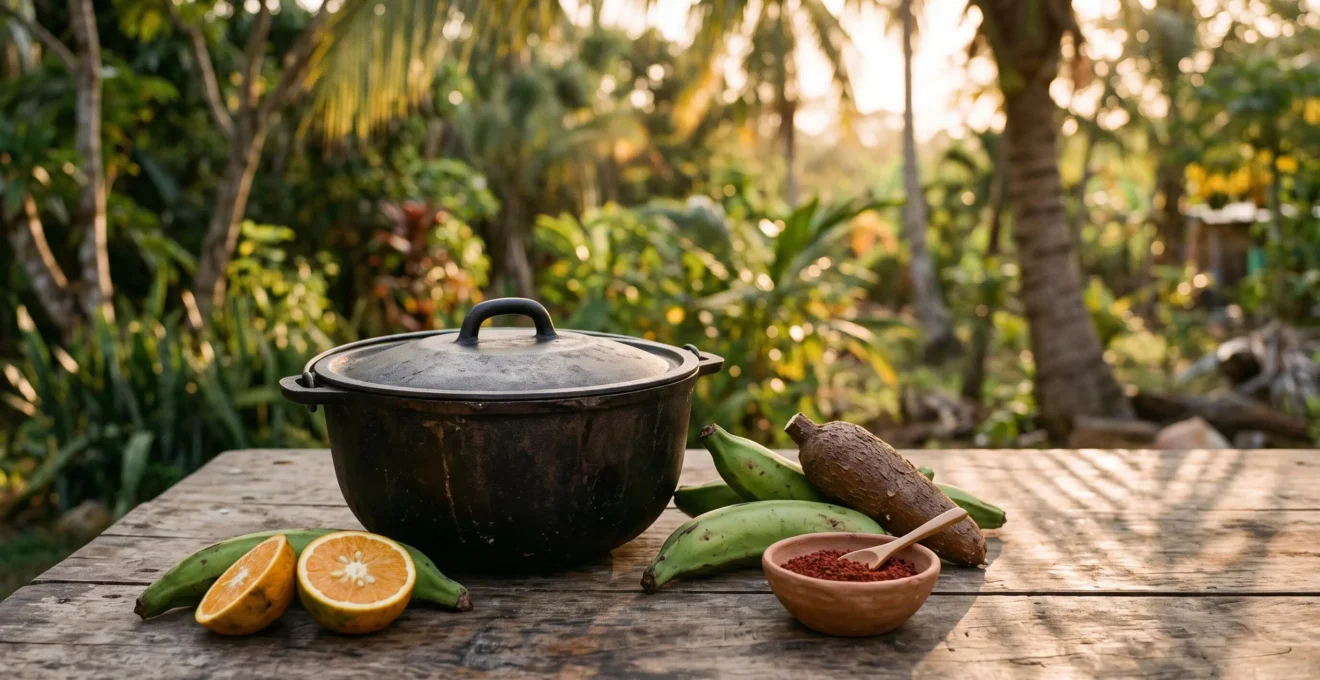
Dominican cuisine’s uniqueness stems not from a simple blend of cultures, but from a deliberate culinary divergence rooted in specific ingredient choices and historical identity struggles.
- Its foundation relies on native Taíno starches like yuca and plantains, a form of ingredient sovereignty that resisted total colonial replacement.
- Its core flavor grammar, or *sazón*, uses vinegar and annatto, creating a sharp, colorful profile distinct from the green, herb-based sofritos of its neighbors.
Recommendation: To understand Dominican food, analyze not just the ingredients on the plate, but the cultural and historical choices that put them there.
To the uninitiated observer, the cuisines of the Hispanic Caribbean can appear as a monolith, a vibrant but homogenous tapestry woven from the threads of Spanish, African, and indigenous Taíno cultures. It’s a common platitude to say Dominican food is a « fusion, » a simple culinary melting pot. This description, while not incorrect, is profoundly incomplete. It captures the « what » but completely misses the « how » and, more importantly, the « why. » The story of Dominican gastronomy is not one of passive blending; it is a narrative of active culinary divergence, a conscious and unconscious shaping of a unique palate that sets it apart from its closest cousins, Puerto Rico and Cuba.
The real key to understanding this distinction lies in examining the specific historical resistances, agricultural priorities, and complex identity politics that unfolded on the island of Hispaniola. Why did certain Taíno ingredients remain central here more than elsewhere? How did African cooking techniques evolve differently? And how does the nation’s ongoing conversation with its own history—particularly its relationship with its Spanish and African ancestry—manifest in the kitchen? This is not just about recipes; it’s about how a nation tells its story through food. The difference is found in the subtle acidity of a marinade, the specific color of a sofrito, and the enduring presence of a humble root vegetable.
This exploration will trace the distinct path of Dominican Creole cuisine. We will investigate its foundational pillars, deconstruct its unique flavor grammar, and connect its evolution to the island’s deep-seated cultural identity, providing a richer understanding of what truly makes it different.
Contents: Decoding the Dominican Culinary DNA
- Why Do Cassava, Plantains, and Yuca Dominate Dominican Creole Dishes?
- Which Dominican Cooking Techniques Originated in West African Traditions?
- How Does Dominican Creole Food Differ From Puerto Rican Cooking?
- The Dominican Food Misconception That It’s as Spicy as Jamaican Cuisine
- Where Can You Taste Authentic Dominican Creole Cuisine Unchanged for Tourists?
- What Did the Taíno People Mean by Calling Hispaniola « Quisqueya »?
- Why Do Many Dominicans Identify More Strongly With Spanish Than African Ancestry?
- Why Do Dominicans Call Their Island ‘Quisqueya’ Instead of Its Colonial Name?
Why Do Cassava, Plantains, and Yuca Dominate Dominican Creole Dishes?
The foundation of any cuisine begins with its starches, and in the Dominican Republic, this foundation is a direct inheritance from its first inhabitants, the Taíno people. While Spanish colonizers introduced wheat and rice, the enduring prominence of native tubers like yuca (cassava), yautía (taro), and batata (sweet potato), alongside the African-introduced plantain, represents a form of ingredient sovereignty. These crops were perfectly adapted to the island’s soil and climate, providing a resilient and reliable food source that persisted through centuries of turmoil. Their dominance is not accidental; it is the bedrock upon which the entire culinary structure is built.
Plantains, in particular, showcase a remarkable versatility that defines the Dominican plate. Used green (*verde*), they are boiled and mashed for *mangú*, fried twice for *tostones*, or sliced thin for *chulitos*. When ripened (*maduro*), their sweet flavour provides a counterpoint in dishes like *pastelón*. This deep integration of tubers and plantains created a distinct textural and flavour vocabulary long before other influences were layered on top. Unlike Caribbean islands where imported grains more thoroughly displaced native crops, the Dominican kitchen held fast to its Taíno agricultural roots, making them a non-negotiable part of its identity.
Case Study: Casabe, the Taíno Bread Unchanged by Time
Perhaps no food item better illustrates this Taíno persistence than *casabe*. This dry, cracker-like flatbread is made from the bitter yuca root, a process that requires grating, squeezing to remove toxins, and baking on a hot griddle. As historical accounts confirm, the method for making casabe today is virtually identical to how the Taíno people made it centuries ago. This living piece of culinary history is not a novelty; according to research from Colonial Zone DR on yuca’s history, it remains a staple and a desired accompaniment for many classic Dominican meals, proving that the island’s most ancient flavours are still very much alive.
Which Dominican Cooking Techniques Originated in West African Traditions?
If the Taíno provided the foundational ingredients, West African culinary traditions provided the grammar and techniques that transformed them into iconic Dominican dishes. The transatlantic slave trade brought not only people but a sophisticated food culture, one centered on one-pot stews, the art of mashing starches, and a deep understanding of flavour layering. This influence is not a footnote; it is the very soul of many beloved national dishes. As Dominican-American Chef Irbania Tavares notes, dishes like Sancocho and Mofongo, now seen as national symbols across the Caribbean, have their origins in African cuisine adapted by enslaved peoples.
The technique of pounding and mashing boiled starches is a direct through-line to West Africa. This method is essential for creating the texture of dishes that are central to Dominican identity. The use of a large wooden mortar and pestle, the *pilón*, is itself a cultural artifact that connects the Dominican kitchen directly to its African ancestry. It is the tool that transforms simple boiled plantains into a national breakfast treasure.
This tactile process is beautifully illustrated in the preparation of mangú, where the starchy mass is worked until smooth.
The image above captures the essence of this transformation, showing the physical work and artisanal tradition embedded in the technique. This process is more than just food preparation; it is a ritual that echoes centuries of history.
Case Study: Mangú’s Direct Lineage to West African Fufu
The most celebrated example of this African culinary heritage is *mangú*, the quintessential Dominican breakfast of mashed green plantains. Its origins are directly linked to West African *fufu*, a staple dish made from pounded yams, cassava, or plantains. As documented in studies on mangú’s origins, enslaved Africans brought this concept to the Caribbean. Over generations, they adapted the recipe using the readily available green plantain and local techniques, eventually creating the dish known today as mangú, a direct and delicious descendant of its African progenitor.
How Does Dominican Creole Food Differ From Puerto Rican Cooking?
Nowhere is the concept of culinary divergence more apparent than in the comparison between Dominican and Puerto Rican food, particularly in their respective flavour bases. While both cuisines share the Spanish concept of a *sofrito*—a cooked-down aromatic blend of vegetables—their evolution led to two distinct preparations that create fundamentally different taste profiles. This difference is the core of their separate culinary identities. The Dominican version, known as *sazón*, is not just a variation; it is a different « flavor grammar » altogether.
The primary distinction lies in the ingredients and colour. Puerto Rican *recaíto* or *sofrito* is defined by its vibrant green hue, derived from a heavy use of cilantro and, most importantly, *culantro* (also known as recao or shadow beni), an herb with a pungent, powerful flavour. It is typically blended raw and stored as a paste. Dominican *sazón*, conversely, is tinted red or orange from the use of tomato paste and, crucially, ground annatto seeds (*bija*). Furthermore, as noted by food writers at Delish D’Lites, Dominican sofrito « uses vinegar for a flavor punch, » adding a sharp, acidic note that is absent in the Puerto Rican version. This acidity brightens flavours and acts as a tenderizer for meats, marking a significant departure.
This comparative analysis from a breakdown of Caribbean sofritos clearly illustrates the different paths taken from a common Spanish origin.
| Style | Core Ingredients | Color | Technique |
|---|---|---|---|
| Dominican Sazón | Onion, garlic, bell pepper, cilantro, annatto (bija), vinegar | Red/orange-tinted | Blended, often used fresh or lightly cooked |
| Puerto Rican Recaíto/Sofrito | Onion, garlic, ají dulce, culantro, green peppers | Vibrant green | Blended raw, stored as a paste |
| Cuban Sofrito | Onion, green bell pepper, garlic, tomato, cumin | Red/orange, caramelized | Chopped and sautéed slowly |
| Spanish Sofrito (origin) | Onion, garlic, tomato | Red | Cooked down slowly in olive oil |
The Dominican Food Misconception That It’s as Spicy as Jamaican Cuisine
A common mistake for those unfamiliar with Caribbean cuisines is to lump them all under the « spicy » umbrella, largely due to the global popularity of Jamaican Jerk. However, this assumption completely misrepresents Dominican food. The Dominican palate is not built on capsaicin heat. Instead, its complexity comes from a masterful blend of aromatic, savory, and acidic notes. The primary source of its distinctive « kick » is not chili pepper, but the sour, fragrant juice of the bitter orange (*naranja agria*).
This citrus is the cornerstone of Dominican marinades, used to tenderize and flavour everything from roast pork (*pernil*) to chicken. Its high acidity cuts through fat, while its floral zest provides a complex aroma that is entirely different from the smoky fire of scotch bonnet peppers. The flavour profile is further deepened by herbs like oregano, but it’s an earthy, savory oregano, distinct from the peppery notes found elsewhere. Dominican *sazón*, as mentioned, gets its flavour from garlic, onions, cilantro, and the mild tang of vinegar, not from hot peppers.
The landscape itself provides the ingredients for this unique flavour profile, where citrus groves offer the source of its signature acidity.
This reliance on acidity and aromatics rather than chili heat is a core tenet of the Dominican taste of place, or terroir. It is a cuisine that aims for a balanced, bright complexity, a flavour that is deep and layered without being overwhelmingly « spicy » in the conventional sense. This is a critical distinction for any culinary anthropologist to make.
Where Can You Taste Authentic Dominican Creole Cuisine Unchanged for Tourists?
To experience the true, unadulterated soul of Dominican Creole food, one must venture beyond the curated menus of all-inclusive resorts and tourist-centric restaurants. The authentic culinary heart of the island beats strongest in its humble, everyday eateries: the *comedores*. These are typically small, family-run establishments, often attached to a home, serving a rotating menu of daily specials known as the *plato del día*. Here, the food is cooked not for a foreign palate, but for local workers, families, and neighbours. It is here that you will find the *sazón* at its most honest and the stews at their most rich.
Another key location for authentic tastes are the *paradas*—roadside stands that dot the highways connecting towns and cities. These are essential pit stops for travelers, offering quick, delicious, and deeply traditional foods. You might find a vendor specializing in *chicharrones* (crispy pork skin), another selling freshly made *yaniqueques* (a fried dough snack), or someone grilling chicken seasoned with the quintessential bitter orange marinade. This is the living, breathing gastronomy of the Dominican people, deeply connected to place and tradition. Seeking out these spots requires a sense of adventure, but the reward is a taste of the real Dominican Republic.
Action Plan: Identifying an Authentic Comedor
- Look for the Crowd: The best sign of a good *comedor* is a steady stream of local clientele, especially during the lunch hour (around 12-2 PM).
- Check the Menu (or lack thereof): A true *comedor* often won’t have a printed menu. The offerings are usually written on a chalkboard or simply recited by the owner. Look for « plato del día. »
- Assess the Ambiance: Authenticity lies in simplicity. Look for basic tables, a bustling but clean kitchen visible to patrons, and the sound of Spanish chatter, not tourist-oriented music.
- Observe the « Bandera »: See if they are serving *La Bandera Dominicana* (The Dominican Flag)—a plate of white rice, stewed beans (red or black), and a choice of stewed meat (chicken, beef, or pork). This is the ultimate daily staple.
- Engage and Ask: Don’t be shy. Ask « Qué hay de bueno hoy? » (« What’s good today? »). The owner’s pride in their food is often the best indicator of quality and authenticity.
What Did the Taíno People Mean by Calling Hispaniola ‘Quisqueya’?
The name *Quisqueya* is deeply woven into the fabric of Dominican national identity, appearing in the national anthem and used colloquially as an affectionate term for the country. The commonly accepted meaning, passed down through generations, is a poetic and powerful one. According to this tradition, rooted in the island’s oral history and supported by cultural publications like La Galería Magazine, the Taíno word *Quisqueya* (or *Kiskeya*) translates to « Mother of all Lands. » This interpretation imbues the name with a sense of primal origin and reverence for the land itself, casting the island as a fertile, life-giving cradle.
This definition has been a powerful tool for forging a post-colonial identity, allowing Dominicans to connect with a pre-Columbian past and assert a name for their home that is indigenous, not one imposed by European conquerors. It represents a symbolic reclamation of the island’s history, positioning the Taíno as the ancestral mothers of the nation. It is a narrative of pride and deep connection to the earth.
However, from a strict linguistic and anthropological perspective, the origin of the word is a subject of academic debate. This adds a layer of complexity that is fascinating for a historical analysis.
The Linguistic Debate Behind Quisqueya’s Taíno Origins
Despite its profound cultural significance, modern linguistic research has cast doubt on the Taíno origins of the word « Quisqueya. » Some historians and linguists argue that the word does not appear in early Spanish chronicles that documented the Arawak Taíno language. These scholars suggest the term may have been introduced later or misinterpreted. Linguistic analysis surrounding the national anthem notes this controversy, highlighting that while the word is central to the anthem’s patriotic message, its direct lineage to the original Taíno language is not definitively proven. This debate does not diminish its cultural power but adds a fascinating layer to how national myths are constructed and adopted.
Why Do Many Dominicans Identify More Strongly With Spanish Than African Ancestry?
The question of identity in the Dominican Republic is a complex and often sensitive topic, deeply rooted in the nation’s unique and turbulent history. Officially, the country’s culture is a product of Taíno, African, and Spanish heritage. Yet, for centuries, a societal and institutional preference for *hispanidad* (Spanishness) has often overshadowed the nation’s profound African roots. This Creole identity axis has tilted towards Europe, a phenomenon shaped by the Trujillo dictatorship’s racist policies, historical conflicts with neighboring Haiti, and a social hierarchy that long prioritized lighter skin. This has had a direct impact on how cultural contributions, including food, have been framed.
For many years, the African influence on Dominican cuisine was acknowledged but not always celebrated with the same fervor as the Spanish contributions. Dishes with clear African origins were simply « Dominican, » their specific lineage sometimes lost or downplayed in the popular narrative. This is not to say the influence was ignored, but it was often absorbed into a generic national identity that de-emphasized its African-ness. The symbolic arrangement of ingredients below can be seen as a metaphor for this complex fusion, where distinct origins converge to form a new whole.
This image of distinct heritages—represented by Spanish sausage, native tubers, and African-style spices—converging in a shared space reflects the ongoing negotiation of identity on the Dominican plate. Fortunately, a new generation is actively working to rebalance this narrative.
Woke Foods: Reclaiming Dominican-African Culinary Heritage
A powerful contemporary movement is working to research, celebrate, and reclaim the African culinary heritage that has long been a cornerstone of Dominican food. A leading voice in this is Afro-Dominican Chef Ysanet Batista, founder of Woke Foods. As chronicled in a feature by the culinary platform Loisa, Batista’s journey began with a simple question: where did her food truly come from? Her research led her to a deeper understanding of how her own family’s dishes and food customs were directly influenced by her African ancestry. Woke Foods was created to document and educate others about these connections, preserving traditions and fostering a renewed pride in the Afro-Dominican identity that is so integral to the nation’s gastronomy.
Key Takeaways
- Foundation of Divergence: Dominican cuisine is built on a resilient base of Taíno starches (yuca, yautía), a choice of ingredient sovereignty that sets its textural profile apart from other islands.
- A Different Flavor Grammar: The use of vinegar and annatto in its *sazón* gives Dominican food a distinctively acidic and colourful flavour base, contrasting with the green, herb-driven sofritos of Puerto Rico and Cuba.
- Identity on the Plate: The cuisine is a dynamic text reflecting the nation’s complex history, from the embrace of the indigenous name « Quisqueya » to the modern reclamation of its deep African culinary roots.
Why Do Dominicans Call Their Island ‘Quisqueya’ Instead of Its Colonial Name?
The choice to use the name *Quisqueya* is a profound statement of national identity and a form of cultural resistance. It is a deliberate act to define the nation on its own terms, looking inward to a pre-colonial, indigenous heritage rather than outward to its colonial past. The island’s colonial name, Hispaniola (« Little Spain »), is a permanent reminder of conquest, of a history defined by outsiders. *Quisqueya*, whether its linguistic origins are perfectly documented or not, represents an identity that is homegrown, authentic, and rooted in the land itself.
This preference is most powerfully and officially enshrined in the country’s national anthem, « *Quisqueyanos valientes* » (« Valiant Quisqueyans »). As noted in an analysis of the anthem by Caribbean Flags Blog, the lyricist, Emilio Prud’homme, made a very conscious choice: the word « Dominican » never appears. Instead, he consistently uses the term *Quisqueyano* to refer to the people. This was not an oversight. It was a poetic and political declaration that the true identity of the people transcends the colonial administrative name of « Santo Domingo » from which « Dominican » is derived. It asserts that to be from the island is to be a child of Quisqueya.
Ultimately, calling the island *Quisqueya* is an embrace of a romantic, idealized, and sovereign identity. It connects the modern nation-state to an ancient, pre-European past, providing a powerful source of pride and a unifying symbol for a people with a complex history. It is the name the nation chooses for itself when it speaks from the heart.
By exploring the island’s cuisine with this anthropological lens—analyzing its ingredient base, its unique flavor grammar, and its connection to a complex national identity—you move beyond the surface to appreciate the rich, divergent story that Dominican food tells. The next step is to taste this history for yourself.