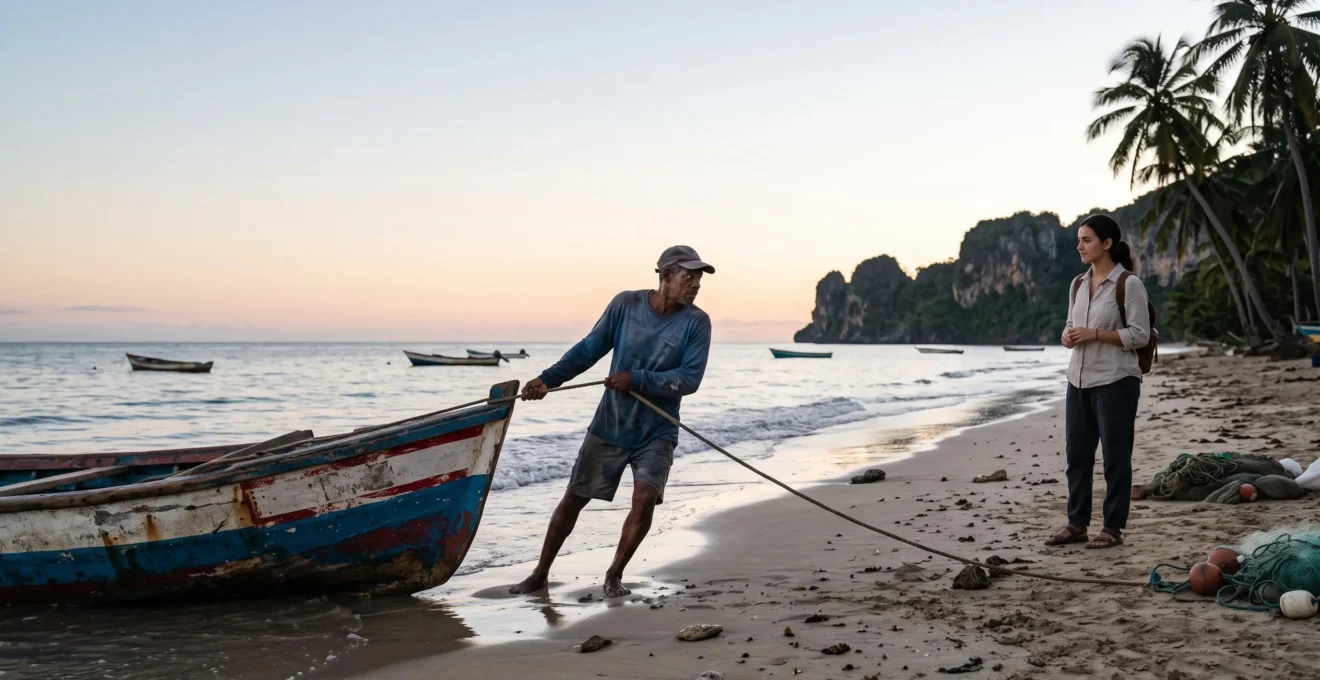
The key to unforgettable Dominican Republic photos isn’t the location you choose, but the strategy you use to capture it.
- Design your itinerary for thematic contrast by moving between different zones like coastal, urban, and luxury.
- Chase specific types of light (golden hour, blue hour) to intentionally create mood and atmosphere in your shots.
- Adopt a « shoot now, post later » mentality to stay present in the moment and avoid the social media pressure that detracts from the experience.
Recommendation: Start thinking like your trip’s creative director, not just a tourist, to build a visual narrative that is uniquely yours.
Your friend’s Instagram feed just popped up: a turquoise ocean, a piña colada in hand, the corner of a resort pool. It’s beautiful, but it looks exactly like the photos from their trip to Cancún last year, and suspiciously similar to your cousin’s snaps from Jamaica. This is the great paradox of Caribbean travel photography: stunning destinations often produce a sea of indistinguishable images. The problem isn’t the Dominican Republic; it’s the approach. Most travellers are consumers of experiences, passively capturing what’s placed in front of them.
This guide proposes a fundamental shift in perspective. Instead of just being a tourist, you will become the creative director of your trip. We won’t just list « Instagrammable spots. » Instead, we will build a strategy. This involves actively designing your moments, understanding the rhythm of the island, and chasing light with intent. It’s about building a visual narrative that tells a compelling story, moving beyond the static postcard shot to capture the texture, energy, and soul of the Dominican Republic.
The secret to leaving with a collection of photos that feel authentic and deeply personal lies not in having a better camera, but in having a better plan. By structuring your time, engaging with your environment thoughtfully, and focusing on the story you want to tell, you can craft memories that are not only beautiful but also meaningful and impossible to replicate. This article will show you exactly how to orchestrate that experience.
This guide is structured to help you build your photographic strategy step-by-step, from high-level itinerary planning to the specifics of capturing light and culture. Follow along to transform your approach to travel photography.
Summary: Your Creative Director’s Guide to Dominican Republic Photography
- Why Do All-Inclusive Resort Photos Look Identical Across Every Caribbean Island?
- How to Structure a Week in the Dominican Republic for Maximum Photogenic Diversity?
- Sunrise Beach Walks or Sunset Catamaran Cruises: Which Creates Deeper Memories?
- The Social Media Mistake That Ruins 50% of Caribbean Holiday Enjoyment
- When Do Dominican Markets and Streets Offer the Best Atmosphere for Authentic Photos?
- When Does Zona Colonial’s Architecture Look Most Photogenic in Natural Light?
- How to Photograph Dominican Carnival Respectfully Without Blocking Parades?
- Which Zona Colonial Buildings Are UNESCO-Listed and Why Do They Matter?
Why Do All-Inclusive Resort Photos Look Identical Across Every Caribbean Island?
The primary reason your Dominican resort photos look like they could have been taken anywhere in the Caribbean is the system itself. The all-inclusive model is designed for seamless comfort and efficiency, which naturally leads to homogenization. These resorts are self-contained ecosystems with curated beaches, standardized architecture, and perfectly manicured landscapes. While relaxing, this environment is a bubble, intentionally separated from the unpredictable, textured reality of the country outside its walls. When you stay within this bubble, your photographic opportunities are limited to the same set of pre-approved, aesthetically pleasing but generic backdrops.
This isn’t a minor trend; it’s the dominant mode of tourism. Data shows that over 78% of visitors to the Dominican Republic choose all-inclusive packages. This means the vast majority of tourists are experiencing and photographing the country from within the same controlled framework. The result is a collective visual memory that endlessly recycles the same infinity pools, swim-up bars, and palm-fringed (but identical) stretches of sand. The photos aren’t uninspired because the photographers are; they’re uninspired because the environment offers a limited visual vocabulary.
Breaking this cycle requires a conscious decision to step outside the resort’s comfort zone, even for a few hours. The goal isn’t to reject comfort but to augment it with authenticity. By understanding that the resort is just one chapter of the story, you can begin to seek out the other, more unique visual elements that define the Dominican Republic. This is the first step in shifting from a passive vacationer to an active moment designer, one who seeks out character and contrast over predictable perfection.
How to Structure a Week in the Dominican Republic for Maximum Photogenic Diversity?
The most effective strategy for creating a diverse photo collection is to build an itinerary based on thematic contrast. Instead of staying in one location, think of the Dominican Republic as a collection of distinct cinematic sets, each with its own character, colour palette, and energy. A well-structured week should feel like a story with different acts, moving between these contrasting environments to build a richer visual narrative. Spending a few days in a polished coastal resort and then a few days exploring the gritty, historic streets of a city creates a powerful juxtaposition that tells a much more interesting story than a week of beach photos alone.
The country is naturally divided into several tourism zones, each offering a unique aesthetic. Structuring your trip around two or even three of these zones is the key to photographic diversity. For example, you could pair the high-energy resort life of Punta Cana with the historic, urban rhythm of Santo Domingo, or contrast the adventurous, windswept coast of Puerto Plata with the ultra-luxe, manicured enclave of La Romana.
This approach allows you to capture a wide range of subjects and moods. A recent analysis of the island’s tourism landscape highlights these distinct zones, providing a perfect framework for planning a multi-location trip. Thinking in terms of these zones helps you move beyond a simple checklist of sights and start designing a journey with a clear narrative arc.
| Zone | Dominant Character | Share / Key Data | Best For |
|---|---|---|---|
| Punta Cana-Bávaro | Resort engine, coastal life | 65% of all arrivals, 44,000+ hotel rooms | Coastal / beach rhythm days |
| Puerto Plata | Renaissance coastal town | $800M new investment 2023-2025, 12% of arrivals | Cultural contrast, cruise culture |
| Santo Domingo | Urban history & grit | 85% of MICE/business tourism activity | Urban history days |
| La Romana / Casa de Campo | Ultra-luxury enclave | Premier golf & cruise excursions | Contrast & scale storytelling |
A practical example of this is combining a visit to the vibrant, chaotic La Vega Carnival with a quiet exploration of the Zona Colonial’s historic streets on a subsequent day. This two-hub structure creates two completely different sets of images: one full of colour, movement, and crowds, the other defined by architecture, light, and history. Together, they form a compelling and complementary visual diary of your experience.
Sunrise Beach Walks or Sunset Catamaran Cruises: Which Creates Deeper Memories?
The choice between a sunrise walk on the beach and a sunset catamaran cruise isn’t merely about picking a time of day; it’s a strategic decision about the kind of memory and photograph you want to create. Both offer beautiful light, but they produce fundamentally different moods and narratives. As a moment designer, you must choose based on the story you want to tell. Neither is « better »—they simply serve different creative purposes.
A sunrise beach walk is about solitude, subtlety, and clean beginnings. The light is often cooler and softer, casting long, gentle shadows. This is the time for introspective and minimalist photography. Your subjects are the quiet details: the texture of the sand left by the receding tide, a lone seabird, the pastel colours of the sky before the sun’s full force. The story here is one of peace, personal reflection, and having a world-famous landscape all to yourself. It’s a quiet moment, and the resulting photos will feel serene and uncluttered. This is the perfect setting for capturing a sense of calm and a personal connection to the environment.
In contrast, a sunset catamaran cruise is about energy, community, and dramatic finales. The light is warm, golden, and often spectacular, creating silhouettes and vibrant, saturated colours. This is a social and dynamic environment. Your subjects are interacting people, the movement of the boat slicing through the water, and the collective experience of watching the day end. The story is one of joy, shared experience, and celebration. Photos will be filled with life, action, and the warm glow of the « golden hour. » It’s a louder, more expressive moment, and the images will reflect that vibrant energy.
The Social Media Mistake That Ruins 50% of Caribbean Holiday Enjoyment
The single biggest mistake that can sabotage both your enjoyment and the authenticity of your photos is falling into the « post-in-the-moment » trap. This is the compulsive need to capture, edit, and share an experience on social media *as it is happening*. Instead of immersing yourself in the Dominican sunset, you’re viewing it through your screen, agonizing over filters and captions. This constant pressure to perform and broadcast your holiday in real-time fractures your attention, pulls you out of the present, and ironically, often results in weaker, more clichéd photos.
This isn’t just a feeling; it’s a widely reported phenomenon. Research indicates that for many, the pressure to post diminishes the travel experience itself. In fact, a recent study found that nearly six in 10 travellers believe frequent social media use negatively impacted their most recent vacation. The problem became so pronounced that companies like Expedia even explored a « Stay Off Social » tool to automate posting, acknowledging that the act of live-sharing was a significant point of friction for travellers who felt it detracted from their trip.
The solution is a simple but powerful creative discipline: « shoot now, post later. » Grant yourself permission to be a photographer during your trip, not a social media manager. Focus entirely on observing, composing, and capturing moments. Fill your camera roll with potential, but resist the urge to immediately curate and share. By separating the act of creation from the act of distribution, you remain fully present and engaged with your surroundings. You’ll notice more details, feel more connected to the experience, and ultimately, take better, more thoughtful photographs.
Adopting this mindset allows you to enjoy the best of both worlds. You get to fully experience the Dominican Republic in the moment, and later, when you’re back at your hotel or home, you can enjoy the creative process of selecting and sharing your best work. This deliberate separation is the key to protecting your experience from the pitfalls of social media validation.
When Do Dominican Markets and Streets Offer the Best Atmosphere for Authentic Photos?
Capturing the authentic life of Dominican markets and streets requires more than just showing up; it requires strategic timing. The atmosphere, light, and activity level change dramatically throughout the day, and each period offers a unique photographic opportunity. To get shots that feel genuine and vibrant, you need to align your visit with the natural rhythm of local life.
For photos filled with a sense of quiet authenticity and preparation, the early morning (around 7-9 AM) is unparalleled. This is when vendors are setting up their stalls, the light is soft and angled, and the streets are not yet crowded with tourists. You can capture intimate moments: a shopkeeper arranging fruits, friends sharing a coffee before the day’s rush, or the clean morning light illuminating colourful building facades. The atmosphere is calm and genuine, allowing for more personal and respectful interactions. This is the time to focus on details, textures, and portraits that tell a story of daily routine.
If your goal is to capture energy, chaos, and the vibrant pulse of commerce, then midday (around 11 AM – 2 PM) is your moment. The sun is high, the crowds are at their peak, and the market is a whirlwind of activity. While the harsh overhead light can be challenging, it’s perfect for capturing dynamic, high-energy scenes. Look for opportunities to shoot from the shadows into the light, focusing on interactions, transactions, and the sheer density of life. This is the time for candid street photography that conveys the bustling, lively character of the Dominican Republic. Your photos will be about movement, connection, and the beautiful mess of a market in full swing.
Finally, the late afternoon (around 4-6 PM) brings the celebrated « golden hour. » This is when the light becomes warm and magical, casting long shadows and bathing everything in a flattering glow. It’s the perfect time for environmental portraits. The heat of the day subsides, people are more relaxed, and the light flatters both skin tones and architectural details. Position yourself so the sun is behind or to the side of your subject to create beautiful rim lighting and a dreamy atmosphere. This is your chance to capture the soul of the street in its most beautiful light.
When Does Zona Colonial’s Architecture Look Most Photogenic in Natural Light?
The centuries-old stone of Santo Domingo’s Zona Colonial is a canvas that is constantly repainted by the changing light. While beautiful at any time, its architecture reveals its true character and texture during two specific windows: the golden hour and the blue hour. Planning your photo walk around these times is the secret to capturing images that feel atmospheric and timeless, rather than flat and touristy. Midday sun, by contrast, tends to be harsh, washing out detail and creating unflattering shadows.
The late afternoon golden hour, roughly the hour before sunset, is when the colonial city truly comes alive. The low, warm sunlight rakes across the stone facades, highlighting every crack, carving, and imperfection that tells the story of its age. The warm light enriches the colours of the pastel-painted buildings and casts long, dramatic shadows down narrow cobblestone streets like the famed Calle las Damas. This is the time for rich, warm, and romantic shots. Position yourself to capture the light hitting the side of a building, like the Cathedral of Santa María la Menor in Parque Colón, to create a sense of depth and dimension.
Perhaps even more magical, and often overlooked by tourists, is the blue hour. This is the brief period just after the sun has set but before the sky is completely dark. The ambient light takes on a deep, cinematic blue hue, which creates a stunning contrast with the warm, artificial glow of the old-fashioned street lamps. During this time, the city feels tranquil, mysterious, and incredibly photogenic. The soft, even light is flattering for wide shots of plazas and streets, creating an atmosphere of quiet contemplation.
By treating these times as your primary shooting windows, you are actively « light-chasing. » You’re not just documenting the buildings; you’re capturing them in their most expressive state. A single walk that starts in the late afternoon and continues through the blue hour can yield two completely different sets of evocative images from the very same locations.
How to Photograph Dominican Carnival Respectfully Without Blocking Parades?
Photographing the Dominican Carnival is an incredible opportunity to capture vibrant culture, but it comes with a responsibility to be respectful. This event is not a performance staged for tourists; it is a deeply rooted cultural celebration with a history stretching back centuries, with the first documented celebration taking place around 1520. Your goal as a photographer should be to document this tradition with reverence, which means understanding the etiquette and focusing on ethical capture rather than just getting the shot.
The most important rule is to maintain a respectful distance and never obstruct the flow of the parade. The performers, particularly the iconic Diablos Cojuelos (Limping Devils), are in a state of performance and have a planned route. Stepping into their path to get a photo is disruptive and disrespectful. Instead, find a good vantage point along the sidelines and use a zoom lens if you have one. If you want a close-up portrait of a costumed performer, always ask for permission first. A simple gesture and a smile are often enough. These are not paid models; they are community members celebrating their heritage.
Beyond asking, a key part of respectful photography is finding unique details that tell a bigger story. Instead of trying to capture the entire chaotic scene in one frame, focus on the specifics. A macro shot of the intricate texture of a mask, a close-up of the handcrafted beadwork on a costume, or a shot of a performer’s expressive hands can be far more powerful and unique than another generic wide shot of the parade.
This approach shows a deeper appreciation for the artistry and craftsmanship involved in Carnival. To ensure you are acting respectfully and responsibly, it helps to have a clear set of guidelines in mind before you arrive.
Action Plan: Respectful Carnival Photography Etiquette
- Ask Before You Shoot: Never photograph a Diablo or costumed performer up close without asking first. A smile and pointing to your camera is a universal gesture.
- Show Appreciation: Offer a small tip (roughly RD$50-100 or $1-2) before or after photographing costumed performers, especially if you have asked them to pose.
- Understand the Interaction: If a Diablo playfully swings a *vejiga* (inflated bladder) near you and you’d rather not participate, simply raise both hands and smile instead of pulling away abruptly. This is a sign of polite refusal.
- Respect the Space: Keep a safe, respectful distance from the main parade route. Never step into the performers’ path or block their movement to get a shot.
- Learn the Lingo: Show genuine interest by learning the regional character names like Lechones, Toros, Cachúas, and Macaraos. Using the correct name when approaching a performer shows cultural respect.
Key Takeaways
- The best Dominican travel photos come from a strategic plan, not just visiting popular spots. Act like a creative director.
- Build your itinerary around thematic contrast, combining different zones (e.g., coastal and urban) for a richer visual story.
- The quality of light dictates the mood. Use sunrise for quiet solitude and sunset for dynamic energy.
Which Zona Colonial Buildings Are UNESCO-Listed and Why Do They Matter?
Understanding which buildings in the Zona Colonial are part of its UNESCO World Heritage designation—and why—elevates your photography from simply capturing old buildings to documenting a pivotal chapter in world history. It’s not just about aesthetics; it’s about significance. The Colonial City of Santo Domingo was inscribed by UNESCO in 1990 because it was the site of the first cathedral, hospital, customs house, and university in the Americas. It was the model for virtually all other colonial towns in the New World. When you photograph these structures, you are capturing the « firsts » of an entire hemisphere.
The designated area is substantial, spanning 106 hectares that include 32 streets and 116 blocks, all bordered by the original city walls and forts. This isn’t just a handful of buildings; it’s the preserved blueprint of a new era of urban planning. Knowing this adds weight and purpose to your exploration. You’re not just on any old street; you might be on Calle Las Damas, the very first paved street of the New World, a place where history was literally set in stone.
For a photographer, this context is everything. It transforms a photo of the Fortaleza Ozama from a picture of an old fort into an image of the first military fortification in the Americas. A shot of the Cathedral of Santa María la Menor is no longer just a pretty church; it’s the cradle of Christianity in a new continent. This knowledge should guide your compositions, encouraging you to find angles and details that convey this sense of historical gravity. The « why it matters » is the story behind the photo, and it’s what separates a snapshot from a powerful historical document.
To focus your efforts, it helps to be aware of the most significant landmarks within this historic zone and their specific « firsts. »
| Landmark | Historical First | Approx. Date |
|---|---|---|
| Cathedral of Santa María la Menor | First cathedral in the Americas | 16th century |
| Calle Las Damas | Oldest paved street in the New World | 1502 |
| Alcázar de Colón | Former Viceroy’s residence, now a museum | 16th century |
| Fortaleza Ozama | First fortification in the Americas | 16th century |
By focusing on these sites and understanding their historical importance, your photographic journey becomes a meaningful exploration of a place that shaped the modern world. You are capturing not just beauty, but legacy.
Now that you have the strategic framework, from planning your itinerary for contrast to chasing light and engaging with culture respectfully, you are equipped to be the creative director of your trip. The next step is to start building your own visual narrative, one unique moment at a time.