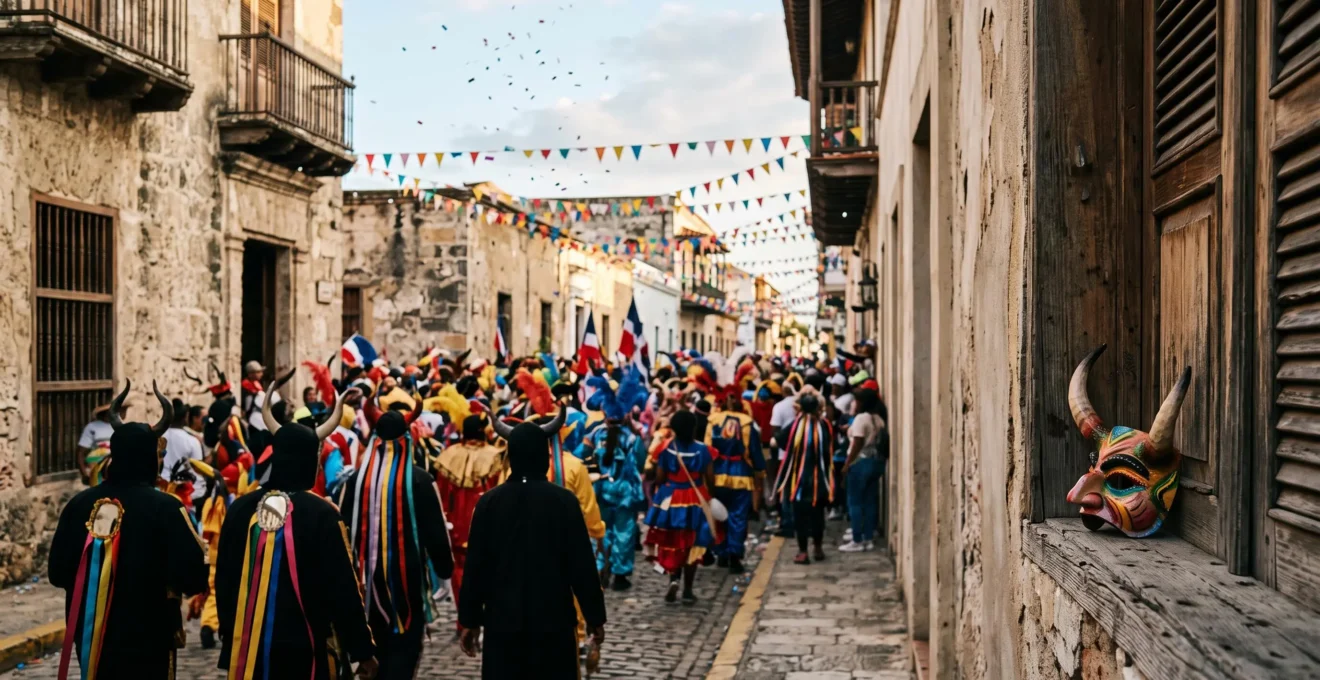
The most ‘authentic’ Dominican Carnival isn’t a single city, but a choice between two distinct experiences: the elaborate spectacle of La Vega or the raw ritual of Monte Cristi.
- La Vega offers the most visually stunning and iconic parade, ideal for first-time visitors seeking Caribbean-level grandeur.
- Monte Cristi preserves a centuries-old folk battle, offering a more participatory and historically unfiltered experience for the cultural purist.
Recommendation: Define what ‘authenticity’ means to you—visual grandeur or historical purity—before choosing your destination.
For the cultural festival enthusiast, the Dominican Republic in February presents a tantalizing promise: Carnival. Yet, the search for an ‘authentic’ experience often leads to a confusing crossroads. Most guides point towards the massive, vibrant parades of La Vega or Santiago, celebrating their spectacular costumes and energetic crowds. This is the postcard image of Dominican Carnival—a dazzling, accessible, and undeniably thrilling event. But for the traveler looking to get beneath the surface, a nagging question remains: is this the whole story? Is the biggest and brightest celebration also the most genuine?
The true nature of Dominican Carnival is not a monolith. Its identity is a mosaic, deeply rooted in the unique history and geography of each region. To understand its authenticity is to move beyond a simple ranking and instead explore a spectrum. At one end lies the polished, large-scale spectacle designed for maximum visual impact. At the other lies the raw, community-driven ritual, a folk tradition that has remained largely unchanged for centuries. The search for authenticity, therefore, is not about finding one correct answer, but about understanding this spectrum and locating yourself upon it.
This guide abandons the simplistic ‘best of’ list. Instead, as a cultural geographer, we will dissect the cultural DNA of the nation’s most significant carnivals. We will explore the historical timing, decode the symbolism of its central characters, and place its two most definitive—and starkly different—celebrations, La Vega and Monte Cristi, in a head-to-head comparison. By understanding the ‘why’ behind the festivities, you can make an informed choice that aligns with your personal definition of a truly authentic cultural immersion.
To navigate the rich tapestry of these traditions, this article breaks down the core components of Dominican Carnival. The following sections will guide you from the foundational history to the practical realities of experiencing this unique cultural phenomenon.
Summary: A Cultural Geographer’s Map to Dominican Carnival
- Why Does Dominican Carnival Happen Every Sunday in February?
- What Do the Diablo Cojuelo Characters Represent in Dominican Carnival?
- La Vega or Monte Cristi: Which Carnival Preserves the Oldest Dominican Traditions?
- The Carnival Safety Risk Where Diablos Hit Spectators With Inflated Bladders
- How to Photograph Dominican Carnival Respectfully Without Blocking Parades?
- Why Do Many Dominicans Identify More Strongly With Spanish Than African Ancestry?
- The Tourist Show Mistake Where Merengue Becomes a Choreographed Performance
- Why Is Merengue the Dominican Republic’s National Music Despite Bachata’s Global Fame?
Why Does Dominican Carnival Happen Every Sunday in February?
Unlike many carnivals tied strictly to the Lenten calendar, Dominican Carnival’s rhythm is uniquely patriotic. The celebration’s placement in February is a deliberate fusion of religious tradition and national history. The entire month is framed by two pivotal dates in the Dominican consciousness: the birthday of founding father Juan Pablo Duarte on January 26th and, most importantly, National Independence Day on February 27th. This patriotic anchor transforms the entire month into a celebration of Dominican identity.
According to historical analyses, the parades are held every Sunday throughout this « Month of the Homeland » (Mes de la Patria). This structure serves a practical purpose, allowing for sustained celebration without completely disrupting the work week, while building momentum towards the grand finale on Independence Day weekend. This dual anchoring in both the pre-Lenten period and the nation’s founding story is the key to its unique calendar. It’s not just a party before a fast; it’s a month-long festival of national pride.
This timing also has a significant economic impact, turning February into a peak tourist season. The predictable Sunday schedule makes it easy for both domestic and international visitors to plan trips around the festivities, and official tourism figures reflect a significant surge in arrivals during this period. The weekly cadence ensures that the energy remains high and that the cultural and economic benefits are spread across the entire month, culminating in the final, most potent expressions of Dominican heritage.
What Do the Diablo Cojuelo Characters Represent in Dominican Carnival?
The central figure of Dominican Carnival is the Diablo Cojuelo, or Limping Devil. This character is far more than a simple demon; it’s a complex satirical figure representing a mischievous, rebellious spirit. The character originates from a 17th-century Spanish novel, but in the Dominican context, it has evolved into a powerful and multifaceted symbol. In one interpretation, noted by the IIC Spanish School, the Diablo Cojuelo’s ornate costume is seen as a parody of decadent Spanish medieval knights, mocking the former colonial overlords with flamboyant excess.
However, the true richness of this character lies in its regional diversity. The term ‘Diablo Cojuelo’ is most common in Santo Domingo and La Vega, but the character’s « cultural DNA » mutates from city to city, reflecting local folklore and history. As a study of Dominican folklore highlights, this single archetype takes on many names and forms across the country. This deep regional variation is a core element of the carnival’s authenticity.
The same central devil figure of Dominican Carnival, for instance, is known by a fascinating array of local names. According to research from Dominican cultural public archives, they are called Cachúas in Cabral, Toros in Monte Cristi, Papeluces in Cotuí, Macaraos in Salcedo, and, most famously, Lechones in Santiago. Each name comes with a unique mask design, costume, and performance style, embodying the specific identity of its hometown. To see a Diablo Cojuelo is one thing; to distinguish between a Macarao and a Lechón is to truly begin to understand the fabric of Dominican Carnival.
La Vega or Monte Cristi: Which Carnival Preserves the Oldest Dominican Traditions?
This question lies at the heart of the search for authentic Carnival. The answer depends entirely on one’s definition of authenticity: is it found in the most elaborate and famous spectacle, or in the most unchanged and raw folk ritual? La Vega and Monte Cristi represent the two polar ends of this spectrum, each offering a legitimate but radically different claim to being the « most traditional. »
La Vega is, without question, the most iconic and visually spectacular carnival in the Dominican Republic, and arguably the entire Caribbean. Its reputation is built on the breathtakingly intricate and expensive Diablo Cojuelo costumes. It is a highly organized parade, a grand performance watched by thousands from sidewalks and paid grandstands. For a first-time visitor wanting the quintessential, postcard-perfect Carnival experience, La Vega is the undisputed champion. It represents the pinnacle of the craft and the height of celebratory spectacle.
In stark contrast, the Carnival of Monte Cristi is not a parade to be watched but a ritual to be witnessed. Its central characters are the ‘Toros’ (Bulls) and ‘Civiles’ (Civilians). This is not a performance but a genuine, centuries-old folk battle reenacted in the streets, where the two groups engage in whip fights. The experience is direct, participatory, and has a raw energy that feels close to its historical origins. This is where the traveler seeking an unfiltered, pre-commercial folk tradition will find it. The table below, drawing from data in a comprehensive carnival celebration guide, breaks down these fundamental differences.
| Aspect | La Vega | Monte Cristi |
|---|---|---|
| Central Character | Diablo Cojuelo (Limping Devil) | Toros y Civiles (Bulls vs. Civilians) |
| Reputation | Most iconic and visually elaborate masked carnival in the Caribbean | A centuries-old ritual fight, largely unchanged in form |
| Experience Style | Organized parade viewed largely from the street or grandstands | Direct, participatory duel between two civilian factions and costumed ‘bulls’ |
| Best Suited For | First-time visitors wanting the classic, postcard Carnival experience | Travelers seeking a raw, unfiltered folk ritual close to its origins |
Ultimately, neither city is more « authentic » than the other. La Vega authentically represents the pinnacle of Dominican artisanal and performative tradition, while Monte Cristi authentically preserves a primal folk ritual. The choice is not about which is better, but which form of cultural expression you, the traveler, have come to see.
The Carnival Safety Risk Where Diablos Hit Spectators With Inflated Bladders
A signature element of many Dominican Carnivals, particularly in La Vega and Santiago, is the vejigazo. This is the act of a Diablo Cojuelo striking people on their backs and legs with a ‘vejiga.’ Far from being a simple balloon, this traditional instrument is a formidable tool. As described by the Barceló Pin & Travel editorial team, vejigas are often made from inflated cow’s bladders which have been dried, cured, and hardened, making the impact surprisingly sharp. While it may seem aggressive to an outsider, it is a deeply ingrained part of the ritual.
For participants, getting hit with a vejiga is considered a form of purification and even good luck. It’s a symbolic cleansing of sins or a playful punishment delivered by the devils. However, for the unprepared visitor, it can be a startling and sometimes painful experience. The key to navigating this interaction is understanding the unwritten rules of engagement. It is not random violence; it is a ritual with its own social cues and codes of conduct.
Knowing how to participate—or how to respectfully opt out—is essential for a positive experience. The energy of the crowd is infectious, but safety and awareness are paramount. Wearing appropriate clothing and understanding how to signal your intentions can make the difference between a memorable cultural exchange and an unpleasant surprise.
Your Action Plan: Navigating the Vejigazo Ritual
- Understand the symbolism: Remember that, as noted in a Dominican Revealed travel guide, getting playfully whacked by a Diablo’s vejiga is traditionally considered good luck.
- Signal your intentions: If you’d rather not participate, the accepted signal is to raise both hands and smile, showing you are an observer, not a target.
- Dress for impact: Wear thick clothing, like jeans, especially in cities like Santiago where the tradition is robust. This will help soften the blow of any potential strikes.
- Minimize accessories: Avoid wearing loose jewelry or items that could easily get caught on a costume or a whip during the crowd’s energetic movements.
By following these guidelines, you can fully immerse yourself in the excitement of the streets while maintaining control over your level of participation.
How to Photograph Dominican Carnival Respectfully Without Blocking Parades?
Photographing the dazzling spectacle of Dominican Carnival is a major draw for many visitors, but doing so respectfully requires a shift in perspective. The biggest mistake is treating the performers as mere objects for a photo, blocking their path or interrupting the flow of the parade for a snapshot. True respectful photography begins with understanding the immense effort behind each costume. As noted in a report by Everything Punta Cana, many families and ‘comparsas’ (troupes) prepare for months, investing significant time and money into their creations. The parade is the culmination of this long process, not a photo op.
The most meaningful and respectful approach is to focus on the story *behind* the spectacle. Instead of jostling for position on a crowded parade route, consider seeking out the workshops in the weeks leading up to the main events. This is where the real magic happens: masks are painted, costumes are stitched, and rehearsals take place. Capturing this preparation tells a much deeper story and fosters a genuine connection with the artists. Building this rapport often leads to more intimate and powerful portraits when the time for the parade arrives.
During the event itself, the key is interaction before transaction. Instead of raising your camera first, make eye contact, smile, and use a gesture to ask for permission. A simple nod of approval from a performer is all it takes to transform the interaction from intrusive to collaborative. Often, performers are proud of their costumes and are happy to pose for a moment, especially if you move to the side, away from the main flow of the parade. The goal is to capture the person within the costume, not just the costume itself. This human-centered approach will not only result in better photographs but also ensure you are a respectful guest, not an obstacle.
Why Do Many Dominicans Identify More Strongly With Spanish Than African Ancestry?
This complex question of identity is woven throughout Dominican culture, and Carnival provides a fascinating lens through which to view it. Officially, the nation celebrates a tripartite heritage: a blend of Indigenous Taíno, African, and Spanish influences. However, for much of its history, a state-sponsored narrative of ‘Hispanidad’ (Spanishness) was promoted, often downplaying or marginalizing the country’s profound African roots. This historical context is crucial for understanding many aspects of modern Dominican society and its cultural expressions.
This preference was shaped significantly during the dictatorship of Rafael Trujillo (1930-1961), who actively promoted an anti-Haitian and pro-European identity for the nation. This legacy has had a lasting impact on how many Dominicans perceive their own racial and cultural makeup. While the reality is a deeply syncretic culture where African influences are undeniable—especially in music, food, and spirituality—the official and social emphasis has often tilted towards Europe.
Interestingly, Carnival itself offers a subversive critique of this simplified narrative. According to one popular Dominican folk interpretation highlighted in a study on the tradition’s origins, the Diablo Cojuelo’s mask is not just a parody of a medieval knight, but a direct representation of the Spanish colonizers who enslaved and brutalized the native and African populations. In this reading, the devil’s whip or vejiga is a symbolic reclamation of the slave master’s whip. This interpretation complicates the surface-level ‘Hispanidad’ of the character, revealing a hidden transcript of resistance and a critique of the very colonial power it appears to mimic. The Carnival, therefore, becomes a space where these complex and often contradictory identities are performed and contested.
The Tourist Show Mistake Where Merengue Becomes a Choreographed Performance
For many visitors, the sound of the Dominican Republic is the fast-paced, two-step rhythm of merengue. It is rightly celebrated as the national music and is a ubiquitous feature of resort entertainment and official parades. However, relying on these tourist-facing performances creates a mistaken impression of the country’s contemporary musical landscape. The merengue of a resort stage is often a choreographed, polished product, designed for easy consumption. It’s a fossilized version of the real thing.
The authentic, living soundtrack of the Dominican streets, especially among the youth and during the boisterous energy of Carnival, is often not merengue but Dembow. This raw, high-energy genre, with its roots in Jamaican dancehall, has a relentless, percussion-driven beat that is far removed from the more structured ballroom elegance of merengue. It is the music of car speakers, corner stores (‘colmados’), and the spontaneous dance circles that erupt during Carnival parades. To miss Dembow is to miss the true pulse of the contemporary Dominican party.
As captured in a 2019 Rolling Stone feature on the genre’s rise, Dembow’s takeover of the Dominican Republic’s soundscape was a grassroots phenomenon. It reflects a shift in cultural energy, one that prioritizes raw rhythm and street-level expression over the more formal national symbols. While merengue holds an esteemed historical and official position, the visceral, high-speed energy of Dembow and the soulful, storytelling nature of Bachata often provide a more accurate picture of what Dominicans are actually dancing to today. The tourist show mistake is assuming the official soundtrack is the only one playing.
Key Takeaways
- Authenticity is a spectrum: Choose between the ‘spectacle’ of La Vega and the ‘ritual’ of Monte Cristi based on your travel style.
- Carnival is patriotic: Its timing is tied to Dominican Independence Day, making it a celebration of national identity first and foremost.
- Look for regional differences: The ‘Diablo Cojuelo’ has many local names and forms (Lechones, Macaraos), each with a unique mask and meaning.
Why Is Merengue the Dominican Republic’s National Music Despite Bachata’s Global Fame?
While bachata has conquered international charts and dance floors, merengue remains enshrined as the Dominican Republic’s official national music and dance. This status has less to do with contemporary popularity and more to do with a century of deliberate nation-building. Merengue’s journey from a regional folk music to a national emblem is a story of political endorsement and cultural policy.
Originally a rural folk music from the northern Cibao region, merengue was elevated to national status by the dictator Rafael Trujillo. He saw it as a powerful tool for forging a unified national identity and promoted it heavily through radio and official events. This state-sponsored push transformed merengue into the soundtrack of the nation, a symbol of ‘Dominicanidad’ that was distinct from both American and Haitian influences. It became the default music for military parades, official functions, and, by extension, the grand national Carnival parades.
This official status was solidified in the 21st century. As recognized by UNESCO, which inscribed it on the List of Intangible Cultural Heritage, this traditional practice was formally acknowledged at the highest level when a presidential decree declared November 26th as National Merengue Day in 2005. Bachata, in contrast, had a very different history. It originated in marginalized, rural communities and was long looked down upon by the urban elite as crude and unsophisticated. Its global fame is a recent, grassroots phenomenon that occurred outside the structures of official state promotion. Therefore, while bachata may rule the world’s airwaves, merengue’s position is cemented by history and official decree as the enduring sound of the Dominican nation.
With this geographical and cultural understanding, your journey into the heart of Dominican Carnival is no longer a matter of chance. It becomes a deliberate choice—an exploration of a rich cultural spectrum where you can find the authentic experience that resonates most deeply with you.