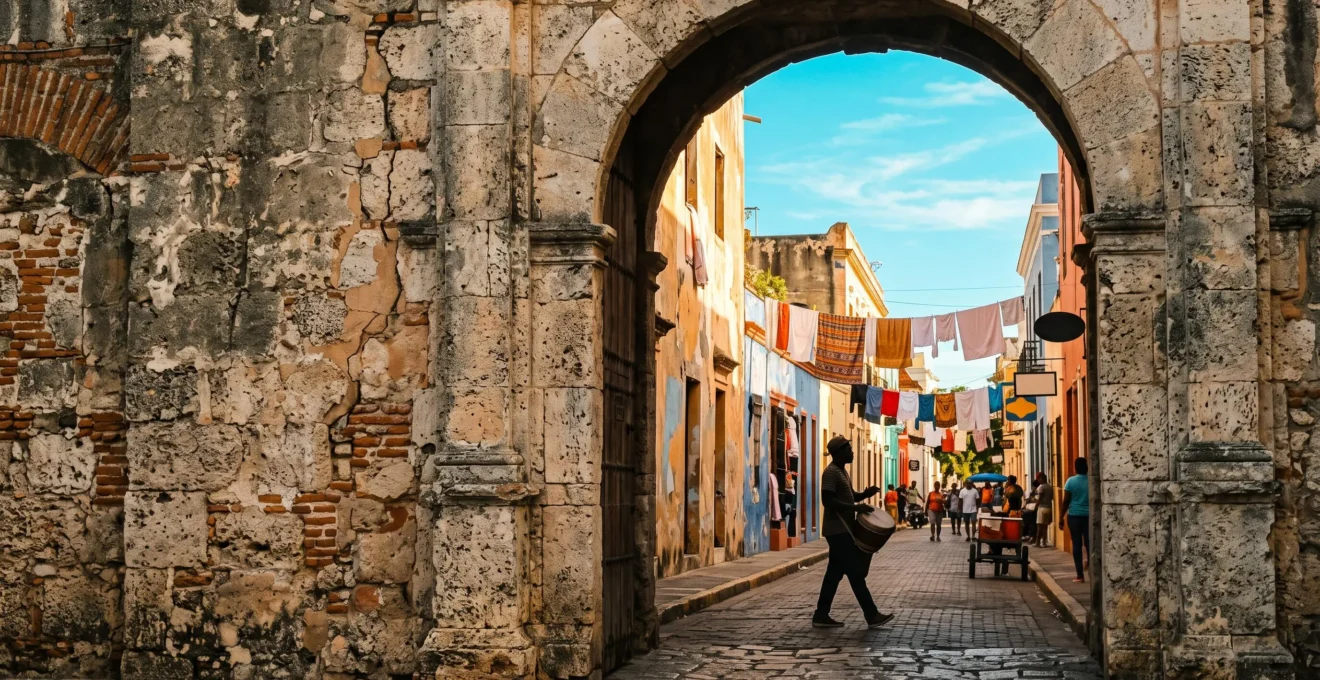
Dominican identity is not a simple melting pot, but a deliberate historical construction that prioritized Spanish heritage while failing to erase deep-seated Taíno and African foundations.
- State policy, particularly during the Trujillo era, actively shaped a national narrative of Hispanidad (Spanishness), often as a direct ideological counterpoint to Haiti’s African-centered identity.
- Despite this official narrative, indigenous and African influences persist undeniably in the nation’s language, genetics, music, and daily customs like cooking, forming resilient substrates of the culture.
Recommendation: To truly understand the Dominican soul, one must learn to see beyond the surface of its Hispanic presentation and recognize the complex, coexisting layers of its full heritage.
To ask about Dominican cultural identity is to peer into a complex tapestry woven with threads of empire, resistance, and deliberate nation-building. For the cultural studies enthusiast, the Dominican Republic presents a fascinating case study in post-colonial identity. The common refrain describes the culture as a syncretic blend of three roots: Spanish, Taíno (the indigenous inhabitants), and African. While true, this simple « melting pot » analogy fails to capture the intricate, and often politically charged, stratification of these heritages.
The general narrative often focuses on the obvious: the Spanish language, Catholic religion, and colonial architecture as proof of a dominant Hispanic legacy. However, this perspective often flattens a far more nuanced reality. It overlooks the power dynamics that have historically elevated one heritage over the others and minimizes the profound, resilient contributions of the Taíno and African peoples that pulse just beneath the surface. This is not a simple mix; it is a geological layering of cultures, where official narratives have buried, but never erased, the foundational strata.
But what if the key to understanding Dominican identity lies not in simply acknowledging the three roots, but in analyzing *how* they were arranged and *why* a specific hierarchy was constructed? The true story of Dominican culture is one of a state-sponsored embrace of Hispanidad (Spanishness) as a defining national characteristic, a process that has deeply shaped how Dominicans perceive themselves and their place in the world. This article will deconstruct this official narrative, layer by layer.
To navigate this complex identity, we will explore the historical reasons behind the emphasis on Spanish ancestry, uncover the hidden linguistic and culinary contributions of Taíno and African heritage, and examine the physical and symbolic places where these cultural layers are most visible. This guide offers a deeper reading of a Caribbean identity that is as resilient as it is complex.
Summary: Deconstructing the Layers of Dominican Heritage
- Why Do Many Dominicans Identify More Strongly With Spanish Than African Ancestry?
- What Spanish Words and Phrases Are Unique to Dominican Republic Usage?
- How Does the Dominican Republic Celebrate Hispanic Heritage Differently From Haiti?
- The Cultural Mistake of Ignoring Taíno and African Contributions to Dominican Heritage
- Where Can You See the Most Authentic Spanish Colonial Architecture in the Dominican Republic?
- How Did the Taíno Name « Quisqueya » Survive 500 Years of Spanish Dominance?
- Which Dominican Cooking Techniques Originated in West African Traditions?
- Why Do Dominicans Call Their Island « Quisqueya » Instead of Its Colonial Name?
Why Do Many Dominicans Identify More Strongly With Spanish Than African Ancestry?
The pronounced identification with Spanish ancestry in the Dominican Republic is not a matter of simple preference but the result of a long and deliberate process of state-led identity construction. For much of its history, particularly during the authoritarian regime of Rafael Trujillo (1930-1961), the nation’s official narrative actively promoted Hispanidad—an ideology centered on Spanish Catholic heritage—as the core of what it means to be Dominican. This was a strategic effort to whiten the nation’s image, both internally and internationally, and to create a distinct identity in opposition to neighboring Haiti.
The effects of this institutionalized narrative are stark. The complexity is reflected in modern data showing that in a national self-perception survey, only 8% of Dominicans self-identified as black, despite a population with significant African ancestry. This is not a denial of genetics so much as an adherence to a deeply ingrained social and racial classification system. As scholar Kimberly Simmons notes in a CUNY Dominican Studies Institute interview, this phenomenon is a result of systemic forces: « Dominicans don’t deny their blackness. Their blackness has been denied to them by the state. » This official denial has fostered a vocabulary where terms like « Indio » (Indian) are often used to describe skin tones that would be classified as Black elsewhere, a linguistic sleight of hand to sidestep the African component.
This ethnolinguistic framing of identity is so profound that it persists even in the diaspora. A foundational academic study on second-generation Dominican-American youth found they often identified not in terms of Black or White, but as Dominican, Spanish, or Hispanic. This demonstrates that the state-sponsored project of Hispanidad created a powerful identity framework that transcends geography, prioritizing cultural and linguistic lineage over phenotypic racial categories. Understanding this historical context is the first step in deconstructing the nation’s complex self-perception.
What Spanish Words and Phrases Are Unique to Dominican Republic Usage?
At first listen, Dominican Spanish appears to be a vibrant, fast-paced dialect of Castilian. Yet, a closer analysis reveals it to be a linguistic stratum, where the official Spanish language rests upon a deep and resilient indigenous substrate. Many words that are fundamental to daily Dominican life, which might be perceived as local slang, are in fact direct linguistic inheritances from the Taíno people, the island’s original inhabitants. These are not mere loanwords; they are pillars of the Dominican lexicon.
This phenomenon is a form of linguistic cimarronaje, or survival. Words for native flora, fauna, and food—such as batata (sweet potato), maíz (corn), maní (peanut), hamaca (hammock), and barbacoa (barbecue)—are all of Taíno origin. They are so deeply integrated into the language that many speakers may not even recognize them as non-Spanish. As the editorial team at Island Hopper Guides correctly points out, « These are not Spanish words. They are Taino, the language of the people who inhabited Hispaniola for centuries before Columbus arrived. » This highlights a critical layer of identity; even the language that symbolizes the Hispanic connection is itself a testament to pre-colonial endurance.
Beyond individual words, the influence can be seen in idiomatic expressions and phonetics. The rapid-fire cadence and aspiration of the ‘s’ sound (where « estás » sounds more like « etá ») create a distinct musicality. Expressions like « ¿Qué lo qué? » (a common greeting akin to « What’s up? ») or using « vaina » as an all-purpose noun for « thing » or « stuff » are uniquely Dominican. This linguistic landscape demonstrates that while Spanish provides the structure, the Taíno and, to a lesser extent, African linguistic substrates provide much of the texture, color, and soul of the language spoken today.
How Does the Dominican Republic Celebrate Hispanic Heritage Differently From Haiti?
The divergent ways the Dominican Republic and Haiti frame their heritage can be traced back to a foundational schism in the 19th century. The island of Hispaniola is home to two nations with starkly different colonial histories and, consequently, opposing national identities. While the Dominican Republic was a Spanish colony that built its national story around Hispanidad, Haiti was a French colony that forged its identity through the crucible of the world’s only successful slave rebellion. This created an ideological fault line that runs deep through the island’s history.
In the Dominican Republic, the celebration of Hispanic heritage is an official, state-sanctioned cornerstone of national identity. Columbus Day, or Día de la Raza, has historically been a significant observance celebrating the « encounter » of cultures and the nation’s Spanish roots. This contrasts sharply with Haiti, where the heroes are not the colonizers but the revolutionaries who overthrew them, like Jean-Jacques Dessalines and Toussaint Louverture. Haitian identity is proudly and fundamentally rooted in its African ancestry and its revolutionary triumph over slavery and colonial rule.
This opposition is not merely historical; it became a core tenet of Dominican state policy. As historical analysis from Study.com highlights, the term « race » is exceptionally loaded in the Dominican context precisely because of Haiti. The Haitian Revolution, where « black slaves killed off most of the white population, many of whom fled to what was then the Santo Domingo colony, » created a foundational trauma for the Spanish-speaking side of the island. In response, Dominican elites and later, the state itself, constructed an identity that emphasized its European and Catholic roots as a bulwark against what was perceived as the « African » and « barbaric » influence of Haiti. This has resulted in two nations on one island: one celebrating its break from Europe, the other celebrating its connection to it.
The Cultural Mistake of Ignoring Taíno and African Contributions to Dominican Heritage
The official narrative of Hispanidad has long been propped up by a corresponding « narrative of extinction » concerning the Taíno people and a systemic minimization of African cultural influence. This historical framing is not just a simplification; it is a profound cultural mistake that erases the foundational pillars upon which much of Dominican daily life is built. To ignore these contributions is to misunderstand the country’s very essence.
For centuries, the accepted history was that the Taíno were completely wiped out by disease and violence shortly after Spanish arrival. However, contemporary science and cultural anthropology resoundingly debunk this myth. Genetic studies indicate that up to 30% of the Dominican population carries Indigenous mitochondrial DNA, a direct biological link to a people who were supposedly extinct. This « cultural cimarronaje » is not only in the blood but also in the soil. Taíno agricultural techniques, knowledge of medicinal plants, and food preparation methods (like the creation of casabe bread from yuca) have persisted for over 500 years, passed down through generations as indispensable survival knowledge.
Similarly, the African contribution, while often socially downplayed, forms the rhythmic heartbeat of the nation. It is impossible to imagine Dominican culture without the syncopated beat of the tambora drum in merengue and bachata, musical forms with deep African roots. The influence extends to spirituality, where folk Catholicism is often blended with African-derived beliefs, and to the kitchen, where cooking techniques and ingredients tell a story of West African origins. Ignoring these deep, foundational layers is to accept a hollowed-out version of Dominican identity, one that favors a polished colonial facade over the vibrant, living culture within.
Where Can You See the Most Authentic Spanish Colonial Architecture in the Dominican Republic?
For any cultural enthusiast seeking the physical embodiment of the Dominican Republic’s Spanish colonial past, there is no substitute for Santo Domingo’s Zona Colonial. This is not merely a collection of old buildings; it is the first permanent European settlement in the Americas and a UNESCO World Heritage site that served as the model for nearly every other colonial town in the New World. It is a living museum of 15th and 16th-century Spanish power, religion, and urban planning.
The scale of this historical core is immense. According to UNESCO, the site spans 106 hectares, encompassing 32 streets and 116 blocks of largely original architecture. Walking its cobblestone streets, particularly the famous Calle Las Damas—the first paved street of the Americas—is a direct journey back to the age of conquistadors and viceroys. Here, the architectural style is a blend of Gothic, Baroque, and Renaissance influences, executed with local stone and brick, creating a unique aesthetic that is both grand and rugged.
To truly appreciate the Zona Colonial, it helps to understand how it was organized to project Spanish authority. The landmarks can be grouped by their original function, each representing a pillar of colonial life. The table below, based on UNESCO’s analysis of the site, provides a clear guide to its most important structures.
| Colonial Function | Key Landmark | Historical Role |
|---|---|---|
| Power & Administration | Alcázar de Colón | Residence of Diego Columbus, Viceroy of the Indies |
| Power & Administration | Museo de las Casas Reales | First seat of Spanish colonial power in the New World |
| Religion & Conversion | Catedral Primada de América | First cathedral built in the Americas |
| Defense & Control | Fortaleza Ozama | First fortified structure, guarding the Ozama River harbor |
Exploring these sites offers more than just a history lesson; it provides a visceral understanding of the scale and ambition of the Spanish imperial project. The thick stone walls of the Fortaleza Ozama speak of defense and control, while the ornate facade of the Catedral Primada de América proclaims the power of the Catholic Church. This architectural legacy is the most tangible and monumental expression of the *Hispanidad* that would come to define the nation’s official identity.
How Did the Taíno Name « Quisqueya » Survive 500 Years of Spanish Dominance?
The survival of « Quisqueya, » the purported Taíno name for the island, is a powerful act of cultural resistance and sentimental preservation. While the Spanish crown imposed the name « Hispaniola » and the modern state is the « Dominican Republic, » Quisqueya persisted not on maps or in official documents, but in the one place colonial power could not fully control: the collective memory and oral tradition of its people. Its endurance is a prime example of cultural cimarronaje, a runaway spirit that keeps indigenous identity alive against all odds.
For centuries, the name was kept alive in folklore, poetry, and popular songs. It became a poetic and romantic term for the homeland, imbued with a sense of pre-colonial purity and a connection to the land that the official colonial names lacked. It represented a non-Spanish, non-colonial « root » that people could claim as uniquely their own. While « Hispaniola » spoke of conquest, Quisqueya spoke of origin. This emotional resonance ensured its transmission from generation to generation, even as the Taíno language itself faded from common use.
The ultimate triumph of its survival came with its formal incorporation into the national identity in the 19th century. The name was immortalized in the first stanza of the Dominican national anthem, « Quisqueyanos valientes, alcemos nuestro canto » (« Valiant Quisqueyans, let’s raise our song »). By placing the indigenous name at the very heart of its patriotic hymn, the Dominican Republic officially embraced this symbol of its pre-Hispanic past. Today, « Quisqueya la bella » (Quisqueya the beautiful) is a term of endearment for the country, a testament to how a name, carried for centuries in the hearts of the people, can ultimately triumph over 500 years of colonial dominance.
Which Dominican Cooking Techniques Originated in West African Traditions?
While Dominican cuisine is often marketed through its Spanish and Taíno ingredients, its soul—the very techniques that define its most iconic dishes—is deeply rooted in West African culinary traditions. This African gastronomic legacy was carried to the island by enslaved peoples and has become so integral to the Dominican kitchen that its origins are often overlooked. These are not just recipes, but foundational cooking philosophies that prioritize slow cooking, deep flavors, and the resourceful use of ingredients.
One of the most significant contributions is the technique of slow-stewing in a single pot. This method is the heart of sancocho, the national dish. The practice of simmering various meats, tubers (like ñame and yautía), and vegetables for hours to meld their flavors is a direct descendant of West African stews. Another key technique is deep-frying, which is central to staples like tostones (twice-fried plantains) and chicharrón (crispy pork skin). While frying existed in Europe, the specific application to starchy vegetables like plantains and yuca is a hallmark of Afro-Caribbean cuisine.
The use of specific ingredients as a base also points to this heritage. The reliance on starchy tubers and the prominent use of coconut milk in savory dishes, particularly in the Samaná region, mirror the culinary practices of coastal West Africa. Even the concept of using the whole animal and valorizing less-prized cuts of meat through slow-cooking methods speaks to a tradition of resourcefulness born from necessity. To identify these fingerprints, one can use a simple mental checklist when analyzing a Dominican dish.
Action Plan: Identifying African Culinary Fingerprints
- Analyze the Base: Does the dish rely heavily on tubers like plantain, yuca, ñame, or yautía as its primary starch, rather than European wheat or potato?
- Examine the Cooking Method: Is it a slow-cooked, one-pot stew where flavors are meant to deeply meld over hours (sancocho)? Or does it involve deep-frying these starchy vegetables (tostones)?
- Check for Key Ingredients: Does the recipe feature coconut milk in a savory context? Does it use smoked ingredients (like smoked herring) for flavor depth?
- Note the Flavor Profile: Is the goal to create a complex, layered flavor from simple ingredients through long cooking times, rather than relying on delicate, quickly prepared sauces?
- Assess the Use of Meat: Does the dish make use of tougher, more flavorful cuts of meat that benefit from braising or stewing, a common practice in African culinary traditions?
By applying this lens, the African influence moves from the background to the foreground, revealing itself not as an accent, but as the very foundation of Dominican flavor.
Key Takeaways
- Dominican identity is not a simple « mix » but a stratified system where a state-sponsored narrative of Hispanidad was historically prioritized over other heritages.
- The national identity was deliberately constructed in opposition to Haiti’s, leading to an official emphasis on Spanish roots and a social downplaying of African ancestry.
- Despite official narratives, Taíno and African influences demonstrate profound resilience, surviving in language (Quisqueya), genetics, music (merengue), and foundational cooking techniques.
Why Do Dominicans Call Their Island « Quisqueya » Instead of Its Colonial Name?
The choice to call the island « Quisqueya » is far more than a preference for a poetic or historical name; it is a profound expression of the nation’s layered and often contradictory identity. While « Hispaniola » is the geographic and colonial name, and « Dominican Republic » is the official political name, « Quisqueya » is the name of the heart. It represents a collective reaching-back to a pre-colonial, indigenous identity that feels more authentic and uniquely « Dominican » than any name imposed by external forces.
Using « Quisqueya » is an act of affection and national intimacy. It sidesteps the entire colonial legacy—the conquest, the administration, the power structures embodied by the name Hispaniola. It also transcends the formal, political identity of the « Republic. » It connects modern Dominicans to the island’s mythical origins and its first inhabitants, providing a sense of timeless belonging. In a nation where identity has been so heavily debated and constructed, Quisqueya offers a moment of pure, uncontested connection to the land itself.
This embrace of the Taíno name perfectly encapsulates the central theme of Dominican identity: the coexistence of stratified layers. While the nation operates within a framework of Hispanic language and institutions, its soul often identifies with its deepest, most foundational root. The fact that the national anthem proudly proclaims « Quisqueyanos valientes » shows that this is not a fringe sentiment but a core component of the national spirit. It is the ultimate proof that the « narrative of extinction » failed; the first root, though buried, remains the one to which the national heart is most deeply attached.
To truly appreciate the richness of the Dominican experience, the next step is to move beyond academic understanding and engage with this living culture, whether by exploring its historic sites, listening to its music, or tasting its complex flavors.