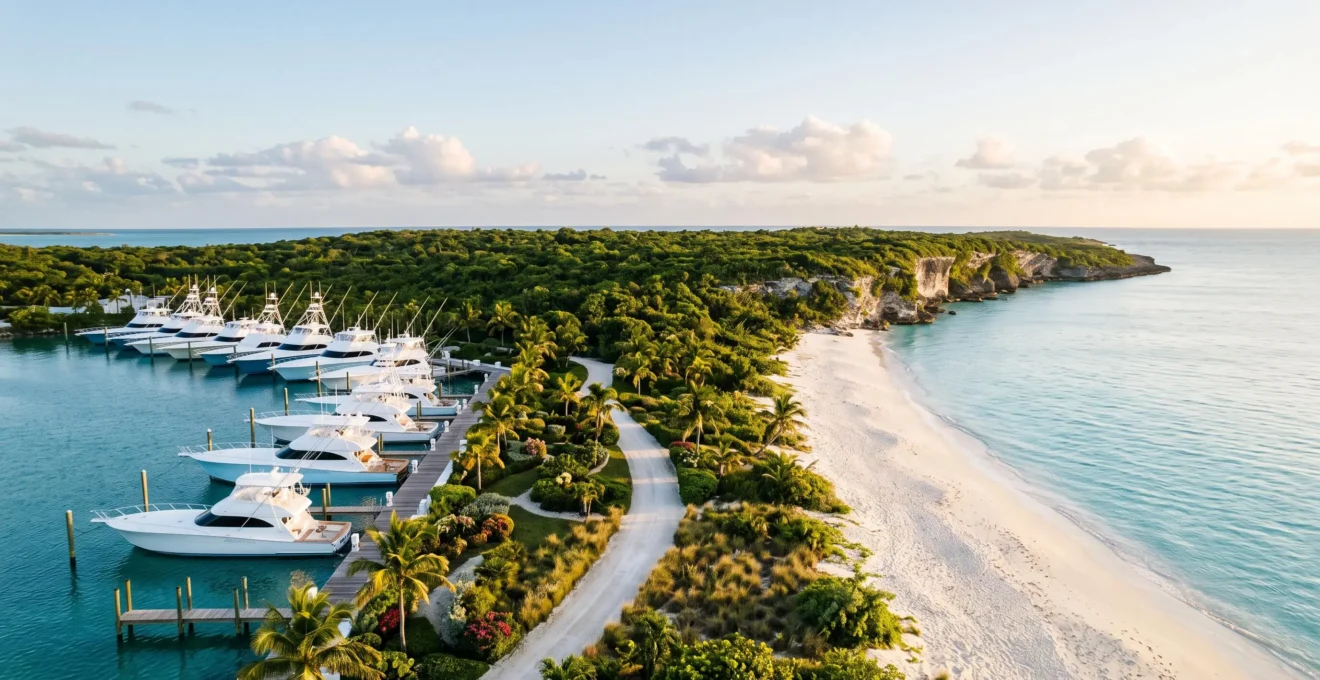
Contrary to popular belief, Cap Cana’s exclusivity isn’t just about higher prices—it’s engineered through a fundamentally different development philosophy than the high-volume luxury model of Punta Cana.
- Cap Cana is a master-planned, low-density community built around infrastructural moats like a mega-yacht marina and world-class security, which standard resorts cannot replicate.
- The real estate here is treated as an appreciating asset class, with branded residences and architectural features designed to increase market value, not just serve tourists.
Recommendation: Evaluate Cap Cana not as a more expensive resort, but as an investment in a distinct, asset-class lifestyle defined by privacy, security, and long-term value.
For the discerning UK traveller researching premium Caribbean destinations, the Dominican Republic presents a paradox. You see a coastline dotted with « 5-star » and « luxury » resorts in Punta Cana, all offering seemingly similar promises of sun, sand, and service. Then you encounter Cap Cana, a name spoken in more reverent tones, accompanied by a price point that often feels like a different currency. The common explanation—that it’s simply « more exclusive »—is both true and utterly unhelpful. It fails to explain the fundamental, structural differences that justify the premium.
The typical advice to « read reviews » or « look at the amenities » misses the point. The distinction is not about one having a nicer pool or a better restaurant. It’s about a divergence in development philosophy. Punta Cana’s model, for the most part, is scaled luxury tourism. Cap Cana, by contrast, was conceived from the ground up as a low-density, high-value, self-contained private city. Understanding this difference requires looking beyond the tourist brochure and into the mechanics of its real estate, infrastructure, and the very lifestyle it was designed to support.
This guide deconstructs that exclusivity. We will move past the superficial and analyse the architectural choices, the layout decisions, the economic drivers, and the infrastructural « moats » that create Cap Cana’s unique positioning. Instead of asking if it’s worth the price, we will explain precisely what that price buys you: not just a holiday, but a stake in a meticulously engineered bubble of world-class luxury.
This article breaks down the tangible elements that separate Cap Cana from its neighbours. The following summary provides a roadmap to understanding the layers of its engineered exclusivity.
Summary: Decoding Cap Cana’s Engineered Exclusivity
- Why Do Cap Cana Luxury Villas Advertise Glass Floors Overlooking Water?
- Marina-Side or Beachfront: Which Cap Cana Location Offers Better Luxury Experience?
- Is Cap Cana Worth Visiting if You Don’t Play Golf?
- The Cap Cana Layout Mistake That Forces Constant Taxi Use
- When Can You Rent Cap Cana Luxury Villas at 50% Off Peak Rates?
- Why Do Some 5-Star Dominican Resorts Cost Triple 4-Star Properties?
- Punta Cana or Cap Cana Marina: Which Offers Better Deep-Sea Fishing Access?
- Why Do Celebrities and Billionaires Choose Casa de Campo Over Other Caribbean Resorts?
Why Do Cap Cana Luxury Villas Advertise Glass Floors Overlooking Water?
The immediate assumption is that a glass floor over water is a purely aesthetic, perhaps even gimmicky, feature. However, in the context of Cap Cana’s real estate market, it serves a much deeper purpose. This is not just decoration; it’s a strategic signal of value. These architectural statements are tangible manifestations of « biophilic design, » a concept that integrates nature into the built environment to improve well-being. This is more than a trend; it’s a key driver in the ultra-luxury market, appealing directly to a health-conscious and sustainability-minded buyer demographic.
As the Vogue House Villas Editorial Team notes, « Biophilic design isn’t just about looks it’s about how your space makes you feel and function. » Incorporating such elements is a calculated investment. A feature like a glass floor transforms a space from a simple dwelling into an experience, a piece of living art. It demonstrates a commitment to high-end, bespoke construction that goes far beyond standard luxury finishes. In a market where differentiation is key, these features become critical pricing levers.
Ultimately, these elements function as markers of an asset-class property. An analysis on biophilic features as a market-value driver highlights this, stating that they create « Increased Market Appeal: Health conscious buyers and sustainability minded investors find biophilic spaces highly desirable. » Therefore, when you see a glass floor advertised, you are not being sold a feature; you are being shown proof that the property belongs to a higher tier of architectural and investment value, designed to appreciate over time.
Marina-Side or Beachfront: Which Cap Cana Location Offers Better Luxury Experience?
Within Cap Cana, the choice between a marina-side or beachfront property is not a simple question of « boats or sand. » It is a fundamental lifestyle and investment decision, reflecting two distinct profiles of the ultra-high-net-worth individual. This choice speaks volumes about what a buyer prioritises: the vibrant, social energy of a yachting hub or the serene seclusion of a private oceanfront estate. The master plan of Cap Cana intentionally caters to both, creating distinct zones that offer different, yet equally luxurious, experiences.
The following table breaks down the key differences, illustrating how each location is tailored to a specific buyer profile and investment strategy. This is less about which is « better » and more about which is the « right fit » for your personal and financial objectives.
| Criteria | Marina-Side | Beachfront |
|---|---|---|
| Primary Appeal | Yachting, dining, boutiques, social buzz | Seclusion, panoramic ocean views, private sand access |
| Typical Buyer Profile | Convenience-seekers, active social lifestyle | Privacy-seekers, families, long-stay owners |
| Signature Amenity | 150-foot yacht slips, marina boutiques | Direct steps-from-sand private pools and chef’s kitchens |
| Rental Positioning | Event- and access-driven consistent demand | Premium nightly rates, more seasonal demand curve |
The marina lifestyle is for those who seek convenience and a social nexus. It’s for the owner who wants to step off their yacht and into a fine dining restaurant, who thrives on the energy of an active, international community. Conversely, the beachfront residence is for the owner who defines luxury as ultimate privacy and tranquillity. These are often larger, more self-contained estates designed for long-stay owners and families, where the primary amenity is the uninterrupted view of the Caribbean Sea. Both property types benefit from the enclave’s overall security and prestige, with data showing that premium Cap Cana properties have shown strong historical appreciation between 7% and 9% annually, driven by massive rental yields.
Action Plan: Defining Your Cap Cana Lifestyle Profile
- Activity Audit: List your top five desired holiday activities. Do they involve socialising, dining out, and events (Marina-Side), or quiet relaxation, family time, and nature (Beachfront)?
- Privacy Spectrum: On a scale of 1 to 10, how important is total seclusion? A 9-10 points towards Beachfront, while a 5-8 might prefer the convenient privacy of the Marina.
- Investment Goal: Are you seeking consistent, year-round rental income driven by events and accessibility (Marina-Side), or are you aiming for peak-season, premium nightly rates from a trophy property (Beachfront)?
- Transport Preference: Do you prefer the ability to walk to restaurants and shops (Marina-Side), or do you value a sprawling estate where a golf cart or private car is a necessity for privacy (Beachfront)?
- Amenity Proximity: Identify your single most important amenity (e.g., yacht slip, private beach access, golf course proximity). Let this anchor your search and define your ideal location.
Is Cap Cana Worth Visiting if You Don’t Play Golf?
To associate Cap Cana solely with golf is to fundamentally misunderstand the scope of its ambition. Whilst the Jack Nicklaus-designed Punta Espada is consistently ranked among the best courses in the Caribbean, it is merely one pillar of a much broader, diversified luxury ecosystem. The developers understood that to attract a global elite, they needed to offer a world-class experience across a spectrum of high-value recreational pursuits. Thinking of Cap Cana as just a « golf resort » is like thinking of London as just a « financial centre »; it’s an accurate but severely incomplete picture.
The community is an officially designated destination for comprehensive sports tourism. As the official guide states, the invitation is to « Experience a world beyond the shore where luxury meets adrenaline. Whether it’s world-class golf, equestrian sports, or exploring eco-trails, discover why we are the ultimate destination for sports tourism. » This points to a deliberate strategy of catering to the diverse passions of high-net-worth families, where one member might be a golfer, another an equestrian, and another a deep-sea fishing enthusiast. Facilities like the Los Establos equestrian centre and the numerous ecological parks provide substantive, high-quality alternatives to the fairway.
Perhaps the most significant non-golf asset is the marina. This is not just a place to park boats; it is a monumental piece of infrastructure and a destination in its own right. The fact that the marina’s capacity for mega-yachts up to 150 feet exists underscores its status as a major Caribbean hub for the international yachting community. It provides a gateway to unparalleled sailing, diving, and, most notably, sport fishing. Therefore, the answer is an unequivocal yes. Forgoing golf in Cap Cana doesn’t mean you’re missing out; it simply means you have the time to explore the other world-class facilities that define its multi-faceted appeal.
The Cap Cana Layout Mistake That Forces Constant Taxi Use
A common observation from first-time visitors accustomed to compact resorts is that Cap Cana’s layout feels inconveniently sprawling, forcing a reliance on taxis or golf carts to get from a villa to the beach, marina, or a restaurant. Labelling this a « mistake, » however, fundamentally misinterprets the intention behind the design. This low-density, sprawling layout is not a bug; it is a core feature of the exclusivity Cap Cana offers. It is, by definition, the luxury of intentional sprawl.
Unlike the dense corridors of many all-inclusive resorts where proximity is prioritised, Cap Cana was master-planned to ensure privacy, space, and a sense of owning your domain. The large plots, winding roads, and extensive green spaces are a deliberate « infrastructural moat » against the feeling of being crowded. This design philosophy directly contributes to the serene and secluded atmosphere that high-net-worth individuals pay a premium for. The necessity of a golf cart is not an inconvenience; it is a symbol of belonging to a community where personal space is the ultimate luxury.
This sense of a private, self-contained world is exactly the appeal. As one real estate specialist describes the environment, « Forget cookie-cutter beach towns—Marina Cap Cana is where the elite play… It’s got that perfect mix of seclusion and buzz: Private clubs, top-tier security, and a quick 10-minute hop to Punta Cana Airport (PUJ). » The layout is the physical manifestation of this « seclusion and buzz. » You are insulated within your private villa or a specific community area, yet you can access the central hubs via a short, pleasant ride in your personal transport. It prevents the resort from ever feeling like a mass-market destination. The « mistake » is, in fact, the very thing that preserves its elite character.
When Can You Rent Cap Cana Luxury Villas at 50% Off Peak Rates?
The idea of a 50% discount on an ultra-luxury Cap Cana villa seems paradoxical. It can lead prospective renters to question the property’s true value or suspect a bait-and-switch. However, this pricing flexibility is not a sign of desperation but rather a reflection of the sophisticated economics of high-value asset management. The owners of these multi-million-dollar properties are not hoteliers trying to fill rooms; they are investors managing significant, capital-intensive assets.
The key to understanding these discounts lies in the substantial carrying costs associated with a large luxury villa. An analysis of owner operating costs explains the dynamic perfectly: « The trade-off is operating cost. Larger homes require regular landscaping, pool maintenance, security, utilities, insurance, furnishings, and management oversight. » These fixed costs are considerable and accrue whether the property is occupied or not. For an owner, generating some income during off-peak periods is a much better financial strategy than letting the asset sit empty while still incurring tens of thousands of dollars in monthly expenses.
This creates opportunities for savvy renters. The « shoulder seasons »—typically late April to early June and from September to mid-November—are the prime time to find these deals. This is the period after the peak winter and spring break crowds have departed and before the festive season rush begins. During this window, owners are most motivated to secure bookings to offset their operating costs. Furthermore, last-minute availability, even during busier times, can also trigger significant price reductions as owners prefer a lower rate to a complete loss of income. The key is to be flexible with your travel dates and to monitor availability closely during these specific windows.
Why Do Some 5-Star Dominican Resorts Cost Triple 4-Star Properties?
The significant price leap between a 4-star and a true 5-star property in the Dominican Republic, particularly within enclaves like Cap Cana, cannot be explained by better linens or a larger television. The difference is not linear; it is exponential. It represents a fundamental shift from providing a product (a room, a meal) to delivering a comprehensive, branded ecosystem of service, security, and prestige. This is the concept of service-level arbitrage, and it is at the heart of the ultra-luxury value proposition.
A 4-star resort excels at providing high-quality, scalable comfort. A 5-star property, especially a branded residence, is selling something else entirely: guaranteed peace of mind and access. As Christie’s International Real Estate points out in their guide, « Branded residences, such as the St. Regis Cap Cana, offer access to world-class amenities, making Cap Cana a top choice for high-end living in the Dominican Republic. » The brand—be it St. Regis, Ritz-Carlton, or Four Seasons—acts as a global benchmark for service. You are not just buying a villa in the Dominican Republic; you are buying the assurance of the St. Regis standard of service, which is a globally understood and valued commodity.
This premium is reflected directly in the real estate itself. The infrastructure required to support this level of service—from staff training and high employee-to-guest ratios to bespoke security protocols and pristine maintenance—is incredibly costly. This operational premium translates to a higher price per square metre for the property. An analysis of the local market confirms this: « Cap Cana usually commands higher prices per square meter, especially for beachfront units, marina properties, golf-front homes, and luxury villas inside established communities. » Therefore, the triple cost is not just for a better holiday; it’s the entry fee into a different tier of asset, one where the brand and the infrastructure that supports it are as valuable as the physical property itself.
Punta Cana or Cap Cana Marina: Which Offers Better Deep-Sea Fishing Access?
For the serious sport fishing enthusiast, this question is almost rhetorical. While other marinas in the Punta Cana area can certainly arrange a pleasant day on the water, the Cap Cana Marina operates in an entirely different league. It is not merely a place with charter boats; it is a world-renowned, tournament-level ecosystem and a powerful infrastructural moat that solidifies Cap Cana’s elite status. The marina was designed and built to be one of the premier sport fishing destinations in the world, and all evidence suggests it has achieved that goal.
The geographical advantage is the first piece of the puzzle. Cap Cana is situated at the easternmost point of the island, where the Atlantic meets the Caribbean, creating a rich feeding ground that attracts a staggering variety of pelagic species. More importantly, the deep-water trenches where marlin, sailfish, and tuna congregate are remarkably close to shore. This means less time travelling and more time fishing. Billfish tournament promoter Rick Alvarez, writing for Marlin Magazine, captures this perfectly: » The number of white marlin found just a short run from the inlet at Cap Cana Marina is pretty amazing. »
This natural advantage is amplified by man-made infrastructure and an established reputation. The marina’s facilities are built to host international tournaments, attracting the best captains and crews in the world. This creates a virtuous cycle: the tournaments build the reputation, which attracts the best anglers, which in turn supports a top-tier charter fleet. It’s no surprise that the marina has been recognized as the #1 ranked in the world for sport fishing. Fishing Booker, a charter booking platform, advises clients that whilst you can fish from many places, « if you’re looking for a professional charter captain, head to Cap Cana Marina. » For anyone serious about deep-sea fishing, the choice is clear. Cap Cana doesn’t just offer access; it offers entry into the major leagues.
Key Takeaways
- Engineered Exclusivity: Cap Cana’s luxury is not accidental; it is the result of a master plan focused on low-density, privacy, and infrastructural « moats » like its world-class marina.
- Asset-Class Lifestyle: Properties in Cap Cana are viewed and designed as appreciating assets within a branded ecosystem, not just as holiday homes.
- Value Beyond the Room: The price premium reflects an investment in a fundamentally different model of service, security, and guaranteed standards, often backed by global luxury brands.
Why Do Celebrities and Billionaires Choose Casa de Campo Over Other Caribbean Resorts?
To fully grasp the DNA of Cap Cana, one must first look to its celebrated predecessor, Casa de Campo. If Cap Cana is the modern, refined expression of a private city resort, Casa de Campo is the original blueprint—the grand patriarch of Dominican luxury that established the very model of the self-contained, ultra-private estate. For decades, it has been the sanctuary of choice for a specific type of global elite, from presidents and titans of industry to Hollywood royalty, who seek something beyond five-star service: absolute privacy and seamless logistics on a monumental scale.
The answer to why they choose it lies in two words: infrastructure and legacy. Long before other resorts were even conceived, Casa de Campo was built as a private kingdom. Its most significant infrastructural moat is its own private, international airport and a 370-slip marina. As the resort itself notes, « Private jets have been arriving at Casa de Campo since it opened in the 1970s when the likes of Michael Douglas, Henry Kissinger…and Frank Sinatra regularly flew into the resort’s private airstrip. » This ability to arrive and depart with maximum discretion, bypassing public terminals entirely, is a level of convenience and security that few places in the world can offer.
This is then combined with sheer, unadulterated scale. Spanning a colossal 7,000 acres, the resort is so vast that privacy is not just a feature, but the natural state of being. This immense size allows for multiple world-class golf courses, a polo and equestrian centre, a shooting club, and a complete replica 16th-century Mediterranean village (Altos de Chavón) to coexist without ever feeling crowded. It’s no wonder that Forbes has ranked the resort as « the largest and wealthiest Resort community in the world. » Celebrities and billionaires do not choose Casa de Campo simply for its luxury; they choose it for its scale, its legacy, and its unparalleled ability to make them disappear.
To truly understand which Dominican luxury enclave aligns with your portfolio and lifestyle, the next logical step is a detailed analysis of your personal requirements against the distinct value propositions these world-class destinations offer.