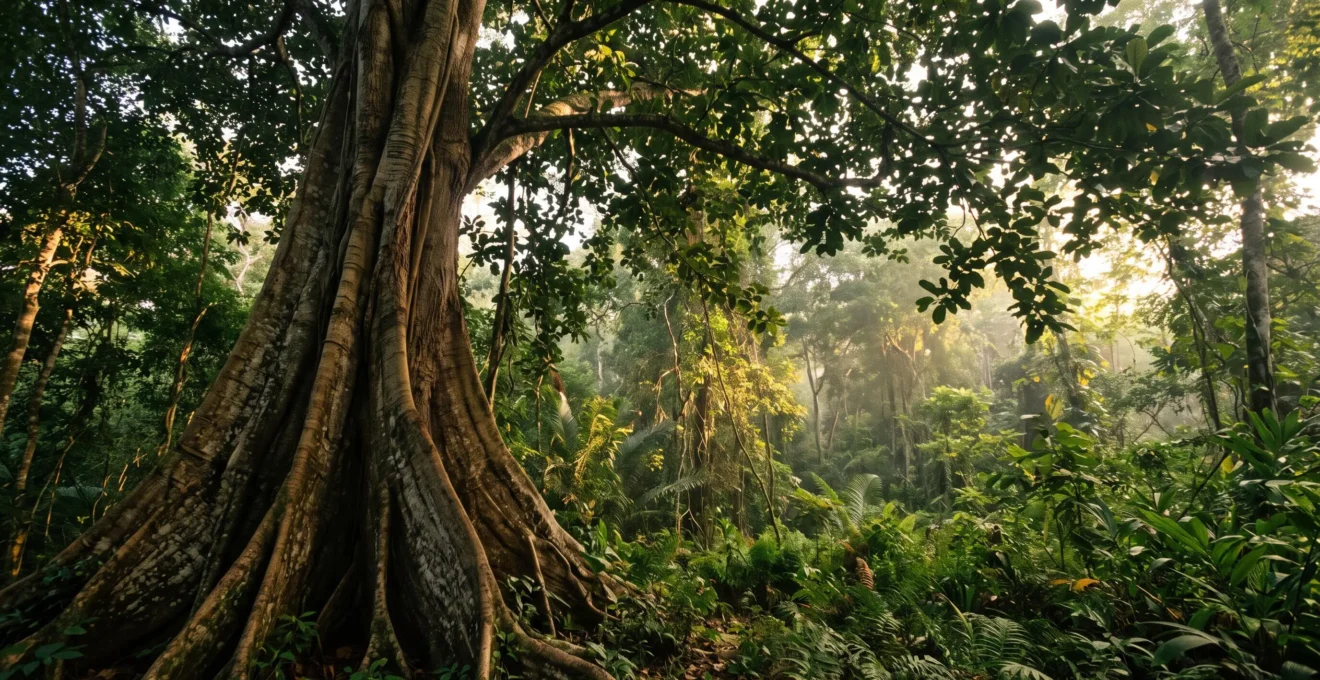
Ethically seeing the Dominican Republic’s mahogany giants requires understanding that you are visiting an ecological crime scene, not just a park.
- Most « original » mahogany forests were destroyed by state-sanctioned logging; what remains is fragmented, fragile, and requires informed stewardship from visitors.
- True ethical access means choosing certified guides in protected areas and prioritising tours that actively fund restoration over simple sightseeing.
Recommendation: Avoid all unmarked mahogany wood souvenirs to stop fuelling illegal logging, and consider supporting a reforestation project to leave a positive conservation footprint.
The quest for an ancient West Indian Mahogany (Swietenia mahagoni) is a powerful pull. For the ecologically-minded traveller, the vision is one of a majestic, centuries-old giant, its reddish-brown trunk soaring towards a dense canopy in a pristine rainforest. You imagine the quiet reverence of standing in its presence. While this romantic vision is the goal, achieving it ethically in the Dominican Republic demands a far deeper understanding than simply booking an eco-tour. The truth is, the story of mahogany here is not one of pristine nature, but of profound ecological scars, political greed, and a fragile, ongoing recovery.
Most guides will point you to national parks and tell you to hire a guide. This is sound, but basic, advice. It fails to address the brutal history that shaped the very forests you wish to see. The Dominican Republic’s forests, particularly its precious mahogany, were systematically plundered for personal and political gain for decades. This legacy means that a truly « ethical » encounter is not passive. It is an active choice, a conscious act of restorative tourism rather than extractive observation. It requires looking beyond the beautiful facade to understand the story written in the trees themselves—and the empty spaces where they once stood.
This guide is different. As a conservation biologist working on the ground in the Dominican Republic, I will take you beyond the surface-level advice. We will explore the difficult history that led to the decimation of these forests. More importantly, we will distinguish between tourism that merely exploits the remaining natural beauty and tourism that actively contributes to its healing. You will learn not just where to go, but how to ensure your visit supports the communities and ecosystems fighting for a greener future, transforming your journey from a simple holiday into a meaningful act of conservation stewardship.
This article will guide you through the essential knowledge needed to plan a responsible and deeply rewarding journey into the heart of the Dominican Republic’s remaining mahogany landscapes. Follow along to understand the history, identify truly sustainable options, and learn how to make your visit count.
Summary: A Guide to the Dominican Republic’s Mahogany Legacy
- Why Have 95% of the Dominican Republic’s Original Mahogany Forests Disappeared?
- How to Visit Los Haitises or Cordillera Central Mahogany Reserves Legally?
- Reforestation Sites or Virgin Mahogany Groves: Which Should Eco-Tourists Prioritise?
- The Souvenir Mistake That Supports Dominican Illegal Mahogany Logging
- When Are Dominican Mahogany Forest Trails Dry Enough for Safe Hiking?
- The Ecotourism Mistake That Harms 30% of Dominican Rainforest Trails
- How to Find Dominican Artisan Cooperatives Offering Taíno Craft Workshops?
- Where to Find Endemic Wildlife in Hispaniola’s Rainforests Beyond the Beach Resorts?
Why Have 95% of the Dominican Republic’s Original Mahogany Forests Disappeared?
To understand where to find mahogany today, one must first grasp why it is so rare. The near-total destruction of the Dominican Republic’s primary forests is not a story of gradual decline; it is a brutal tale of state-sponsored exploitation. For much of the 20th century, the nation’s forests were treated as a private bank account for the powerful. The most devastating period was under the dictatorship of Rafael Trujillo (1930-1961), a regime described by Encyclopaedia Britannica as one of the longest and cruelest in modern times. During his 31-year rule, forest exploitation was systematised not for national benefit, but for the personal enrichment of the dictator and his inner circle.
The Trujillo Dictatorship: Turning Forests into Fortunes
The Trujillo regime perfected the art of turning natural resources into private wealth. An analysis by the Food and Agriculture Organization of the United Nations (FAO) highlights how many of the country’s large family fortunes originated from unchecked logging concessions granted during this era. This wasn’t sustainable forestry; it was a liquidation of the nation’s natural heritage. The state essentially facilitated the razing of its own forests, with mahogany—the « red gold »—as the prime target. This historical context is crucial; it created the ecological scars visible today and set the stage for a long, difficult path toward conservation.
The scale of the devastation was catastrophic. The felling of old-growth mahogany and other valuable hardwoods was so intense that by the time a comprehensive survey was conducted, the damage was stark. A 1967 OAS survey of natural resources found that the Dominican Republic’s total forest cover had been reduced to a shocking 11.7% of the national territory. This figure represents the culmination of decades of plunder. The 95% of original mahogany forest that has vanished didn’t just disappear; it was cut down, sold, and converted into fortunes, leaving behind a fractured and fragile ecosystem that conservationists are still fighting to piece back together.
How to Visit Los Haitises or Cordillera Central Mahogany Reserves Legally?
Given the history of exploitation, accessing the remaining pockets of old-growth forest is now a rightly regulated process. You cannot simply drive into the heart of a national park and wander off. Legal access is designed to protect the fragile ecosystems and the visitors themselves. Your two primary targets for experiencing these forests are Los Haitises National Park and the scientific reserves of the Cordillera Central, like Ébano Verde. Each offers a different experience and requires a distinct approach. Choosing between them is the first step in defining your conservation footprint.
Los Haitises is the more accessible of the two, known for its dramatic karst landscape, mangrove forests, and Taíno cave paintings. While it contains stands of moist broadleaf forest, access is almost exclusively via organised boat tours departing from Sabana de la Mar. Independent entry into the park’s core is prohibited. You must book with a licensed guide or tour operator who holds the necessary permits. This is not bureaucratic red tape; it is a critical measure to manage visitor impact in a heavily visited area.
The Ébano Verde Scientific Reserve in the Cordillera Central offers a more challenging, purist’s experience. It’s a high-elevation cloud forest environment, cooler and more rugged. Here, you are more likely to find isolated, older native hardwood specimens, including the magnificent Ébano Verde (Magnolia pallescens) tree for which it is named. Access is limited and hiking is more strenuous, making it better suited for experienced trekkers.
This table breaks down the key differences to help you make an informed choice based on your goals and fitness level.
| Reserve | Access | Forest Profile | Best Suited For |
|---|---|---|---|
| Los Haitises National Park | Boat-based, guided tours only, roughly 2.5 hours from Punta Cana | Karst limestone terrain with mangroves and broadleaf forest, mostly younger or scattered stands | First-time visitors seeking easier access and Taíno cave sites |
| Ébano Verde Scientific Reserve (Cordillera Central) | Two limited entrances, Casabito and Arroyazo, in cooler high-altitude terrain | Broadleaf cloud forest, pine forest and riparian forest with isolated older native hardwood specimens | Experienced hikers seeking a quieter, higher-elevation cloud-forest challenge |
Reforestation Sites or Virgin Mahogany Groves: Which Should Eco-Tourists Prioritise?
The ethical traveller faces a crucial question: is it better to seek out the last remaining giants in virgin groves, or to support the new life taking root in reforestation sites? From a conservation biologist’s perspective, this isn’t an either/or choice. A truly responsible visit should ideally involve an appreciation for both. Prioritising one over the other depends on your primary goal: are you there to witness the past or to invest in the future? This is the core of shifting from passive ecotourism to active restorative tourism.
Visiting a remnant old-growth grove is a powerful, humbling experience. These areas are living museums, genetic reservoirs, and critical habitats. Ecologists note that in the island’s moist-forest lowlands, oak and mahogany are key indicator species of a healthy, mature ecosystem. Seeing them in their natural context provides an irreplaceable connection to the island’s original biodiversity. However, these sites are exceptionally sensitive. Your visit should be low-impact, strictly guided, and focused on observation, contributing financially through park fees and certified guide employment.
Conversely, visiting and participating in a reforestation project offers a different, but equally profound, experience. These sites, often on degraded land, may not have the grandeur of old-growth, but they represent hope and direct action. They are the future forests. Several NGOs and even tourism operators have developed programs where visitors can contribute directly.
Case Study: Tourist-Funded Reforestation in Action
A notable model involves a partnership between the Fathom cruise line, the Ministry of Environment, and the Instituto Dominicano de Desarrollo Integral (IDDI). This program enables volunteers to physically plant native trees, including tropical cedar, on mountain slopes in the Yasica region. This approach transforms tourists from passive consumers into active participants in ecological recovery. By investing your time or money in such a project, your tourism dollars are directly channelled into creating new habitats, sequestering carbon, and stabilising soil. It is the most tangible form of leaving a positive conservation footprint.
The Souvenir Mistake That Supports Dominican Illegal Mahogany Logging
Your journey of ethical discovery can be undone in a single, seemingly innocent transaction: buying a wooden souvenir. After experiencing the majesty of the forest, the desire to take home a piece of its beauty is understandable. You’ll see countless stalls and shops selling beautifully carved parrots, polished bowls, and other crafts made from rich, reddish-brown wood. The vendor will tell you it’s « caoba »—mahogany. This is the moment where your role as an informed steward is most critical.
The vast majority of this « souvenir-grade » mahogany is sourced from illegal logging. While there are laws and regulations governing the harvest of mahogany, the reality on the ground is that poaching trees from protected areas or private lands is rampant, driven largely by the tourist market’s demand for « authentic » wooden crafts. Each small, unmarked bowl or figurine you purchase contributes to a supply chain that incentivises cutting down the very trees you came to admire. It directly undermines every conservation effort and negates the positive impact of your park fees and responsible tour choices.
So how can you tell the difference? It is nearly impossible for a tourist. There is no reliable certification system for small crafts. The wood could be from a sustainably managed source, but it is far more likely to be from a tree illegally felled in a national park. The risk is simply too high. The only ethical choice is to assume all uncertified mahogany products are from illicit sources. This is a hard line to take, but it’s essential for breaking the cycle of demand that fuels the destruction. Your most powerful tool for conservation here is not what you do, but what you refuse to do. By walking away, you send a clear market signal that this form of exploitation is not profitable.
When Are Dominican Mahogany Forest Trails Dry Enough for Safe Hiking?
Planning your visit around the weather is not just about comfort; it’s a matter of safety and ecological responsibility. The Dominican Republic is a tropical country with distinct wet and dry seasons that dramatically affect trail conditions, especially in the mountainous interior where the best forest reserves are located. Hiking on waterlogged, muddy trails is not only difficult and dangerous but also contributes to significant trail erosion, widening paths and damaging delicate root systems—a key aspect of your conservation footprint.
Generally, the driest and most reliable period for hiking in the Dominican Republic is during the winter and early spring. The window with the most consistently good weather runs from December to April. During these months, trails are more likely to be firm and passable, river crossings are lower, and the risk of being caught in a torrential downpour is significantly reduced. This is the prime season for anyone looking to seriously explore the Cordillera Central or other high-altitude parks on foot.
However, the Dominican Republic’s climate is complex, with significant regional variations. The northern mountain ranges, which face the Atlantic, receive far more precipitation than the southern ranges. A simple calendar is not enough; you must understand the microclimate of your destination.
This table illustrates the dramatic difference in rainfall, highlighting why a trip to the northern rainforests requires more careful planning than a visit to the southern dry forests.
| Region | Annual Precipitation | Climate Character |
|---|---|---|
| Northern moist/rainforest zones (Cordillera Septentrional) | Roughly 1,000–2,000 mm, exceeding 4,000 mm in true rainforest pockets | Atlantic-facing, wet year-round |
| Southern dry forest zones (Sierra de Bahoruco / Enriquillo Basin) | Roughly 545–980 mm | Semi-arid, markedly drier climate |
Your Action Plan: Preparing for a Safe Mahogany Forest Hike
- Pack for the Environment: Always bring sunscreen, potent insect repellent, comfortable and sturdy walking footwear (not sandals), a hat, ample water and snacks, and a camera in a waterproof bag.
- Verify Permits and Fees: Entrance fees to national parks are standard, but special permits may be required for certain activities or less common trails. Check with licensed local tour operators or the park authority for the most current information before you go.
- Prioritise a Licensed Guide: Never hike alone in remote areas. The risk of getting lost on unmarked or unmaintained trails is very real. A licensed local guide provides safety, navigation, and invaluable ecological interpretation.
- Heed Storm Warnings: Regardless of the official season, any recent named storm (hurricane or tropical storm) is a red flag. Trails can be washed out, blocked by fallen trees, or dangerously unstable for weeks afterward. Always confirm current conditions with a local guide before setting out.
The Ecotourism Mistake That Harms 30% of Dominican Rainforest Trails
One of the most pervasive mistakes in ecotourism is the concentration of visitors. The vast majority of tourists who come to the Dominican Republic never leave the manicured confines of their all-inclusive resorts. As a result, the few « eco-tours » that are easily accessible from these tourist hubs receive a disproportionate amount of foot traffic. This creates pockets of intense environmental pressure, where the very act of « appreciating nature » leads to its degradation. While there isn’t a precise figure for all trails, conservationists on the ground observe that the most accessible trails often suffer from the worst erosion and disturbance.
This phenomenon is perfectly described by the observation in a Mongabay report that while the Dominican Republic has an incredible variety of ecosystems, most visitors miss out, creating a massive gap between the « resort bubble » and the island’s true ecological wealth. This gap is where the damage occurs. When hundreds of people walk the same short, easily-reached trail every day, the path widens, the soil becomes compacted, and vegetation is trampled. Hikers, trying to avoid muddy patches, create « social trails » or shortcuts, which further scar the landscape and disrupt the undergrowth.
This disturbance is more than just cosmetic. It disrupts wildlife. For example, Los Haitises National Park is a critical sanctuary where visitors can spot the endangered Ridgway’s Hawk, one of the rarest birds of prey in the world. These birds, and many other endemic species, are sensitive to human presence. Constant noise, movement, and the degradation of their foraging habitat by trail erosion can push them away from otherwise ideal territories. The mistake is assuming that because a trail is an « eco-trail, » it is immune to harm. In reality, the trails that need the most care are often the ones marketed most heavily.
The solution for the ethical traveller is to seek dispersal. Instead of taking the most obvious tour from the nearest resort, work with a specialised guide to visit less-trafficked parts of a park or explore a different, more remote reserve altogether, like those in the Cordillera Central. This spreads out the economic benefit and the ecological impact, relieving pressure on the « sacrificial » trails near tourist centres.
How to Find Dominican Artisan Cooperatives Offering Taíno Craft Workshops?
Connecting directly with artisans who practice traditional crafts is one of the most rewarding cultural experiences you can have, and it offers a powerful alternative to buying questionable souvenirs. Finding authentic Taíno-inspired craft workshops, where you can learn and purchase directly from the makers, requires moving beyond the typical tourist trail. These opportunities are rarely advertised on major booking platforms. Instead, finding them is an exercise in informed stewardship and community-level engagement.
Your first and best resource is your certified, independent guide—especially one who specialises in ecological or cultural tours. These guides often have deep roots in the local communities and can connect you with legitimate artisan cooperatives. They can vouch for the source of the materials (for example, using sustainable wood from managed plots or non-wood materials like clay, natural fibres, or recycled materials) and ensure the money from your purchase or workshop fee goes directly to the artists and their families. This is a world away from buying a mass-produced item from a roadside vendor.
Another strategy is to research and contact community-based tourism (CBT) projects. These initiatives are often supported by local or international NGOs and are designed to empower communities to build sustainable livelihoods through tourism. A CBT project in a rural area near a national park is a prime place to find workshops on everything from pottery (a major Taíno craft) to weaving or jewelry making. Look for organisations working on conservation and community development in the region you plan to visit and inquire about any artisan groups they partner with.
Finally, be prepared to be flexible and inquisitive. When visiting a local market in a smaller town (away from the major tourist hubs), strike up conversations. Ask about who makes the items, where they are from, and if it’s possible to visit their workshop. Prioritise crafts made from clay, amber, larimar, or woven fibres over wood, unless the seller can provide a compelling and verifiable story about the wood’s sustainable origin. This proactive approach turns your search for a souvenir into a meaningful cultural exchange.
Key Takeaways
- The Dominican Republic’s mahogany forests are not pristine wilderness but ecological scars from a history of state-sanctioned logging, particularly during the Trujillo dictatorship.
- Ethical tourism requires moving beyond passive observation to active support for conservation, such as participating in or funding reforestation projects.
- Your consumer choices have a direct impact; refusing to buy uncertified mahogany souvenirs is one of the most powerful conservation actions a traveller can take.
Where to Find Endemic Wildlife in Hispaniola’s Rainforests Beyond the Beach Resorts?
The Dominican Republic is a global biodiversity hotspot, a place that one writer for Mongabay aptly described as being like a continent squished into half an island. This incredible diversity of life, however, is not found by the hotel pool. To find the island’s unique endemic species—those found nowhere else on Earth—you must venture into the very forests we’ve been discussing. The national parks and scientific reserves are the last great sanctuaries for Hispaniola’s unique fauna.
For its stunning variety of ecosystems, the Dominican Republic is like a continent squished into half an island.
– Jeremy Hance, Mongabay — « Beyond the resorts: traveling the real and wild Dominican Republic »
Los Haitises National Park, despite the visitor pressure near its entry points, remains a vital stronghold for birdlife. Its protected status has allowed many species to thrive. The park is home to more than 20 endemic bird species, making it a prime destination for birdwatchers. With a good guide, you can spot the endemic Hispaniolan Woodpecker, Hispaniolan Parakeet, and, with luck, the critically endangered Ridgway’s Hawk patrolling the skies. The park’s intricate network of caves also provides shelter for large colonies of bats, which are crucial for pollination and insect control.
For those willing to trek higher, the cloud forests of the Cordillera Central offer a different suite of species. Reserves like Ébano Verde provide a cooler, wetter, and quieter environment that is perfect for seeking out more elusive birds and amphibians.
Ébano Verde: A Cloud-Forest Sanctuary for Endemic Birds
Located just an hour and a half from Santo Domingo, the Ébano Verde Scientific Reserve protects a vital slice of high-altitude habitat. Within its 2,300 hectares of broadleaf cloud forest and pine forest, some 90 species of birds have been reported. Crucially for the dedicated naturalist, over half of these are permanent residents, including 20 endemics. This makes it a premier destination for spotting species like the Hispaniolan Trogon, Hispaniolan Emerald, and a variety of warblers that are difficult to find in the lowland resort areas. The misty, moss-draped environment itself is a world away from the sunny coast, offering a glimpse into one of Hispaniola’s most unique and threatened ecosystems.
The key to finding this wildlife is hiring a knowledgeable local guide. Their trained eyes and ears can pick out a bird call or spot movement in the canopy that an untrained visitor would easily miss. They know the best times of day and the specific locations to find certain species, transforming a simple walk in the woods into a rich wildlife-viewing experience.