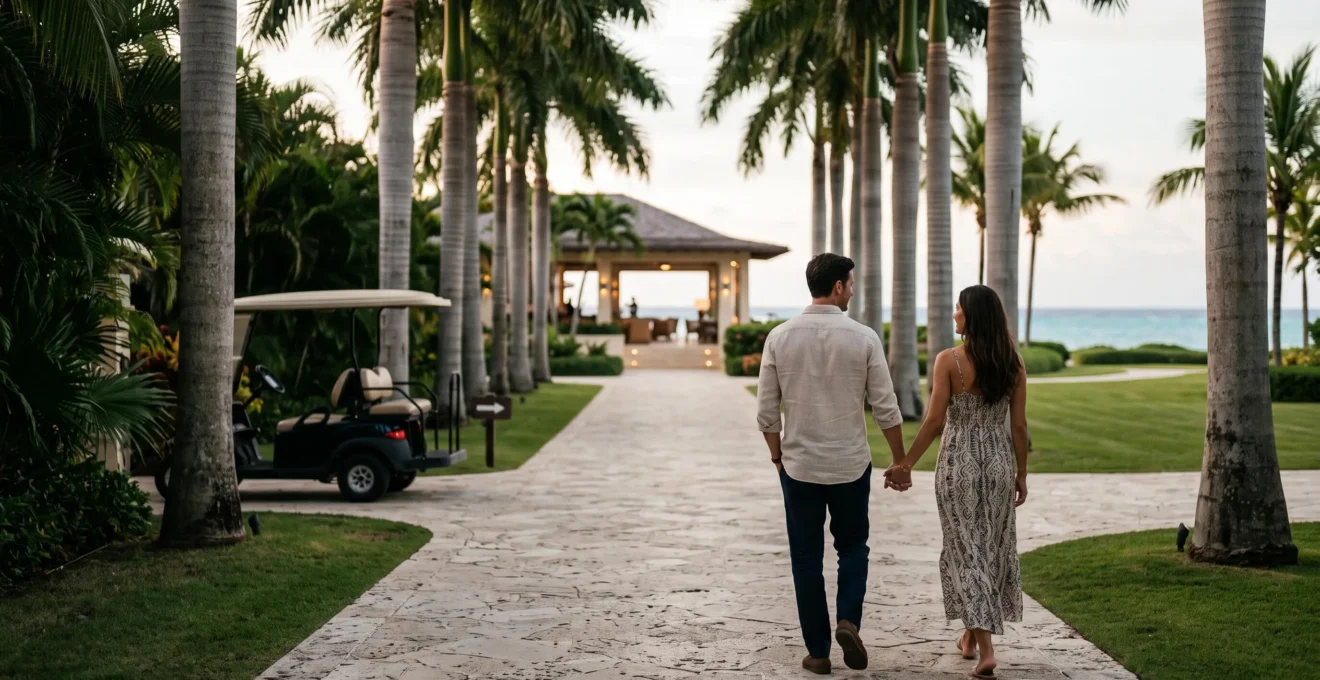
The real reason billionaires choose Casa de Campo has little to do with traditional luxury; it’s because the resort operates less like a hotel and more like a private, sovereign state offering total environmental control.
- Privacy is enforced not just by gates, but by a state-like security and registration apparatus that governs all movement.
- Daily life is made frictionless through a mandatory, bundled private staff (maid, butler, cook), making the villa a self-sufficient ecosystem.
- Even nature is engineered to perfection, with man-made solutions to regional problems like sargassum seaweed, guaranteeing a flawless experience.
Recommendation: To understand its value, analyse Casa de Campo not as a vacation spot, but as an investment in a seamless, predictable, and utterly private bubble.
For the discerning high-net-worth traveller, the Caribbean offers a familiar menu of five-star resorts, infinity pools, and azure waters. Yet, within this competitive landscape, one destination—Casa de Campo in the Dominican Republic—consistently attracts a disproportionate share of global titans, celebrities, and billionaires. The common explanation points to its world-class golf and luxurious villas, but this surface-level analysis misses the point. Many resorts offer such amenities. The real question is what fundamental need Casa de Campo satisfies that others cannot.
The mistake is to evaluate it as a simple hotel or resort. It is an entirely different category of product. While other locations sell luxury, Casa de Campo provides something far more valuable to its clientele: absolute control. It’s an exercise in world-building, a 7,000-acre private kingdom where every variable, from security and staffing to the very condition of the beach, is meticulously managed to create a frictionless and hermetically sealed environment. This is not merely a vacation; it is the temporary acquisition of a private, sovereign domain.
This analysis will deconstruct the operational blueprint that makes Casa de Campo the preferred sanctuary for the global elite. We will move beyond the brochures to examine the infrastructure of its exclusivity, the economics of its service model, and the deliberate engineering that separates it from every other luxury destination in the region.
This guide breaks down the core components of Casa de Campo’s unique appeal, from its governance and accommodation models to its iconic, and highly controlled, amenities.
Summary: Decoding Casa de Campo: An Analysis of Its Elite Appeal
- Why Is Casa de Campo Described as a Private Gated Community?
- Should You Rent a Casa de Campo Villa or Stay in the Hotel Rooms?
- Can Non-Guests Play the Famous Teeth of the Dog Golf Course?
- The Casa de Campo Mistake Families Make Expecting Child-Focused Activities
- When Does Casa de Campo Have Villa Availability Outside Peak Winter Season?
- Why Do Some 5-Star Dominican Resorts Cost Triple 4-Star Properties?
- Why Does Minitas Beach Have Zero Seaweed Whilst Other Beaches Accumulate Tons?
- Why Is Playa Minitas Considered the Dominican Republic’s Most Exclusive Beach?
Why Is Casa de Campo Described as a Private Gated Community?
The term « gated community » is an understatement for Casa de Campo; it functions more like a private municipality with its own set of laws, security apparatus, and border control. Access is not merely restricted; it is governed. Every individual entering the 7,000-acre property—whether a guest, resident, or staff member—is logged and tracked through a central security system. This creates a bubble of sovereign privacy that is the foundation of its appeal. The goal isn’t just to keep people out, but to create a predictable and controlled environment for those inside.
This level of control is immediately palpable upon arrival. The entrance is not a simple gate with a friendly guard but a formal checkpoint. Visitors, even those with confirmed reservations for activities like golf, must present identification and be registered in the system. This meticulous process ensures that everyone within the resort’s boundaries is accounted for, eliminating the randomness and unpredictability of the outside world. This is infrastructural luxury, where the investment is in process and systems, not just aesthetics.
The visual landscape itself reinforces this sense of order and control. The roads are immaculate, the landscaping is perfectly manicured, and the signage is discreet. As one frequent guest noted, the operational excellence is striking: “being such a large community, the guest was still very impressed with service and level of security.” This is the core product: a large-scale, flawlessly executed private world where the elite can lower their guard, knowing the environment is completely managed on their behalf.
Should You Rent a Casa de Campo Villa or Stay in the Hotel Rooms?
This question reveals the fundamental social and experiential structure of Casa de Campo: a clear hierarchy of access and service. The hotel offers high-end accommodation, but the private villas represent the resort’s true, intended experience. Choosing a villa is not merely about gaining more space; it is about buying into a system of frictionless living, where a dedicated, bundled staff erases the mundane logistics of daily life. This distinction is the core of the value proposition.
Hotel guests experience a luxury resort; villa guests inhabit a private, fully serviced estate. Most villa rentals include, at minimum, a daily maid. However, moving into the Classic, Exclusive, and Oceanfront tiers means acquiring a private butler and often a cook. This team handles everything from preparing meals and serving drinks to arranging transport and managing personal requests. The villa becomes a self-contained sanctuary, insulated even from the minor transactional efforts of a typical hotel stay (e.g., making dinner reservations or calling for room service).
This symbolic difference—a unique house key versus a generic hotel keycard—represents a profound shift from standardized convenience to bespoke control. The following table illustrates the clear escalation in service and cost, which defines the internal hierarchy of the Casa de Campo experience.
| Villa Category | Included Staff | Typical Nightly Price Range |
|---|---|---|
| Garden Villas | Maid service | From US$750 |
| Classic Villas | Maid + Butler | Mid-range |
| Exclusive Villas | Maid + Butler | Upper-range |
| Oceanfront Villas | Maid + Butler | Up to US$13,000 |
Can Non-Guests Play the Famous Teeth of the Dog Golf Course?
Yes, but the process of doing so perfectly illustrates the principle of tiered exclusivity that governs every aspect of Casa de Campo. The course is not a public amenity with a simple pay-to-play system. Instead, access is a privilege granted according to a strict hierarchy: villa owners and members at the top, followed by registered hotel and villa guests, and finally, a limited number of outside visitors at the bottom. This structure ensures the course remains an exclusive sanctuary, never crowded and always pristine.
For non-guests, playing Teeth of the Dog is a formal undertaking. It requires pre-registration with resort security and arriving at least 90 minutes before the tee time to clear the main gate, where a passport must be presented. This is not golf; it’s an application for temporary access to a private institution. Furthermore, the pricing structure heavily favours insiders. According to an analysis of current rates, the course costs a considerable sum for hotel guests and even more for non-guests, creating a significant financial barrier to entry that preserves its exclusivity. The most cost-effective way to play is as a registered guest, who receives preferential rates.
The experience on the course is similarly structured and controlled. A caddie is mandatory and must be paid in cash, ensuring every group is professionally guided and the pace of play is maintained. This is not a casual round of golf with friends; it is a highly orchestrated, premium experience designed to meet the expectations of a clientele accustomed to seamless service and flawless conditions. Every rule, from documentation to mandatory staffing, is designed to uphold the course’s legendary status and protect the quality of the experience for those at the top of the access pyramid.
The Casa de Campo Mistake Families Make Expecting Child-Focused Activities
A common miscalculation for first-time visitors is to assume Casa de Campo’s vastness translates into a family-friendly amusement park akin to other large Caribbean resorts. This is a fundamental misreading of its ethos. While families are welcome, the resort is overwhelmingly engineered for adult leisure and sophisticated tastes. The « activities » on offer are not waterslides and kids’ clubs, but world-class polo, sports shooting, golf, and high-end dining. It is a playground for adults who appreciate craftsmanship and sporting excellence.
The cultural heart of the resort is not a character breakfast but Altos de Chavón, a stunningly recreated 16th-century Mediterranean village. As the resort itself describes it, this is a place that celebrates artistry and heritage:
An architectural masterpiece overlooking the Chavón River, Altos de Chavón is a timeless Mediterranean-style village brought to life by artisans, a cultural landmark home to art, history, and unforgettable experiences that celebrate craftsmanship and tradition.
– Casa de Campo Resort, Official Casa de Campo website
This focus on art, culture, and high-level sport sets a tone that is elegant and refined, rather than child-centric. Even the simple freedom of zipping around in a golf cart—the primary mode of transport—is regulated, with rules stating that children under a certain age are not permitted to drive golf carts on course, typically requiring a driver to be at least 17.
Families seeking a holiday where children are independently entertained by dedicated programming may find the resort’s offerings wanting. The expectation here is that families will create their own entertainment within their private villa estates or participate in the available high-skill sports together. The mistake is expecting the resort to provide a structured, child-focused agenda; its true nature is to provide a serene and sophisticated backdrop for adults to enjoy.
When Does Casa de Campo Have Villa Availability Outside Peak Winter Season?
While the peak season from December to April sees high demand and premium rates, the savvy analyst knows that the « shoulder seasons » offer a strategic window for experiencing Casa de Campo. Specifically, the period from May to June presents a compelling value proposition. During these months, the weather remains very similar to the peak winter period, but the crowds thin out, and both villa and golf rates become significantly more accessible. This is the time for those « in the know » to visit.
Booking during this off-peak window allows for a more relaxed and arguably more exclusive experience. Tee times on the legendary golf courses are easier to secure, the beaches are quieter, and the overall pace of the resort is more tranquil. According to insiders who track green fees, for lower green fees and quieter tee sheets, late spring offers excellent value with very similar weather to the high season. This timing allows visitors to enjoy the full scope of the resort’s infrastructure without the peak-season premium.
However, booking an off-peak stay requires careful planning to ensure the experience is not compromised. Course maintenance schedules and seasonal closures can come into play. A strategic approach is necessary to navigate these variables and secure the best possible experience, confirming that « value » does not come at the cost of quality.
Action Plan: Timing Considerations for an Off-Peak Booking
- Confirm current course conditioning and any limited closures directly before booking, since rates and access policies change by season and year.
- Book a resort stay first, as tee times are offered to registered guests, villa owners and residents rather than the general public.
- Ask a concierge to bundle lodging and golf together so timing around restoration or maintenance windows is handled for you.
Why Do Some 5-Star Dominican Resorts Cost Triple 4-Star Properties?
The dramatic price difference between a standard 4-star all-inclusive and a 5-star property like Casa de Campo is not a simple matter of better rooms or fancier restaurants. The premium is paying for a fundamentally different service model: the shift from a shared, public luxury to a private, bespoke one. At Casa de Campo, the high cost of a villa rental is directly tied to the concept of infrastructural luxury—specifically, the bundled, private staff that transforms a residence into a frictionless personal resort.
Whereas a 4-star resort offers buffet meals and communal pools, a Casa de Campo villa includes a private cook for daily meal preparation, a butler to serve meals and attend to requests, and a housekeeper for daily cleaning. This is not an optional add-on; it is an integral part of the product. The cost covers not just the real estate, but an entire team dedicated solely to the occupants of that villa. This model explains why, on average, Casa de Campo tends to have higher rental prices due to its reputation as a premium luxury destination. The price reflects a service ratio that is impossible to achieve in a traditional hotel context.
The Bundled Staff Model
An analysis of villa rentals confirms this comprehensive service package. A typical stay includes a complimentary airport transfer, a private cook, a butler, a housekeeper, a garden caretaker, and a concierge for bookings. On top of this, a mandatory resort registration fee is paid directly to the Villa Owners Club upon arrival, further funding the private infrastructure. The cost is high because you are not just renting a house; you are hiring an entire domestic and logistical team for the duration of your stay.
Guests consistently validate this value proposition, with reviews frequently highlighting the quality of the private staff as the most memorable part of their stay. One guest succinctly put it: “We stayed in a beautiful villa on the golf course with pool/hot tub and daily maid and butler service. It was clean, spacious and the staff were outstanding.” This is the core equation: the triple cost buys a tenfold increase in personal service and privacy, a trade the ultra-wealthy are more than willing to make.
Why Does Minitas Beach Have Zero Seaweed Whilst Other Beaches Accumulate Tons?
The pristine, seaweed-free shoreline of Playa Minitas is perhaps the most powerful example of Casa de Campo’s core philosophy: the complete and total control of the guest environment. This is not a gift of nature; it is a triumph of engineering and investment. While the rest of the Caribbean grapples with an unprecedented sargassum crisis, with 20 million tons of this seaweed washing up on Caribbean beaches in 2024, Minitas Beach remains immaculate. This feat of engineered serenity is a key component of the resort’s ultra-luxury promise.
The sargassum issue is a massive, region-wide environmental challenge, viewed by some as an ecological disaster. As Sylvie Gustave dit Duflo, a regional environmental expert, stated, “Seaweed must be seen as an impact of global warming…” While other destinations are overwhelmed, Casa de Campo deploys significant resources—including offshore barrier nets and teams of workers—to physically prevent the seaweed from ever reaching its shores. The resort has effectively declared war on a force of nature and won.
This allows the resort to deliver a guaranteed, perfect beach experience, regardless of the chaotic natural conditions outside its borders. For a clientele that pays a premium for predictability and perfection, the ability to control nature itself is the ultimate luxury. They are not paying for a beach; they are paying for the *guarantee* of a perfect beach, a promise that few other places in the Caribbean can make. The clean sand at Minitas is a testament to the resort’s operational power and its commitment to shielding its guests from any and all external friction, even environmental ones.
Key takeaways
- The true luxury of Casa de Campo is not its amenities but its operational model, which functions like a private state to deliver total environmental control.
- Access and experience are governed by a strict hierarchy (‘Tiered Exclusivity’), where villa owners and guests receive preferential treatment over all others.
- The high cost is justified by a bundled, private staffing model that provides ‘Frictionless Living’, a level of personal service unattainable in a traditional resort.
Why Is Playa Minitas Considered the Dominican Republic’s Most Exclusive Beach?
Playa Minitas’s status as the most exclusive beach in the Dominican Republic has little to do with its natural geography and everything to do with its man-made barriers to entry. Its exclusivity is a direct product of the resort’s overarching strategy of sovereign privacy and controlled access. Unlike public beaches, Minitas is located deep within the private territory of Casa de Campo, making it physically inaccessible to anyone who has not first cleared the resort’s rigorous security checkpoints.
Access is not just physically restricted; it is monetized. To even be eligible to use the beach and other facilities, a non-negotiable, a mandatory Casa de Campo resort fee must be paid on arrival to access the facilities. This fee, typically charged per person, per night, acts as a financial gate that ensures the beach is used only by those who have bought into the resort’s ecosystem. It transforms the beach from a public good into a private club amenity, reserved exclusively for its paying « members. »
This curated environment has made it the chosen venue for some of the world’s most high-profile private events, further cementing its exclusive reputation. For example, it was the backdrop when former Australian supermodel Kristy Hinze celebrated her billionaire husband Jim Clarke’s 70th birthday party in lavish style right here in Casa de Campo. Such events are only possible in a location that can guarantee absolute privacy and control. Ultimately, Playa Minitas is not exclusive because of its sand or water, but because it exists within a powerful, privately-controlled bubble that insulates it from the public entirely. It is exclusive by design.
To fully grasp the unique position of Casa de Campo, one must cease to compare it with other resorts and begin to analyse it as a case study in private governance and environmental control. Its product is not a holiday, but a temporary reality, engineered to perfection. For those seeking to understand the mindset of the ultra-elite, the next logical step is to evaluate how this model of absolute control might apply to other aspects of luxury service and investment.
Frequently Asked Questions about Why Do Celebrities and Billionaires Choose Casa de Campo Over Other Caribbean Resorts?
Is a caddie mandatory at Teeth of the Dog?
Yes. According to the course’s booking policy, the caddie is mandatory and must be paid in cash directly at the golf course, with fees varying by group size.
Can non-golfers accompany a group on the course?
Non-golfing riders are permitted, subject to availability and additional charges.
What documentation is required to play as an outside visitor?
All golfers must be registered with Casa de Campo Resort’s security before playing, and a passport must be presented at the resort gate.