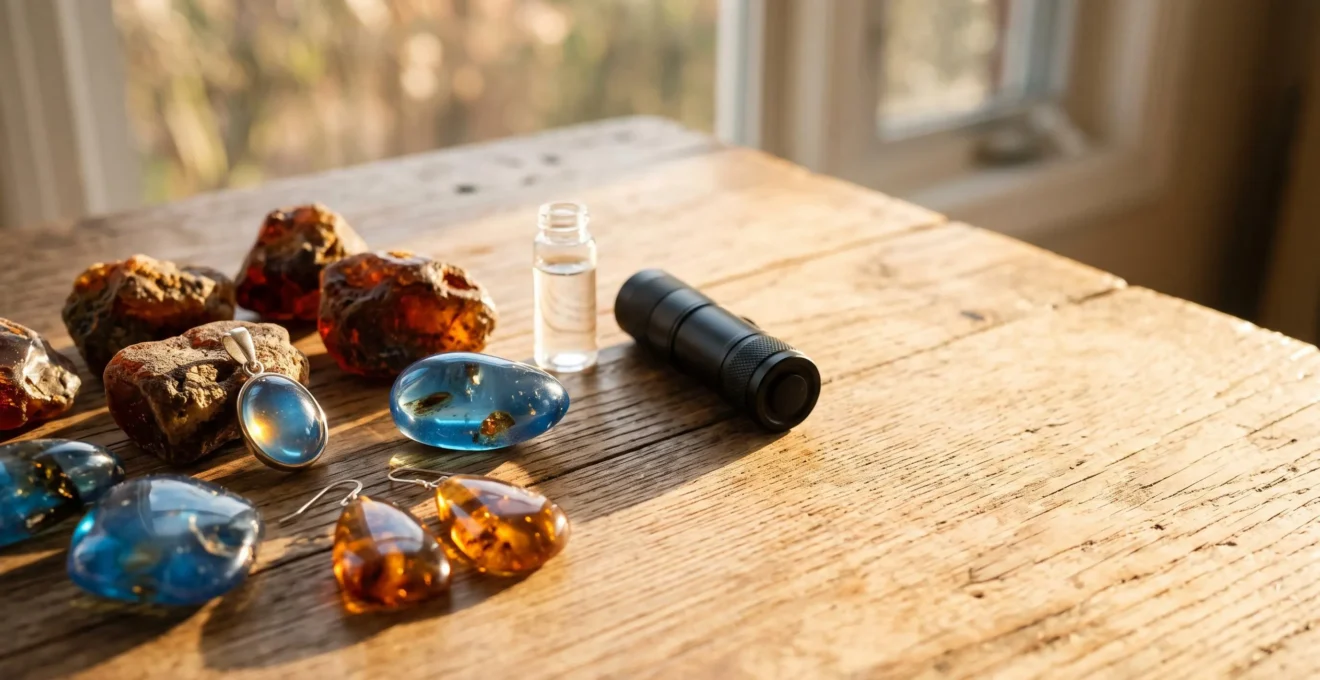
Most « Dominican Amber » sold to tourists is worthless plastic or manipulated resin, but simple field tests can instantly reveal the deception.
- Genuine Dominican amber is scientifically distinct from Baltic amber due to its transparency and high rate of tropical fossil inclusions.
- Authentication relies on a combination of tests (saltwater, UV light, static) because some fakes, like pressed amber, are designed to pass a single test.
Recommendation: Always perform at least two different tests before any purchase and immediately distrust a seller who resists or tries to hurry you.
The allure of Dominican amber is powerful. For a visitor from the UK, holding a piece of this solidified ancient resin, perhaps with a prehistoric insect trapped inside, feels like capturing the very essence of the island’s tropical soul. It promises to be the ultimate authentic souvenir. But this allure is precisely what fuels a pervasive and lucrative counterfeit market. Many tourists, eager for a keepsake, walk away with nothing more than cleverly disguised plastic or reconstituted resin, having paid a premium for a worthless trinket.
You may have heard of the classic saltwater test, but in the face of sophisticated fakes, relying on this one trick is dangerously naive. The modern amber scam artist anticipates this and has developed fakes that can fool the unprepared buyer. To truly protect yourself, you must stop thinking like a tourist and start thinking like a gemologist. This requires a shift in mindset—from simply looking for a pretty object to actively hunting for the tell-tale signs of fraud. It’s not about being cynical; it’s about appreciating the genuine article enough to refuse anything less. This guide will arm you with the knowledge not just to perform tests, but to understand the scientific reasons they work, and why some fakes can bypass them.
This article provides a complete framework for authenticating Dominican amber, from understanding its unique value to performing on-the-spot tests. Below is a summary of the key areas we will cover to empower you on your next trip.
Summary: A Gemologist’s Guide: How to Verify Genuine Dominican Amber Before You Buy
- Why Is Dominican Amber More Valuable Than Baltic Amber?
- Where Can You Visit Authentic Amber Mines Near Puerto Plata?
- Puerto Plata Amber Market or Santo Domingo Jewellers: Where to Buy Safely?
- The Amber Scam Where Tourists Buy Plastic for $100
- What Should Genuine Dominican Amber Jewellery Actually Cost?
- The Souvenir Scam Where Mass-Produced Items Are Sold as Artisan Crafts
- Where Can You See the Most Authentic Spanish Colonial Architecture in the Dominican Republic?
- Where Can You Learn Authentic Taíno Pottery or Weaving in the Dominican Republic?
Why Is Dominican Amber More Valuable Than Baltic Amber?
The first step in fraud detection is understanding what makes the genuine article so desirable. While Baltic amber is more abundant, Dominican amber is prized by gemologists and collectors for a unique combination of characteristics that set it apart. Its formation from the resin of the extinct tree species Hymenaea protera in a tropical environment resulted in a gemstone that is almost always transparent, unlike the often cloudy or opaque nature of its Baltic counterpart. This clarity is not just an aesthetic advantage; it provides a crystal-clear window into a lost world.
This is where Dominican amber’s true value lies: its inclusions. It contains a significantly higher number of fossil inclusions from a prehistoric tropical forest ecosystem. This means you are more likely to find perfectly preserved insects, plants, and other life forms that simply don’t exist in the temperate European forests captured by Baltic amber. Beyond the common honey and yellow tones, Dominican amber also boasts a wider and rarer color palette, including reds, greens, and the extraordinarily rare fluorescent « Blue Amber. »
The unique properties of Blue Amber are a subject of scientific fascination. As experts have noted through detailed study, its famous fluorescence is a key identifier. As noted by researchers, Vittorio Bellani and Enrico Giulotto at the University of Pavia, Italy, studied several amber specimens by means of optical absorption and fluorescence spectroscopy to understand its distinct blue glow under UV light—a property most fakes cannot replicate.
| Characteristic | Dominican Amber | Baltic Amber |
|---|---|---|
| Transparency | Nearly always transparent | Often cloudy or opaque |
| Fossil Inclusions | Higher number of fossil inclusions from a lost tropical forest | Fewer inclusions, from a temperate European forest |
| Color Range | Yellow, honey, red, green, and the rare fluorescent ‘Blue Amber’ | Predominantly golden/honey tones |
Where Can You Visit Authentic Amber Mines Near Puerto Plata?
The quest for authentic amber might lead you towards the source: the mines scattered in the hills around Puerto Plata. However, it’s critical to abandon any romanticized image of a polished ‘show mine’ tour. The reality of amber extraction in the Dominican Republic is a world away from a sanitized tourist attraction. The primary method is bell-pit mining, a dangerous and rudimentary process that underscores the gem’s rarity and the human effort required to obtain it.
These are not large, stable operations. Miners dig narrow, foxhole-style shafts deep into the mountainside, often by hand with basic tools like machetes and picks. They then crawl on their knees through cramped, unlevel tunnels with nearly 100% humidity, lit only by candlelight, and with virtually no safety infrastructure. This raw, arduous process is what brings genuine amber to the surface. Understanding this reality is the first step in differentiating a true story from a seller’s fabricated tale. No mass-market vendor can convincingly describe the specific challenges of a particular mine shaft.
Case Study: The Reality of Bell-Pit Mining
Dominican amber, especially blue amber, is extracted through bell-pit mining, a technique using foxhole-style pits dug largely by hand with machetes, shovels, and picks. Miners crawl on their knees inside cramped, unlevel shafts lit only by candles, with 100% humidity and almost no safety infrastructure — a stark reality check for travelers expecting a polished ‘show mine’ experience.
Puerto Plata Amber Market or Santo Domingo Jewellers: Where to Buy Safely?
When it comes to purchasing amber, the environment where you buy is as important as the piece itself. Your two main options will likely be the bustling, tourist-focused amber markets in Puerto Plata or the more established, formal jewellers in Santo Domingo’s Colonial Zone. A gemologist’s perspective reveals a stark contrast in risk and reliability between these two scenarios. The mass-market stalls are flooded with altered or outright fake pieces, with sellers relying on high tourist turnover and a general lack of buyer knowledge.
In contrast, a reputable jeweller in Santo Domingo, who serves both locals and discerning tourists, has a reputation to uphold. They are more likely to have a direct-sourcing chain of custody, bypassing the multiple middlemen who introduce fakes into the supply chain. A key advantage for buyers is that the Dominican Republic lacks the industrialized autoclave treatment plants common in other regions, meaning large-scale, high-tech alteration is less prevalent. This puts power back in the hands of the knowledgeable buyer who asks sharp, specific questions about the stone’s origin and characteristics. An artisan or trusted jeweller will welcome such questions; a scam artist will deflect them.
| Factor | Mass-Market / Altered Amber | Direct-Sourced / Artisan Amber |
|---|---|---|
| Supply chain | Passes through large commercial entities exploiting labeling loopholes | Bypasses middlemen, sourced straight from miners and mine owners |
| Treatment risk | Market flooded with mass-market altered pieces | Dominican Republic lacks industrialized autoclave treatment plants, limiting large-scale alteration |
| Buyer power | Marketing language blurs the lines of truth | Knowledgeable customers who ask sharp, specific questions shift power back to the buyer |
The Amber Scam Where Tourists Buy Plastic for $100
This is where theory meets practice. You’re standing in a market, a beautiful, clear piece of « amber » in your hand, and the price seems reasonable. How do you unmask a potential fake on the spot, without a lab? You use a pocket test kit—a series of simple, effective field tests that, when used in combination, can expose most common forgeries, from simple plastic to more deceptive materials.
The most notorious fakes are made of modern plastics or young, immature resin called copal. A single test can be misleading. For example, some plastics are weighted to sink in saltwater, foiling the most common test. Therefore, a multi-test approach is non-negotiable. Begin with the saltwater float test, but follow it up immediately with a UV light examination. Real amber’s fluorescence is difficult to fake convincingly. Then, perform a static test. This combination of physical and optical checks creates a web of verification that cheap fakes cannot escape.
However, be aware of a more sophisticated fake: pressed amber. This material is made from real amber dust and fragments that have been heated and compressed. Because it’s chemically real amber, it will pass the saltwater, scent, and even UV tests. Its weak point is its unnaturally uniform internal structure. Genuine amber has natural strain patterns visible under polarized light, which are destroyed in the pressing process. While you won’t have a polariscope in the market, be suspicious of large, perfectly clear pieces with an unnaturally flawless appearance sold at a low price—it could be a sign of reconstitution.
Your Field Authenticity Checklist: The Pocket Test Kit
- Saltwater Float Test: Prepare a strong salt-water solution (roughly 7 teaspoons of salt in a glass of water). Genuine amber is buoyant and will float, while most plastics and glass will sink.
- UV Light Glow Test: Use a small ultraviolet (UV) torch. Real Dominican amber, especially from certain mines, will typically glow with a distinct blue, white, or greenish fluorescence. Plastic shows little to no reaction.
- Warmth and Scent Test: Rub the piece vigorously in your palm until it’s warm. Sniff it immediately. You should detect a faint, pleasant pine-resin smell. A harsh chemical or plastic odor is a major red flag.
- Static Electricity Test: Rub the piece briskly on a soft cloth (like your t-shirt) for 20-30 seconds. A briskly rubbed genuine piece builds enough static electricity to attract and lift small bits of paper or a strand of hair.
- Final Verification: Never rely on one test alone. For maximum confidence before making a purchase, always run two or three of these tests in succession.
What Should Genuine Dominican Amber Jewellery Actually Cost?
There is no simple price-per-gram for genuine amber, and any seller who offers one is likely dealing in mass-produced, uniform fakes. The value of an authentic piece is determined by a hierarchy of rarity factors, with the quality and nature of its inclusions being paramount. A small, cloudy piece with no inclusions is worth very little. A large, crystal-clear piece containing a perfectly preserved, identifiable insect or botanical specimen is a collector’s item with a correspondingly high price tag.
Not all inclusions are created equal. Common flies or ants add value, but a piece containing a complete flower, a small lizard, or a feather is exponentially rarer and more valuable. A praying mantis, for example, is so exceptionally rare in Dominican amber that a single specimen is considered a major gemological find, not a simple souvenir. Therefore, if a street vendor offers you a large piece with a « perfect scorpion » for $50, you can be 100% certain it’s a fake. The price itself is the proof of fraud.
For the average buyer not looking for a museum-grade specimen, a sound strategy is to focus on classic Dominican amber. As the editorial team at Blue Amber Australia advises, you should » Opt for Dominican classic when you want tropical pedigree and rich hues—without blue-amber premiums. » This means seeking out beautiful, clear, honey-coloured pieces with interesting but not necessarily ultra-rare inclusions. This is the sweet spot for acquiring a genuine, beautiful, and fairly-priced piece of the Dominican Republic’s natural history.
The Souvenir Scam Where Mass-Produced Items Are Sold as Artisan Crafts
The mindset of a gemological authenticator—scrutinizing origins, questioning stories, and looking for evidence—extends far beyond amber. The Dominican Republic has a rich tradition of handmade crafts, but tourist markets are also rife with mass-produced items masquerading as « artisan » work. The same logic applies: if an item is sold on dozens of identical stalls, it is not a unique, handmade piece from a small village.
To identify genuine crafts, you must look for an « artisan benchmark »—a verifiable example of a true workshop that you can use as a standard for comparison. This means seeking out studios or cooperatives where you can see the creation process in action. Can you see the potter at the wheel? The weaver at the loom? Can you talk to the person who made the item? A true artisan’s workshop has a story, a physical location, and a process to show. Mass-produced souvenirs have none of this; they only have a price tag and a generic sales pitch.
Case Study: Casa Alfarera as an Artisan Benchmark
Casa Alfarera is a stoneware workshop located in the Colonial City of Santo Domingo, staffed by a team of master potters, wheel throwers, glazers, and decorators who create ceramic wares from raw material to fired piece. The entire process is transparent and traceable. A visitor can use this model as a benchmark to evaluate whether another vendor’s « handmade » claim is credible. If a seller cannot tell you who made an item or where their workshop is, it’s a significant red flag.
Where Can You See the Most Authentic Spanish Colonial Architecture in the Dominican Republic?
The story of Dominican amber is intertwined with the island’s colonial history. The prime location to experience this connection is Santo Domingo’s Zona Colonial, the first permanent European settlement of the New World and a UNESCO World Heritage site. Walking its cobblestone streets, you are surrounded by the oldest colonial buildings in the Americas, offering a tangible link to the era when amber first became a coveted export to the Old World.
This is where the most reputable jewellers and amber experts are often found, operating from beautifully restored historic buildings. A perfect example is the Amber World Museum. While it is a commercial enterprise, it is housed within a stunningly restored historic building, creating a direct link between the island’s geological past and its architectural heritage. The building itself is an artifact, reportedly constructed between 1505 and 1508, making it one of the oldest structures in the city. Visiting such places provides not only a safer buying environment but also a richer cultural context, allowing you to appreciate amber as part of a much larger historical narrative.
Unlike the purpose-built tourist traps of the coastal resorts, the Zona Colonial offers an authentic atmosphere where history is not a theme, but the very fabric of the city. Here, you can find workshops and stores that have been in families for generations, providing a level of trust and provenance that is impossible to find in a pop-up beach stall. It is the ideal hunting ground for a discerning buyer.
Key Takeaways
- Dominican amber’s value comes from its high transparency and rate of unique tropical fossil inclusions, making it a prime target for counterfeiters.
- Authenticity verification must be a multi-step process; relying on a single test like the saltwater float is insufficient to detect sophisticated fakes like pressed amber.
- True value is tied to the rarity of inclusions, not just size or color. Be skeptical of « rare » specimens sold at low prices, as this is a primary indicator of fraud.
Where Can You Learn Authentic Taíno Pottery or Weaving in the Dominican Republic?
While amber is a geological treasure, the deepest cultural roots of the island belong to the Taíno people. Seeking out authentic Taíno-inspired craft is a way to connect with the island’s pre-Columbian soul. Unfortunately, much like the amber market, this space is filled with mass-produced caricatures sold as authentic art. True Taíno craft is not about bright colours and cartoonish faces; it’s about specific pottery techniques, motifs, and weaving styles passed down through generations.
Finding genuine learning experiences requires moving away from the main tourist hubs. The most revered centre for this is Altos de Chavón, a stunningly recreated 16th-century Mediterranean village that houses a vibrant arts and design school. Its artist-in-residence programs and workshops have long been a bastion for preserving and teaching traditional Dominican crafts, including ceramics inspired by Taíno traditions. While direct public workshops can be seasonal, the school and its associated galleries are the best starting point for finding legitimate artists working in this style.
Engaging with this deeper artistic heritage offers a profound alternative to simply buying an object. It shifts the goal from possession to understanding. Learning about the symbolism behind a Taíno motif or the specific clay used in a pot provides a much more lasting and meaningful connection to Dominican culture than any polished stone. This is the ultimate authentic souvenir: not an object, but a piece of knowledge and a genuine cultural exchange.
By adopting this critical, evidence-based mindset for all your souvenir purchases, you transform a simple shopping trip into a rewarding cultural investigation, ensuring the treasures you bring home are as genuine as the memories you’ve made.