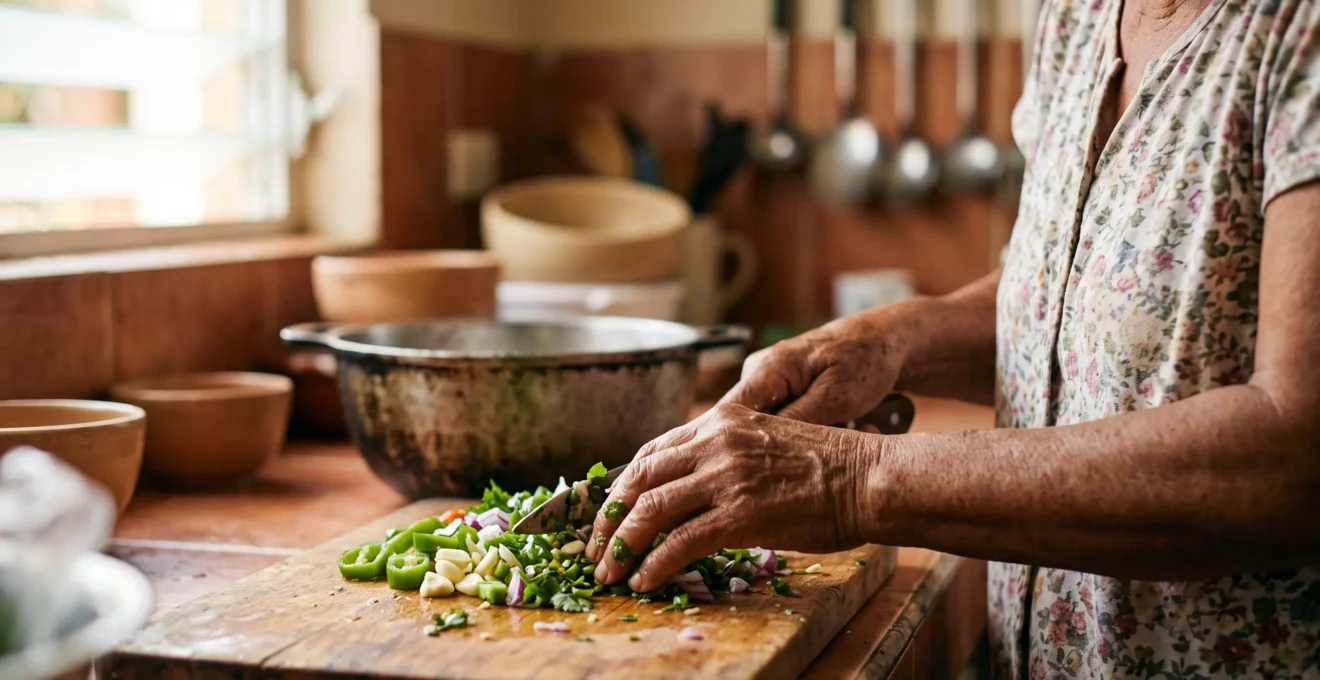
Your Dominican dishes taste flat because you’re treating sofrito as a recipe, not as the foundational flavour architecture it truly is.
- The specific ingredients, particularly broadleaf cilantro and ají cubanela, create a distinct Dominican aromatic profile that is non-negotiable.
- Authentic texture, achieved through hand-chopping rather than blending, is critical for how flavours release and build during cooking.
Recommendation: Stop using powdered sazón as a shortcut and focus on mastering the ratio and preparation of a fresh, coarse sofrito to build a genuine Dominican flavour blueprint from the ground up.
If you’ve ever followed a Dominican recipe to the letter yet felt the result was missing a certain depth, a soulful essence you can’t quite name, the culprit is almost certainly your understanding of sofrito. Many home cooks in the UK, armed with a list of ingredients, see it as a simple vegetable paste. They toss peppers, onions, and herbs into a blender, press a button, and believe they’ve created the « base ». This is the first and most critical mistake. That soupy green purée is not Dominican sofrito; it’s a generic vegetable mix.
The truth is, authentic Dominican sofrito is not a recipe—it is a technique. It’s a foundational flavour architecture built on specific ingredient ratios and, crucially, a specific preparation method that dictates how flavour is released and layered throughout the cooking process. It’s the difference between a house built on a solid concrete foundation and one built on loose sand. One stands strong, its character deepening over time; the other collapses into a muddle of indistinct flavours.
This guide is not another ingredient list. As a culinary instructor, my goal is to deconstruct the *why* behind this cornerstone of our cuisine. We will analyze the precise ingredients that define it, explore the critical debate of chopping versus blending, understand its preservation, and identify the common shortcuts that guarantee failure. By the end, you will no longer be following a recipe; you will be executing a technique, building a flavour blueprint that is the non-negotiable soul of every authentic Dominican savoury dish.
This comprehensive guide will walk you through the essential knowledge needed to master this foundational element. We will cover everything from ingredient selection and preparation techniques to the cultural and historical context that makes Dominican cuisine unique.
Summary: Why Sofrito is the Soul of Dominican Flavour
- What Ingredients Separate Dominican Sofrito From Puerto Rican Recaito?
- Should You Hand-Chop or Blend Dominican Sofrito for Authentic Flavour?
- How Long Can Homemade Dominican Sofrito Last in the Refrigerator?
- The Sofrito Shortcut That Ruins Authentic Dominican Dish Flavour
- Does Sancocho Sofrito Differ From Habichuelas Sofrito in Composition?
- Which Dominican Cooking Techniques Originated in West African Traditions?
- Why Do Dominican Colmados Operate Until Midnight When Supermarkets Close at 8 PM?
- What Makes Dominican Creole Food Different From Other Caribbean Cuisines?
What Ingredients Separate Dominican Sofrito From Puerto Rican Recaito?
The most fundamental error a cook can make is assuming all Caribbean « green bases » are interchangeable. The distinction between Dominican sofrito and its closest cousin, Puerto Rican recaito, is a perfect lesson in flavour architecture. The difference is not trivial; it’s foundational, changing the entire aromatic profile and colour of a dish. The primary separator is the choice of herbs and peppers. Dominican sofrito is built on the wide, flat leaves of broadleaf cilantro (cilantro ancho) and the mild, thin-skinned ají cubanela (Cubanelle pepper). This combination yields a bright, yet earthy base.
In contrast, Puerto Rican recaito is defined by its heavy use of culantro (also known as recao), a long, spiny-leafed herb with a much more potent, pungent flavour than cilantro. This, combined with small, aromatic ajíes dulces, gives recaito its signature deep green colour and intensely herbaceous character. Furthermore, acidity is a key differentiator. Dominican sofrito often includes a splash of sour orange or vinegar, which brightens the flavour and aids in preservation. Another key distinction, as the Loisa Editorial team notes, is that « In the Dominican Republic, some Sofrito recipes call for the addition of fresh tomatoes or tomato paste, » giving our sofrito a characteristic reddish or yellowish hue, unlike the intensely green, tomato-free recaito.
This table breaks down the core differences, which are essential to understand before you begin. Choosing the wrong base is like trying to build a brick house with wood-frame blueprints. As this comparative analysis shows, the roles are fundamentally different.
| Aspect | Dominican Sofrito | Puerto Rican Recaito |
|---|---|---|
| Star Aromatic | Broadleaf cilantro, ají cubanela | Culantro (recao), ajíes dulces |
| Color | Reddish/yellowish (tomato or paste often added) | Intensely green, tomato-free |
| Acidity | Vinegar or sour orange common | Rarely acidic; herb-forward |
| Role in Cooking | Cooked-down foundational base (‘sazón’) | Concentrated paste, often added later |
| Naming Convention | Sofrito = fresh paste; sazón = full seasoning | Recaito and sofrito often used interchangeably |
Should You Hand-Chop or Blend Dominican Sofrito for Authentic Flavour?
This is not a matter of convenience; it is the most crucial technical decision you will make. The modern impulse is to use a blender, but this is a critical error that fundamentally misunderstands the function of sofrito. Blending doesn’t just chop; it pulverizes. The high-speed blades create an emulsion, a smooth, homogenous paste. While efficient, this process ruptures cell walls indiscriminately, releasing all aromatic compounds at once and creating a flavour that can become flat or even « muddy » when cooked.
The authentic, and superior, method is hand-chopping. While more laborious, dicing the onions, peppers, garlic, and herbs into a small, coarse brunoise preserves their individual integrity. This is the concept of controlled cellular rupture. When you introduce this coarse sofrito to hot oil, the ingredients release their flavours sequentially, not all at once. The onions sweeten, the garlic toasts, and the peppers soften, creating distinct layers of flavour that form a complex and dynamic foundation. A blended sofrito, by contrast, simply stews in the pan as a single entity.
The visual difference in the image above is not just aesthetic; it represents two entirely different approaches to flavour development. The coarse, hand-chopped mixture allows for Maillard reactions and caramelization on individual pieces, building a deep, savoury base. The blended paste boils and steams, its potential for complexity lost in a watery purée. For authentic flavour, put the blender away. Your knife is your most important tool.
Your Checklist for Authentic Sofrito Preparation
- Ingredient Audit: Have you sourced true ají cubanela and broadleaf cilantro, not substitutes like bell peppers or standard curly parsley?
- Texture Check: After chopping, can you still identify individual pieces of onion, pepper, and herbs? If it looks like a paste, you’ve gone too far.
- Aroma Profile: Does it smell fresh and vegetal? A slight « grassy » note from the cilantro and a mild sweetness from the peppers should be present.
- Moisture Content: Is the mixture moist but not watery? Excess water from over-washing vegetables or blending will cause the sofrito to steam instead of sauté.
- Action Plan: Practice dicing with a sharp knife to achieve a consistent, small dice (brunoise). This ensures even cooking and flavour release.
How Long Can Homemade Dominican Sofrito Last in the Refrigerator?
Once you’ve prepared a proper batch of hand-chopped sofrito, the next practical consideration is storage. Because it is a fresh preparation of raw vegetables and herbs, its shelf life is naturally limited. Stored in an airtight container in the refrigerator, a basic sofrito will typically last for about 5 to 7 days. This is usually sufficient for a week’s worth of cooking, allowing you to build the foundation for several dishes from a single prep session.
However, the longevity of your sofrito can be significantly extended through the strategic use of natural preservatives that are already integral to many family recipes. Two key elements are salt and acid. As culinary expert Clara Gonzalez of DominicanCooking.com explains, « the salt makes it a little inhospitable for bacteria and helped prolong the shelf life ». Adding a proper amount of salt not only seasons the base but also draws out moisture and creates an environment less prone to spoilage. Similarly, incorporating an acidic component like sour orange juice (naranja agria) or a simple white vinegar does more than just add a bright flavour note; it lowers the pH of the mixture, further inhibiting bacterial growth.
A well-seasoned sofrito containing adequate salt and acid can easily last up to two weeks in the refrigerator. For long-term storage, freezing is the best method. You can portion the sofrito into ice cube trays, freeze them solid, and then transfer the cubes to a freezer bag. This provides perfectly portioned flavour bombs ready to be dropped into a hot pan, lasting for up to six months without significant loss of quality.
The Sofrito Shortcut That Ruins Authentic Dominican Dish Flavour
In our modern, convenience-driven world, there is one « shortcut » that has done more to damage the integrity of home-cooked Dominican food than any other: the substitution of fresh sofrito with powdered `sazón`. These little packets of reddish-orange powder are ubiquitous, and many online recipes tragically call for them interchangeably. This is a catastrophic error. Powdered `sazón` is not a dehydrated version of `sofrito`; it is a completely different product with a different function.
Fresh sofrito is a flavour base—a coarse mixture of fresh vegetables and herbs that you sauté in oil to build layers of aromatic complexity from the ground up. Powdered `sazón`, on the other hand, is a flavour enhancer. Its primary ingredients are typically salt, MSG (monosodium glutamate), ground annatto or turmeric for colour, and dehydrated garlic and onion powder. It provides a hit of umami and a vibrant, artificial colour, but it offers none of the fresh, nuanced, layered flavour that comes from slowly cooking down real vegetables. It’s an illusion of flavour, not the real thing. The pervasiveness of this shortcut is alarming; one analysis notes that it’s the default in almost all recipe instructions calling for ‘sazón’, blurring the lines for novice cooks.
Using this powder in place of real sofrito is like trying to make a fresh garden salad using only a vinaigrette. You’re missing the primary components: the lettuce, the tomatoes, the cucumbers. The result is a dish that might be salty and brightly coloured, but it will be utterly devoid of the soulful, aromatic depth that defines Dominican cooking. There are no shortcuts to a solid foundation. If a recipe for a stew or a pot of beans begins with a packet of powder instead of a spoonful of fresh, sizzling sofrito, you are not making authentic Dominican food.
Does Sancocho Sofrito Differ From Habichuelas Sofrito in Composition?
After establishing the non-negotiable core of sofrito, a new level of mastery emerges: understanding its flexibility. The question of whether the sofrito for a hearty `sancocho` should differ from the one for a simple pot of `habichuelas` (beans) gets to the heart of sofrito as a dynamic technique, not a static recipe. The answer is yes, a skilled cook absolutely adjusts the sofrito’s composition based on the final dish.
As Kelvin from KelvinsKitchen.com astutely points out, « there is no single ‘correct’ Dominican sofrito recipe ». This is the key. Once you have mastered the foundational ratio of aromatics, you can treat sofrito as a flavour blueprint that can be modified. For a rich, complex `sancocho`—a stew laden with root vegetables and various meats—a cook might create a more robust sofrito. This could mean increasing the quantity of garlic, adding a bay leaf, or even incorporating a different type of pepper for more depth. A great example of this flexibility is highlighted in a family recipe shared by Jerra’s Garden, noting how pepper choice dictates the final character of a dish:
You can use sweet or hot peppers depending on whether you want your sofrito spicy or mild, and traditionally Ají Cachucha peppers are favored since they thrive in the tropical garden.
– Jerra’s Garden, Dominican-Style Sofrito: A Garden-Fresh Family Recipe
Conversely, for a pot of creamy `habichuelas guisadas` (stewed beans), the goal is often a smoother, more subtle background flavour. Here, a cook might use a more standard sofrito, perhaps even ensuring the herbs are chopped finer so they melt into the beans completely. They might also add a sprig of fresh thyme or a piece of pumpkin (`auyama`) directly to the pot, allowing those flavours to complement the sofrito base. The sofrito remains the foundation, but its specific expression is tailored to serve the dish’s final character. This is the art of Dominican cooking.
Which Dominican Cooking Techniques Originated in West African Traditions?
To fully grasp the soul of Dominican cooking, and by extension sofrito, one must look beyond the island to its deep West African roots. The influence is not just in ingredients, but in foundational techniques of flavour building. The very method of creating a flavour base by pounding or grinding aromatics is a direct culinary inheritance. While today we may use a knife, Heritage Food Stories reminds us that « traditionally it was the mortar and pestle or the pilón that children were given to pound garlic and peppers ». This act of physically breaking down aromatics in a pilón to release their essential oils is a technique that echoes across the African diaspora and is central to the development of sofrito.
This connection is not abstract; it’s visible in some of the most iconic Dominican dishes. The technique of preparing mangú is a prime example of this direct lineage.
Mangú’s Direct Lineage to West African Fufu
The technique of boiling and mashing plantains, used in Dominican mangú and Puerto Rican mofongo, was originally practiced in the West African dish fufú, illustrating how enslaved West Africans directly shaped core Dominican cooking methods.
This simple act of boiling and mashing a starchy staple is a culinary thread connecting the Caribbean directly to West Africa. The `pilón` itself, a heavy wooden mortar and pestle, is more than a kitchen tool; it is a symbol of this heritage, an object that embodies the physical process of transforming raw ingredients into the flavourful foundation of a meal. Understanding this history enriches our appreciation for every spoonful of sofrito, recognizing it not just as a mix of vegetables, but as the result of centuries of culinary tradition and resilience.
Why Do Dominican Colmados Operate Until Midnight When Supermarkets Close at 8 PM?
While seemingly unrelated to a cooking lesson, understanding the `colmado` is essential to understanding the ecosystem of Dominican flavour. Why do these small neighbourhood corner shops stay open so late, long after large supermarkets have closed? Because they serve a different function. The `colmado` is not just a place to buy groceries; it is the social and economic hub of the barrio, and the lifeblood for daily, fresh cooking. And for our purposes, it is where the freshest sofrito ingredients are sourced, often daily.
Supermarkets operate on a rigid, formalized schedule. The `colmado`, however, operates on the rhythm of the neighbourhood. It’s where you go when you run out of garlic mid-`sancocho`, where you pick up a single onion for the evening’s `habichuelas`, or buy a few loose `ajíes cubanela` for a small batch of fresh sofrito. Their extended hours are a direct response to the community’s needs and a reflection of their role in the informal economy.
Colmados as the Archetype of Dominican Microenterprise
AMCHAM’s analysis identifies colmados alongside mechanic workshops, beauty salons and street vendors as the most visible face of Dominican informality, businesses that operate flexibly outside strict registration norms — a structural trait that explains their round-the-clock, needs-based hours compared to regulated supermarkets.
This flexibility is what makes the `colmado` indispensable to the Dominican cook. The ability to source fresh, high-quality ingredients at almost any hour supports a cooking culture that prioritizes freshness over bulk buying. The `colmado` ensures that the cilantro for your sofrito was likely delivered that morning, not sitting in a warehouse for a week. So while the supermarket provides convenience, the `colmado` provides life, community, and the very freshness that makes Dominican food so vibrant.
Key Takeaways
- Sofrito is a foundational technique, not a simple recipe; its preparation dictates the flavour architecture of a dish.
- The choice between hand-chopping (authentic) and blending (a shortcut) fundamentally alters flavour release and texture, with chopping being superior.
- Authentic Dominican sofrito is non-negotiable; substituting it with powdered sazón or other Caribbean bases will not yield a genuine result.
What Makes Dominican Creole Food Different From Other Caribbean Cuisines?
Ultimately, to master Dominican sofrito is to understand what makes our entire Creole cuisine unique. While we share a common Caribbean geography, Dominican food stands apart due to its specific historical blend. As Kelvin’s Kitchen succinctly states, « It blends three primary influences: indigenous Taíno cooking, Spanish colonial cuisine, and West African flavor profiles ». Sofrito itself is the perfect embodiment of this fusion: Spanish cooking techniques (`sofreír`, to sauté) are applied to a mix of native and African aromatics. It is the active, living result of this cultural « sancocho ».
Other Caribbean islands share parts of this history, but the specific balance and expression are unique to the Dominican Republic. Our culinary identity is not defined by the intense heat of Scotch bonnet peppers found in Jamaica, nor the heavy French influence seen in Martinique. It is defined by a more subtle, garlic-and-herb-forward profile, where sofrito provides a savoury, aromatic depth rather than overwhelming spice. This allows the natural flavours of the core ingredients—be it beef in a `sancocho` or beans in `habichuelas`—to shine, supported by the sofrito foundation rather than being masked by it.
This unique identity is perfectly crystallized in our national breakfast, ‘Los Tres Golpes’, a daily ritual with no direct parallel in its centrality elsewhere in the Caribbean.
Mangú and ‘Los Tres Golpes’ as a Uniquely Dominican Daily Ritual
Mangú, mashed boiled green plantains traceable to West African fufu, is served as the official national breakfast alongside fried cheese, fried Dominican salami and fried eggs — a combination known as ‘los tres golpes’ that has no direct equivalent in its ritual centrality elsewhere in the Caribbean.
This is what makes our food distinct. It’s a cuisine built on foundational techniques like sofrito, which carry the DNA of our Taíno, Spanish, and African ancestors. Mastering this base isn’t just about learning to cook; it’s about learning to speak the language of Dominican flavour.
Now that you understand the theory, the techniques, and the cultural importance, the next step is to move from the page to the pan. The only way to truly internalize this lesson is through practice. Get your hands on the freshest ingredients you can find, sharpen your knife, and begin the work of building your own authentic flavour architecture.