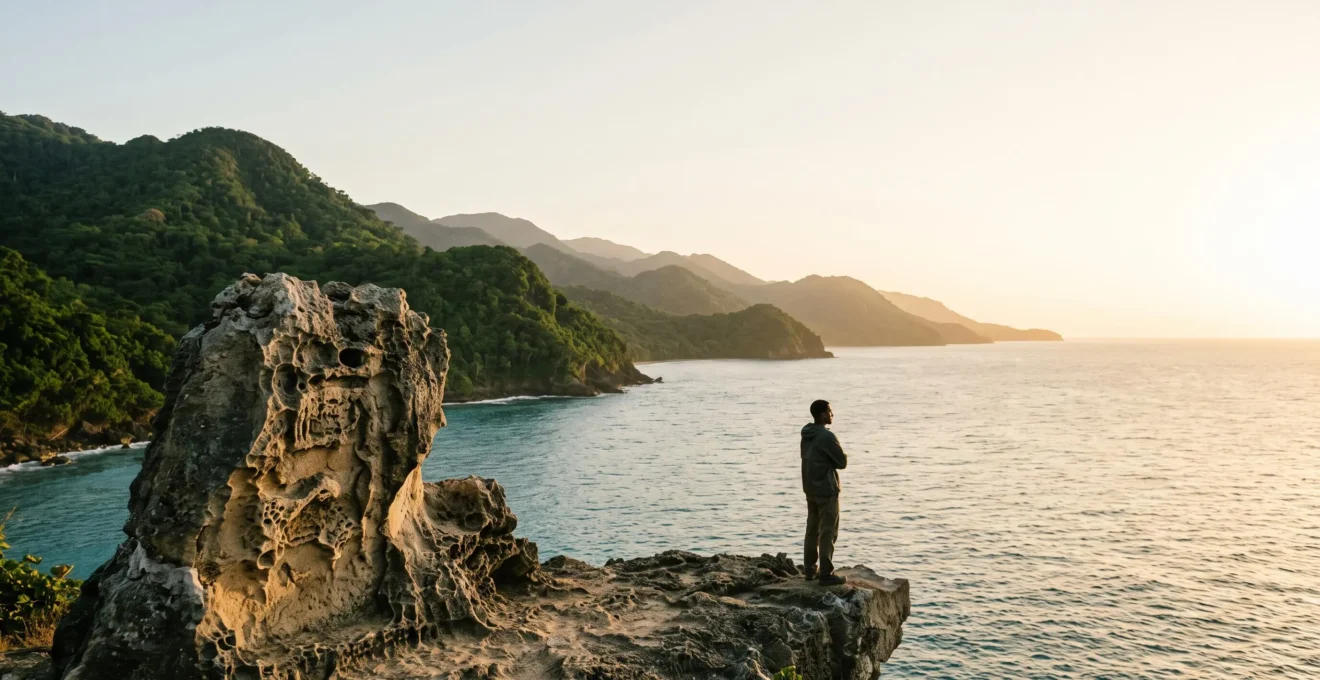
The name « Quisqueya » is not the simple story of « Mother of all Lands » you’ve been told; it’s a deeply political act of identity creation.
- The term’s Taíno origin is linguistically debated by scholars, making its popular meaning more of a national myth than a historical certainty.
- It was strategically revived in the 19th century to forge a national identity, often as a way to prioritize indigenous and Spanish heritage over the island’s significant African roots.
Recommendation: Listen for when and how Dominicans use « Quisqueya. » Understanding its context is the key to grasping the complex racial and cultural politics of the nation today.
If you’ve spent any time in the Dominican Republic, you’ve likely encountered a puzzle. You hear the name « Quisqueya » everywhere—in the soaring national anthem, in proud declarations from locals, on storefronts. Yet, on your map, the island is Hispaniola, and the country, the Dominican Republic. The common explanation is simple and poetic: « Quisqueya » is the original Taíno name for the island, meaning « Mother of all Lands. » It’s a beautiful story, a nod to a pre-Columbian past. But as a cultural anthropologist, I can tell you this simple story obscures a far more complex and fascinating reality.
The embrace of « Quisqueya » isn’t merely a nostalgic reference. It is a profound act of post-colonial identity construction, a tool used over centuries to shape a national narrative. This narrative has been strategically deployed to navigate the island’s fraught history with colonialism, its complex relationship with Haiti, and its internal struggles over race and ancestry. To truly understand the Dominican soul, we cannot just accept the poetic meaning. We must peel back the layers and examine the name as a cultural artifact, a contested symbol that reveals as much about the present as it does about a long-lost past.
This article will guide you through that process. We will deconstruct the name’s contested origins, trace its survival and political revival, and explore how Taíno heritage is both genuinely preserved and commercially exploited today. By the end, you’ll understand that when a Dominican says « Quisqueya, » they are not just naming a place; they are making a powerful statement about who they are.
This exploration will delve into the specific historical, cultural, and political forces that have shaped the use of this powerful name. The following sections break down this complex tapestry of identity.
Summary: The Contested Soul of an Island Name
- What Did the Taíno People Mean by Calling Hispaniola « Quisqueya »?
- How Did the Taíno Name « Quisqueya » Survive 500 Years of Spanish Dominance?
- Do Dominicans or Haitians More Actively Preserve Taíno Cultural Identity?
- The Cultural Mistake of Treating Taíno Heritage as Decorative Resort Theming
- When Should Foreign Visitors Use « Quisqueya » Without Seeming Performative?
- Why Did Taíno Basket Weaving Survive Whilst Ceremonial Pottery Nearly Disappeared?
- Why Do Many Dominicans Identify More Strongly With Spanish Than African Ancestry?
- Where Can You Learn Authentic Taíno Pottery or Weaving in the Dominican Republic?
What Did the Taíno People Mean by Calling Hispaniola « Quisqueya »?
The popular translation of « Quisqueya » as « Mother of all Lands » is a cornerstone of Dominican national identity. It evokes a powerful, Edenic image of a pre-colonial past. However, from a linguistic and historical perspective, this narrative is far from settled. In fact, the very authenticity of the word as a pan-island Taíno toponym is a subject of scholarly debate. This is a classic case of a contested narrative, where national myth and historical evidence do not perfectly align.
The primary challenge comes from linguistic analysis. As Julian Granberry and Gary S. Vescelius noted in their work on Taíno language, a critical examination reveals a significant issue. They argue that « The toponym Quisquella, phonetically khiskheya, cannot be a Taino form, due to its phonological structure. » This suggests the word, as we know it, may have been misinterpreted or altered by early Spanish chroniclers, who were often imprecise with indigenous languages. This act of « linguistic archaeology » forces us to question whether the name was ever used in the way we assume.
The Regional Division of Quisqueya into Five Chiefdoms
Further complicating the matter is the island’s political geography. Historical sources indicate that the Taíno territory was not a single entity but was divided into five distinct chiefdoms: Maguá, Jaragua, Marién, Higüey, and Maguana. Each was ruled by its own cacique. This regional structure fuels the debate over whether « Quisqueya » designated the entire island or perhaps just one specific region, possibly the eastern part. This stands in contrast to the parallel Taíno name for the island, ‘Haiti’ (or ‘Ayti’), which meant ‘Land of High Mountains’ and more clearly described the island’s topography. The poetic « Mother of all Lands » may be a later, romanticized interpretation rather than a direct translation.
How Did the Taíno Name « Quisqueya » Survive 500 Years of Spanish Dominance?
If the name’s origin is so contested, its survival and elevation to a national symbol is even more remarkable. The answer lies in its strategic resurrection during the 19th century as Dominican intellectuals and politicians sought to build a national identity distinct from both their former Spanish colonizers and their Haitian neighbors. The survival of « Quisqueya » is a textbook example of identity-as-strategy, where elements of the past are selectively chosen to serve the needs of the present.
The 19th-century nationalist project promoted an idealized « three roots » narrative for the Dominican people: Spanish, African, and Taíno. However, this narrative was shaped by what can only be described as selective historical amnesia. As academic research shows, this framework allowed the nation’s founders to embrace the poetic, « noble » Taíno heritage, symbolized by the name Quisqueya, while simultaneously declaring the actual Taíno people extinct. This created a safe, non-threatening indigenous ancestor that could be celebrated without challenging the existing social hierarchy.
This historical narrative is now being directly challenged by a modern revival of indigenous identity. A powerful indicator of this shift is that it wasn’t until the national census of November 2022 that Dominicans were officially given the option to self-identify as « indio » or indigenous. This is a monumental step, moving Taíno identity from a purely historical or poetic concept to a living, contemporary category recognized by the state. This revival demonstrates that the Taíno name and identity did not just passively survive; they were actively preserved in oral traditions, family histories, and cultural practices, waiting for a political moment to re-emerge.
Do Dominicans or Haitians More Actively Preserve Taíno Cultural Identity?
Posing this question as a competition is tempting but ultimately misleading. Both nations on the island of Hispaniola have complex, yet vastly different, relationships with their shared Taíno heritage. The preservation is not a zero-sum game but a reflection of their distinct national identity projects. In the Dominican Republic, the Taíno has been elevated as a primary root, partly as a way to differentiate from Haiti and de-emphasize African ancestry. In Haiti, the African identity is central, but Taíno influence persists, starting with the very name of the country, ‘Haiti’, which is an authentic Taíno word.
On a genetic level, the narrative of Taíno extinction has been thoroughly debunked. Groundbreaking DNA studies show that between 23 and 30 percent of Dominicans possess Native American mitochondrial DNA, a direct maternal link to the island’s first inhabitants. This « paper genocide »—declaring a people extinct on paper while their genes and cultural traits persist in the population—is a key part of the story. While similar studies in Haiti are less common, the genetic legacy is undoubtedly present there as well.
However, it is crucial to approach this with anthropological nuance. As Antonio Curet, a curator at the National Museum of African American History and Culture, reminds us, the identity itself is complex. He states:
The term Taíno lacks specificity because a multitude of groups inhabited those islands.
– Antonio Curet, National Museum of African American History and Culture
This is a vital point. The « Taíno » identity that is being preserved and revived is itself a modern construction, a pan-Caribbean identity that simplifies a more diverse pre-Columbian reality. Therefore, preservation is not about reviving a pure, unbroken culture, but about how different modern nations choose to connect with and interpret a shared, complex past.
The Cultural Mistake of Treating Taíno Heritage as Decorative Resort Theming
One of the most significant challenges facing the authentic revival of Taíno culture is its commercialization. For many visitors, the first—and often only—encounter with Taíno heritage is through the lens of the tourism industry. This often takes the form of what can be termed « decorative folklore »: generic geometric patterns on towels, resort logos featuring stylized sun symbols, and cocktail names vaguely referencing indigenous gods. While seemingly harmless, this superficial theming commits a profound cultural mistake: it reduces a living, breathing heritage into a sterile, marketable aesthetic.
This process strips the symbols of their meaning and context. A cemí, a sacred object containing ancestral spirits, becomes a featureless silhouette on a t-shirt. The intricate patterns of basketry, which tell stories of community and environment, are flattened into a repeating digital print. This decorative approach reinforces the outdated idea that the Taíno are an extinct, romantic people of the past whose legacy is now public domain for commercial use. It actively works against the efforts of modern Dominicans who are fighting to have their indigenous ancestry recognized as a living identity.
Even when a commercial entity, like a resort, speaks of its commitment to local culture, the perspective is often framed by its own needs. For example, a travel editorial might describe local crafts as « a way to preserve traditions, tell stories, and share the collective identity of the country, » which is true. However, when the primary goal is to create a marketable « authentic experience » for tourists, there is a risk of curating a version of that identity that is palatable and picturesque, rather than complex and real. It prioritizes aesthetics over anthropology, turning heritage into a backdrop rather than the main story.
When Should Foreign Visitors Use « Quisqueya » Without Seeming Performative?
Navigating cultural terminology as a visitor is always a delicate exercise in respect and awareness. Given the complex political and social weight of « Quisqueya, » using it correctly is about understanding context, not just vocabulary. The goal is to show informed appreciation, not to perform a superficial « insider » status. There is no simple rule, but there are guiding principles rooted in observation and intent.
First and foremost, listen more than you speak. Pay attention to when and how Dominicans use the name. Is it in a moment of passionate national pride, like during a baseball game? Is it in the lyrics of a merengue or bachata song, connecting to a deep cultural vein? Is it used in a formal, historical context? This act of listening will reveal that « Quisqueya » is often reserved for moments that touch upon the nation’s soul or identity. It is not typically a casual, one-for-one replacement for « the Dominican Republic » in everyday conversation.
The key to avoiding performative usage is to use the word to show you’ve been listening. For instance, in a conversation about Dominican music, you might say, « I’m starting to understand why so many songs reference ‘Quisqueya’; there’s so much passion in that name. » This acknowledges the word’s significance rather than simply adopting it. It positions you as a curious and respectful observer, not someone trying to co-opt a term they’ve just learned. In short, use it when referencing the concept of Quisqueya you’ve heard others express, rather than using it as a simple label for the country. True respect comes from demonstrating understanding, not just mimicry.
Why Did Taíno Basket Weaving Survive Whilst Ceremonial Pottery Nearly Disappeared?
The divergent fates of Taíno crafts like basket weaving and ceremonial pottery offer a powerful lesson in cultural survival. The explanation is not about the inherent value of one craft over another, but about their function within society, especially after the Spanish conquest. The core principle is this: utilitarian traditions integrated into daily life are more likely to survive cultural upheaval than ritualistic traditions tied to a suppressed belief system.
Basket weaving, using materials like palm fibers and cane, was essential for everyday Taíno life. They created baskets for carrying produce, mats (esteras) for sleeping, and even woven roofs for their homes (bohios). When the Spanish arrived, these practical skills remained indispensable. The woven goods were useful to everyone, regardless of cultural background. This continuous utility allowed the techniques, patterns, and knowledge to be passed down through generations, adapting and blending with Spanish and African influences, but never fully disappearing. It was a living heritage because it was a lived-in necessity.
In contrast, much of the finest Taíno pottery was ceremonial. These were not everyday cooking pots; they were vessels intricately decorated with faces of cemíes, used in religious rituals like the cohoba ceremony, or made as elaborate funerary offerings. The Spanish, in their mission to eradicate indigenous religion, systematically targeted and destroyed these practices and their associated objects. Because this type of pottery was so deeply intertwined with a belief system that was being violently suppressed, the craft lost its primary purpose. While simple, functional pottery continued, the high art of ceremonial pottery-making nearly vanished because the spiritual ecosystem it belonged to was destroyed.
Why Do Many Dominicans Identify More Strongly With Spanish Than African Ancestry?
The question of racial identity in the Dominican Republic is perhaps the most complex and sensitive aspect of its national character. For an outsider, it can be confusing to see a population with clear African heritage so strongly identify with its European and indigenous roots. This is not a matter of simple denial, but the result of a long and deliberate state-sponsored project of identity construction, a strategy in which the Taíno « indio » identity played a pivotal and troubling role.
The key to understanding this is the concept of blanqueamiento, or « whitening. » As a social strategy, it created a hierarchy where European features were prized. In this context, identifying as Black (and thus connecting to Haiti, which was demonized) was a social disadvantage. The « indio » identity offered a third way. As scholar Ernesto Sagas explains, it allowed Dominicans of mixed heritage to « lighten » themselves by assuming the indio identity and Hispanic culture. It became a buffer, a way to acknowledge non-white ancestry without identifying with the African part, which was socially and politically stigmatized.
Trujillo’s State-Sponsored Distancing from African Heritage
This social tendency was cemented into official state policy during the dictatorship of Rafael Leónidas Trujillo (1930-1961). The Trujillo regime mobilized the entire state apparatus—historians, schools, and the media—to systematically distance Dominican identity from its African roots. This was achieved through a virulent anti-Haitian racial discourse and the promotion of the nation as fundamentally Hispanic. The official national color on identity cards was defined as « indio, » a policy that effectively erased Blackness from the country’s official self-image and solidified the Taíno as a convenient, historical ancestor used to obscure a more immediate and visible African heritage.
Key Takeaways
- The name « Quisqueya » is a powerful symbol, but its popular meaning « Mother of all Lands » is a national myth more than a linguistic fact.
- Taíno identity has been strategically used in Dominican history to build a national narrative, sometimes at the expense of acknowledging the nation’s strong African heritage.
- Distinguishing between authentic « living heritage » in artisan communities and « decorative folklore » in tourist shops is key to respectfully engaging with the culture.
Where Can You Learn Authentic Taíno Pottery or Weaving in the Dominican Republic?
For the culturally curious visitor, moving beyond the « decorative folklore » of resort gift shops is the most rewarding step. The goal is to find and support the living heritage of Taíno-inspired craftsmanship. This means seeking out the communities where these traditions have been passed down for generations, not as a tourist attraction, but as a part of their cultural fabric. Fortunately, these places exist and are accessible to respectful visitors.
Rather than looking for a single « Taíno village » theme park, the real heritage is found in specific towns known for their artisanal specialties. The artisanal pottery, particularly the creation of burenes (clay griddles for making cassava bread), carries deep native heritage. This craft is a specialty of the towns of Reparadero and El Higüerito in Moca, within the Espaillat province. Another major hub for pottery is Bonao, in the Monseñor Nouel province, which is famous for its local white and red clay mines. Visiting these areas allows you to see where the raw materials are sourced and where the artisans live and work, making them significant living centers of Taíno-rooted craft.
Engaging with this living heritage requires a thoughtful approach. It is not about consumption, but about connection and contribution. When you buy directly from an artisan in their workshop, you are not just acquiring an object; you are participating in the survival of a cultural legacy. To ensure your engagement is meaningful and supportive, you can use a simple checklist to guide your interactions and purchases.
Checklist: Your Guide to Recognizing Authentic Taíno-Inspired Craftsmanship
- Verify the craft traces back to pre-Columbian Taíno techniques, such as hand-modeled pottery or palm-fiber basketry, rather than generic imported designs.
- Ask whether the motifs used (geometric patterns, cemí figures) are explained by the artisan as carrying specific cultural or mythological meaning.
- Look for natural, locally sourced materials such as guano palm, cane, or regional clay rather than synthetic substitutes.
- Prioritize purchasing directly from artisan communities or cooperatives like those in Higüerito or Bonao rather than mass-market souvenir shops.
By seeking out these living traditions, you transform your visit from a passive vacation into an active, respectful engagement with the vibrant, complex, and resilient soul of Quisqueya.