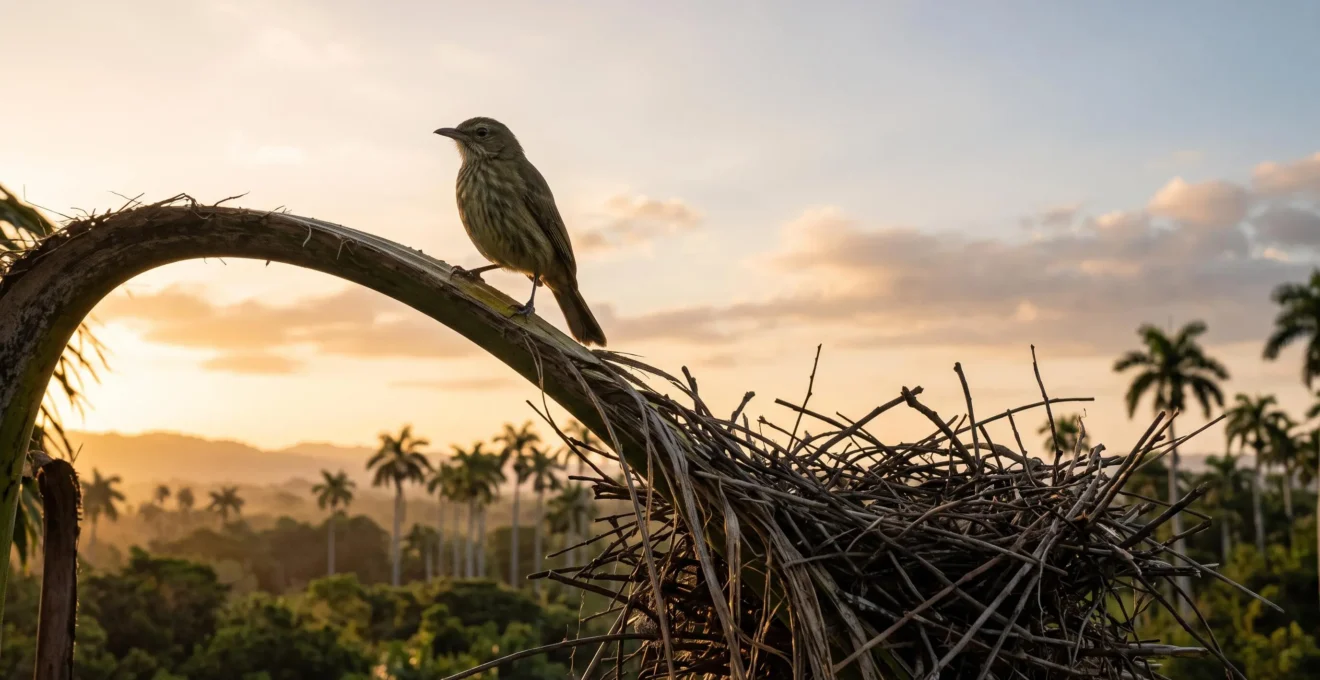
The key to spotting the Palmchat isn’t just looking in palm trees; it’s learning to listen for its distinctive, chaotic chorus of calls that cuts through the island’s soundscape.
- Palmchats are an evolutionary anomaly, the only species in their entire bird family, making them a truly unique sighting.
- They are most active and vocal in the cool hours of early morning and late afternoon, making midday searches largely fruitless.
- Reliable hotspots exist even near tourist hubs, such as the National Botanical Garden in Santo Domingo.
Recommendation: Focus your efforts on identifying the bird’s unique auditory signature first, then pinpoint its location visually within stands of Royal Palms.
For any UK birdwatcher touching down in the Dominican Republic, the air is immediately thick with unfamiliar sounds. Amidst the hum of the tropics, the desire to tick off the country’s national bird, the Palmchat, is a primary goal. You’ve probably read the standard advice: « look for them in palm trees » or « listen for their noisy calls. » While true, this is like telling someone to find a Blackbird in an English garden; it’s a starting point, but it lacks the specific fieldcraft needed for a guaranteed and rewarding encounter. The island of Hispaniola is a hotspot of biodiversity, buzzing with calls that can easily be confused with those of common sparrows or other gregarious species.
But what if the real secret to finding this enigmatic bird wasn’t just visual, but auditory? What if the key lay not in spotting another small, brown bird, but in decoding its unique acoustic signature? The Palmchat, or Cigua Palmera as we call it locally, is more than just a national symbol. It’s an evolutionary anomaly with a complex social life expressed through a symphony of raucous, conversational calls. To truly find it, you must learn its language.
This guide moves beyond the generic to give you the on-the-ground knowledge of a local ornithologist. We’ll explore why this bird is a living relic, pinpoint exact locations where you can reliably find it, and teach you how to distinguish its sound from the background noise. We will also cover the essential fieldcraft for observing its magnificent communal nests ethically and delve into the island’s wider endemic treasures, all rooted in the rich natural history of a land the Taíno people called « Quisqueya. »
To help you navigate this rich ornithological landscape, this article is structured to build your expertise, from understanding the species’ unique context to practical tips for observation in the field. Below is a summary of the key areas we will explore.
Summary: A Practical Guide to the Dominican Republic’s Avian Jewel
- Why Is the Palmchat Found Nowhere Else in the World Except Hispaniola?
- Where Can You Reliably Spot Palmchats Near Punta Cana or Santo Domingo?
- How Do Palmchat Calls Sound Different From Common Dominican Sparrows?
- The Birdwatching Mistake of Searching for Palmchats at Noon
- When Can You Photograph Palmchat Nests Without Disrupting Breeding?
- Which Endangered Dominican Species Can You Ethically Observe in the Wild?
- What Did the Taíno People Mean by Calling Hispaniola « Quisqueya »?
- Where to Find Endemic Wildlife in Hispaniola’s Rainforests Beyond the Beach Resorts?
Why Is the Palmchat Found Nowhere Else in the World Except Hispaniola?
To understand the Palmchat (Dulus dominicus), you must first appreciate its profound uniqueness. This isn’t just another island endemic; it is a living fossil, an evolutionary anomaly. The Palmchat is so distinct that it is the sole living member of its entire biological family, the Dulidae. Unlike other bird families that contain dozens or even hundreds of species, the Palmchat stands alone, as the only member of its genus and family worldwide. This taxonomic solitude suggests it’s the last survivor of an ancient avian lineage, with its closest relatives having vanished long ago.
Its isolation on the island of Hispaniola (shared by the Dominican Republic and Haiti) is a classic example of island biogeography. Having arrived on the island millions of years ago, its lineage evolved in a contained environment, free from the specific competitive pressures and predators of the mainland. It adapted perfectly to its niche, particularly its relationship with the Royal Palm (Roystonea hispaniolana), which provides both food and, crucially, the scaffolding for its enormous communal nests. This long, separate evolutionary journey resulted in a bird that is perfectly suited to Hispaniola and found nowhere else on Earth.
This uniqueness is recognized by both scientists and locals. Conservation groups like BirdsCaribbean have highlighted its special status through projects monitoring its behaviour, reinforcing its identity as a flagship species for the island. Locally, it is affectionately known as the Cigua Palmera, a name that directly translates to « Palm Chatterer, » a testament to its inseparable bond with its preferred tree and its highly social, vocal nature.
Where Can You Reliably Spot Palmchats Near Punta Cana or Santo Domingo?
While the Palmchat is widespread, a visiting birder with limited time needs reliable, accessible locations. Fortunately, you don’t always need to venture into remote wilderness. Palmchats are highly adaptable and thrive in human-modified landscapes, including parks and gardens in major cities. For anyone staying in or near the capital, the premier location is the Jardín Botánico Nacional Dr. Rafael Ma. Moscoso in Santo Domingo. This expansive green space is a paradise for urban wildlife and a hotspot for Palmchats, which are drawn to the numerous Royal Palms within its grounds.
The botanical garden offers a perfect mix of open palm savannas and wooded areas, creating an ideal habitat. You will almost certainly see their large, messy stick nests lodged high in the palm crowns. To maximize your chances, follow this simple plan:
- Getting There: Approach via Ave. Lincoln heading north from the city centre. After the Ave. John F. Kennedy overpass, stay right at the rotunda and take the first exit. The garden entrance is a few hundred yards further.
- Early Access for Birders: While official hours are 9:00 AM to 5:00 PM, security often allows birdwatchers carrying binoculars and cameras to enter as early as 6:30 AM. This is the golden hour for bird activity.
- Key Areas: Dedicate 2-3 hours to walk through the main palm-lined avenues, the Japanese Garden, and the areas with mixed woodland. Listen for their calls to pinpoint active colonies.
The park is a confirmed high-density site. Recent eBird checklists from the location frequently log counts of up to 50 Palmchats in a single morning visit, confirming it as a top-tier, easily accessible destination for securing a fantastic sighting. For those near Punta Cana, look for them in the gardens of larger resorts or in any area with a high concentration of mature palm trees, especially away from the immediate beachfront.
As this view of a palm-lined avenue suggests, the structured yet natural environment of a botanical garden provides the perfect ecosystem for Palmchats to thrive, offering both nesting sites and foraging opportunities in close proximity.
How Do Palmchat Calls Sound Different From Common Dominican Sparrows?
The single most important piece of fieldcraft for identifying the Palmchat is learning its auditory signature. Many visitors make the mistake of listening for a simple, melodic song. The Palmchat’s vocalizations are the complete opposite. They are a complex, noisy, and seemingly chaotic chorus of squeaks, cheeps, and raspy notes. The key difference between their calls and those of, say, the Hispaniolan Woodpecker or local sparrows lies in the delivery. A sparrow will typically produce repeated, simple chirps. A Palmchat colony produces a continuous, « conversational » racket.
Imagine a dozen people talking at once in a small room—that is the essence of the Palmchat’s sound. It’s a social babble, not a solo performance. Listen for a constant stream of varied, unmusical sounds emanating from a single treetop or dense bush. This raucous chorus is their primary mode of communication, used to maintain social bonds within their large family groups. Once you hear this distinctive, scratchy chatter, you will be able to locate them from hundreds of feet away, long before you can get a visual.
In the field, technology can be an excellent confirmation tool. The Cornell Lab of Ornithology’s Merlin Bird ID app has a powerful Sound ID feature. While a seasoned birder relies on their ear, the app can help you confirm a new sound with confidence. With Merlin’s Sound ID feature able to identify over 1,000 species, it is more than capable of picking out the Palmchat. To use it effectively:
- When you hear the suspected call, start recording on the app.
- The app will provide real-time suggestions based on its analysis of the sound’s spectrogram.
- Compare what you’re hearing to the reference calls for the Palmchat within the app to confirm the match.
- Always use your own judgment. The app is a fantastic aid, but the final identification is always yours.
The Birdwatching Mistake of Searching for Palmchats at Noon
A common mistake visiting birders from temperate climates make is underestimating the impact of the midday tropical heat. In the UK, you might find bird activity throughout the day, but here in the Caribbean, the rhythm of life is dictated by the sun. Searching for Palmchats—or most other birds—between 11:00 AM and 3:00 PM is often a recipe for frustration and a long, hot walk with little to show for it.
During these peak hours, the intense heat forces birds into a state of torpor, a kind of « siesta. » They retreat into the coolest, shadiest parts of the vegetation to conserve energy and avoid overheating. Their vocalizations will drop to a minimum, and foraging activity will cease almost entirely. The vibrant, noisy colony you might have heard at dawn will fall eerily silent. You may be standing right underneath a nest of 50 birds and not see or hear a single one.
The true magic happens during the « golden hours. » Your fieldcraft should be centered around two key windows of activity:
- Early Morning (approx. 6:00 AM to 9:00 AM): This is the absolute best time. The air is cool, and the birds are at their most energetic. They emerge from their communal roosts to forage, interact, and fill the air with their signature chatter. This is when you will get your best sightings and photographs.
- Late Afternoon (approx. 4:00 PM to 6:00 PM): As the heat of the day subsides, there is a second burst of activity. The birds will engage in another round of foraging and socializing before returning to their nests for the evening.
This simple shift in timing can be the difference between a fleeting glimpse and an unforgettable, prolonged encounter with a bustling Palmchat colony.
When Can You Photograph Palmchat Nests Without Disrupting Breeding?
One of the most spectacular aspects of Palmchat behaviour is their massive, communal nest. These structures, often the size of a small car, are an incredible feat of avian engineering. They are built from thousands of twigs and woven into the fronds of a palm tree, with each family having its own private chamber and entrance within the larger apartment-like complex. It’s only natural to want to photograph this marvel, but doing so must be guided by strong ethical principles to avoid disturbing the birds.
The most important factor is the breeding season, which typically runs from March to June. During this period, the birds are particularly sensitive to disturbance. Getting too close can cause them to flush from the nest, potentially exposing eggs or young chicks to predators or temperature extremes. Outside of this season, the birds still use the nest for roosting but are generally less sensitive. Regardless of the time of year, ethical observation should always follow these rules:
- Use a Long Lens: The single best way to ensure you are not a threat is to maintain distance. A lens with a focal length of 300mm or more is essential. This allows you to fill the frame with your subject without physically approaching the nest.
- Watch the Birds’ Behaviour: Your greatest guide is the birds themselves. If they stop their normal activities, begin to make alarm calls (a more frantic, sharp version of their usual chatter), or fixate on you, you are too close. You must retreat immediately until their normal behaviour resumes.
- Never Use Flash: Artificial light is startling and disruptive to wildlife. Rely on natural light, which is best during the early morning and late afternoon hours anyway.
- Stay on Designated Paths: Do not trample vegetation or attempt to get « a better angle » by going off-trail, as this can damage the habitat and cause unnecessary stress.
The intricate texture and complex construction of the nest are best appreciated up close, but this should only be done through the power of your lens, not your proximity.
This close-up view reveals the incredible detail of the nest’s construction, with each stick and fiber carefully woven into a dense, protective matrix—a sight best captured with a telephoto lens from a respectful distance.
Which Endangered Dominican Species Can You Ethically Observe in the Wild?
While the Palmchat is a must-see, the Dominican Republic offers opportunities to observe some of the Caribbean’s rarest species, often in the context of inspiring conservation success stories. Ethical observation here means supporting the very projects that are bringing these birds back from the brink. The poster child for this is the Ridgway’s Hawk (Buteo ridgwayi), a critically endangered raptor found only on Hispaniola.
Once on the verge of extinction due to habitat loss and persecution, this species has become a beacon of hope. Thanks to intensive efforts, conservation programs have helped the population nearly double from around 250 to over 450 individuals in the last two decades. The main stronghold for this species is Los Haitises National Park, a stunning landscape of karst limestone hills and lush forest. Here, responsible tourism plays a direct role in the hawk’s survival.
The key is to hire local guides or book tours with operators who are partnered with the conservation projects. This ensures that a portion of your money funds the research and protection efforts, and that your guide is trained to locate the birds without disturbing them.
Case Study: A Collaborative Conservation Model for the Ridgway’s Hawk
The Peregrine Fund’s Ridgway’s Hawk Project exemplifies how ethical tourism and conservation can merge. The project involves a multi-partner collaboration with the Dominican Ministry of the Environment, the National Zoo (ZOODOM), and local NGOs. Critically, it also partners with tourism operators in the Los Haitises area. These partnerships fund everything from veterinary care for injured hawks to staff education and community outreach, illustrating how birdwatching dollars can directly fuel the recovery of a critically endangered species.
Other notable endemics to look for include the Hispaniolan Woodpecker, Hispaniolan Trogon, and the Ashy-faced Owl. By choosing eco-lodges and certified guides in key birding areas like the Sierra de Bahoruco, you are voting with your wallet for a sustainable future for the island’s unique avifauna.
What Did the Taíno People Mean by Calling Hispaniola « Quisqueya »?
Before the arrival of Columbus, the island of Hispaniola was inhabited by the Taíno people. Their name for their home was not Hispaniola, but Quisqueya (or Kiskeya). This indigenous name, still used today in the Dominican national anthem and as a term of national pride, translates to « Mother of All Lands. » This poetic title was not just a name; it was a reflection of the Taíno’s deep spiritual connection to the island and their recognition of its incredible fertility and natural abundance.
For the Taíno, the land was sacred. Their cosmology was intricately woven with the natural world. Mountains were the homes of spirits, caves were portals to the celestial realm, and animals were both physical beings and powerful symbols. The abundance of endemic species, from unique birds like the Palmchat to the now-extinct giant rodents known as hutias, would have been an integral part of their worldview. Calling the island « Mother » signified that it was the source of all life, a provider that sustained them completely.
Understanding the meaning of Quisqueya provides a powerful lens through which to view the island’s biodiversity. The existence of so many endemic species, including the Palmchat as an entire unique family, is the modern biological proof of what the Taíno understood intuitively: that this island is a uniquely generative and special place. It is a ‘mother’ land that has given birth to forms of life found nowhere else on the planet. When you observe a Palmchat, you are not just seeing a bird; you are witnessing a living piece of Quisqueya’s ancient, creative power.
This symbolic arrangement, featuring a palm leaf, a river stone, and a single feather, evokes the profound and reverent connection the Taíno people had with the natural world, seeing the divine in every element of their island home.
Key Takeaways
- Listen, Don’t Just Look: The Palmchat’s primary identifier is its noisy, continuous, and « conversational » chorus of calls, not its appearance.
- Time is Everything: Focus your birdwatching in the early morning (6-9 AM) and late afternoon (4-6 PM) to coincide with peak activity and avoid the silent midday heat.
- Location is Key: For accessible sightings, target reliable hotspots like the National Botanical Garden in Santo Domingo, focusing on areas with mature Royal Palms.
Where to Find Endemic Wildlife in Hispaniola’s Rainforests Beyond the Beach Resorts?
To truly experience the « Mother of All Lands, » you must eventually look beyond the convenience of the resorts and urban parks. The Dominican Republic is a country of staggering ecological diversity, from dry lowland forests to cloud-draped mountain peaks. It is in these wilder, less-visited regions that the island’s full endemic richness is revealed. According to the Caribbean Birding Trail, the country hosts 33 endemic bird species, and the majority of these are found in the mountain ranges far from the coast.
The undisputed epicentre of Dominican birding is the Sierra de Bahoruco in the southwest. This mountain range, which forms part of a cross-border biosphere reserve with Haiti, is home to nearly all of the island’s endemics. It offers a range of elevations, from dry forests at the base to pine and cloud forests at the summit, each with its own set of target species. Here you can search for the elusive La Selle Thrush, the Western Chat-Tanager, and the critically endangered Bay-breasted Cuckoo. Reaching these high-elevation sites requires planning and is not for the casual tourist, but for the dedicated birder, the rewards are immense.
Venturing into these remote areas requires a different approach than a morning stroll in a city park. Success depends on logistics, local knowledge, and the right equipment. To make the most of an expedition into the heart of Quisqueya’s wilderness, a clear plan is essential.
Your Action Plan for Birding Remote Hispaniola
- Target the Right Region: Focus your planning on the Lago Enriquillo–Sierra de Bahoruco region. This is widely considered the top birding area in the country for high-elevation and specialized endemics.
- Book an Eco-Lodge: Stay at a dedicated birding lodge with screened cabins and on-site trails. This provides easier access to prime habitats and often includes knowledgeable staff.
- Arrange a 4×4 Tour: To access higher-elevation trails, remote sites like Hoyo de Pelempito, or the Cachote cloud forest, a 4×4 vehicle with an experienced local driver and guide is non-negotiable.
- Combine Park Tours: For Los Haitises National Park, book a package that combines a standard guided boat tour through the mangroves and caves with a dedicated Ridgway’s Hawk birdwatching excursion for a comprehensive experience.
- Hire Local Expertise: For any serious trip, hiring a local birding guide is the single best investment you can make. Their expertise in locating cryptic species and navigating rural roads is invaluable.
Armed with this knowledge of calls, locations, and fieldcraft, your quest for the Cigua Palmera can transform from a simple holiday objective into a deep and rewarding dive into the unique natural history of the Dominican Republic. The next step is to start planning your own ornithological adventure.