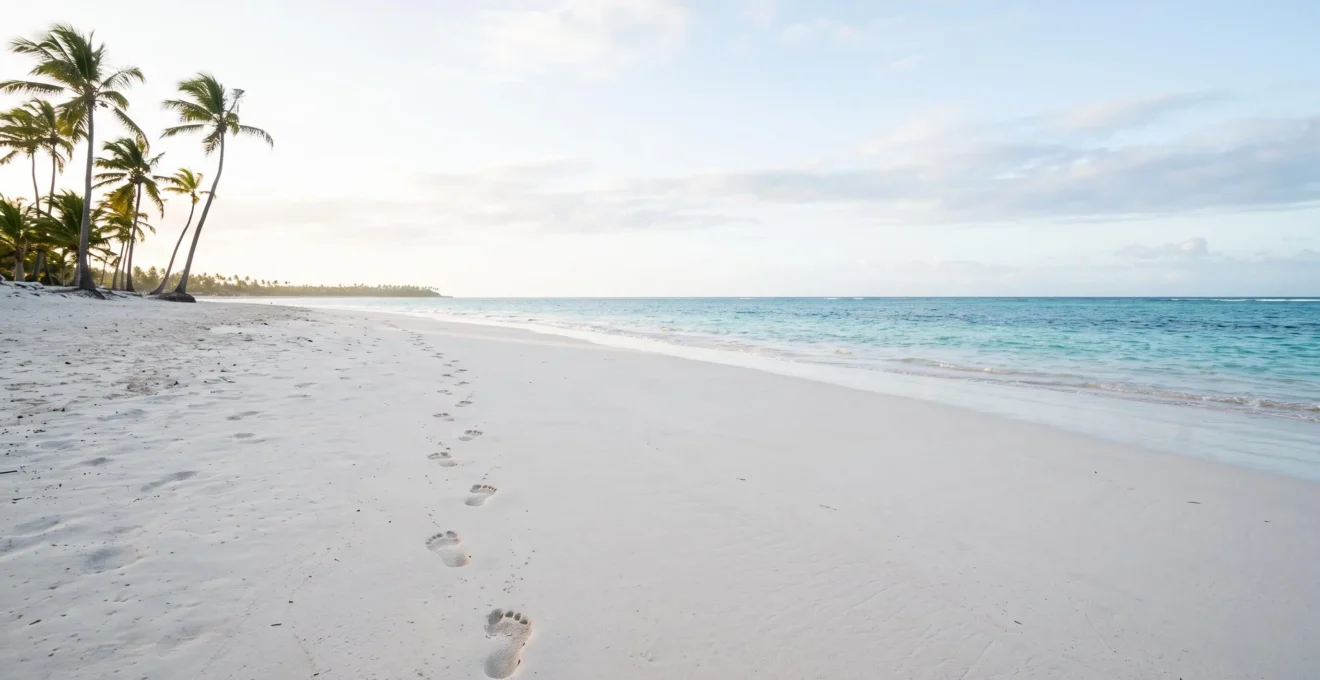
The common belief that Bavaro Beach is one uniform stretch of perfect sand is a myth; its texture is a direct result of coastal geology.
- The finest, powder-like sand accumulates in areas shielded by the offshore reef, which reduces wave energy.
- Coarser sand, rocks, and seaweed are concentrated in zones with higher exposure to ocean currents and less reef protection.
Recommendation: To find the best sand, don’t just follow hotel recommendations; learn to read the coastline’s geography and tidal patterns to locate the zones of finest sediment deposition.
For the beach purist, the dream of a Caribbean holiday is distilled into a single, perfect sensation: the feeling of sinking your bare feet into soft, cool, powder-fine sand. You imagine long, uninterrupted walks along the water’s edge, the shoreline a seamless ribbon of white against the turquoise sea. Bavaro Beach, with its legendary 20-kilometre expanse, is marketed as the epicentre of this dream. Yet, for the discerning visitor, the reality can be jarring. One section offers the promised silken texture, while just a few hundred metres down, the ground underfoot becomes coarse, littered with sharp coral fragments, or choked with a thick line of sargassum.
Most guides will offer vague advice, suggesting « resort A has a better beach than resort B » or simply « watch out for seaweed. » This advice misses the fundamental point. The quality of sand along Bavaro Beach is not a matter of luck or hotel maintenance alone; it is a direct consequence of coastal dynamics, sedimentology, and the powerful, invisible influence of the offshore reef. Understanding these forces is the key to unlocking the perfect barefoot experience.
This is not a guide about which hotel to book. This is a coastal geologist’s analysis of the Bavaro shoreline. We will dissect the coastline to understand why the sand quality changes so dramatically from one section to another. We will identify the precise characteristics of the powder-fine hotspots and pinpoint the zones where barefoot comfort is compromised. By learning to read the beach’s natural signals—from wave patterns to tidal flats—you can move beyond the marketing brochures and find the pristine, untouched sand you came for.
This detailed analysis will equip you with the knowledge to navigate the entire coastline like an expert, ensuring every barefoot step is on the softest, cleanest sand Bavaro has to offer. Discover the science behind the perfect beach and how to apply it to your next Dominican escape.
Summary: A Geologist’s Guide to Bavaro Beach Sand
- Why Is Sand Coarser and Rocky at Some Bavaro Beach Sections Versus Others?
- How to Find the Exact Bavaro Beach Spots With Powder-Fine White Sand?
- Bavaro, Macao, or Juanillo: Which Punta Cana Beach Has the Softest Sand?
- The Bavaro Beach Zones Where Rocks and Seaweed Ruin Barefoot Comfort
- When Does Low Tide Reveal Bavaro’s Firmest Sand for Morning Beach Walks?
- The Seaweed Problem That Ruins 40% of Dominican Beach Photos
- How Does Minitas Sand Compare to Punta Cana’s Public Beaches?
- Why Is Playa Minitas Considered the Dominican Republic’s Most Exclusive Beach?
Why Is Sand Coarser and Rocky at Some Bavaro Beach Sections Versus Others?
The texture of the sand under your feet is a direct geological story of its origin and journey. Bavaro’s iconic white sand is primarily biogenic, meaning it’s composed of the ground-down calcium carbonate skeletons of coral and other marine organisms. However, not all sections of the beach receive the same quality of this precious sediment. The variation is governed by two main factors: wave energy and the proximity of the offshore coral reef.
The vast coral reef system running parallel to the coast acts as a natural breakwater. In areas where the reef is close to shore and well-formed, it absorbs the brunt of the Atlantic’s wave energy. This creates a low-energy environment behind the reef, allowing the lightest, finest sand particles to settle and accumulate. The result is the soft, powder-like sand that beach connoisseurs seek. These zones are where the « grain sorting » process, driven by gentle water movement, has had the time to separate fine particles from coarse ones.
Conversely, in sections where the reef is further out, less developed, or has gaps, higher wave energy reaches the shore. This constant, powerful churning action does two things. First, it washes away the finer sand particles, leaving behind the heavier, coarser grains and small shell fragments. Second, it has enough force to carry and deposit larger, rockier debris and eroded coral chunks onto the beach. Therefore, a coarser, more granular feel is a clear indicator that you are in a higher-energy coastal zone. The presence of rocks is not random; it’s a signpost of powerful coastal dynamics at play.
How to Find the Exact Bavaro Beach Spots With Powder-Fine White Sand?
Armed with an understanding of coastal geology, you can now « read » the beach to locate the premium barefoot zones. Instead of relying on resort maps, use visual and environmental cues. The primary mission is to identify the sections of the beach enjoying the most significant reef attenuation—the calming effect of the offshore reef.
Look out at the sea. In the best sections, you will notice a distinct line of breaking white water far offshore, marking the reef’s location. The water between this line and the beach will be significantly calmer, often appearing as a placid, turquoise lagoon. This calm water is the key. It lacks the energy to suspend and carry away fine sediment, creating the perfect depositional environment for powder-fine sand. The sand in these areas will often appear brighter and whiter, a higher albedo reflecting its purity and fine grain size.
A good starting point is the central section of Bavaro Beach, particularly the areas fronting the Barceló and Lopesan resorts. This zone historically benefits from strong reef protection. As you walk, pay attention to the tactile feedback from the sand. You will physically feel the transition from soft powder to a more granular texture as you move into areas with less reef protection, particularly as you head towards the northern or southern extremities of the main Bavaro stretch.
The visual gradient from a wide, bright white beach to a narrower, darker shoreline is often visible from a high vantage point or satellite imagery. The widest and whitest sections are almost always the calmest and, therefore, the softest. Use this visual reconnaissance to plan your walk, aiming for the heart of these placid, protected zones.
Bavaro, Macao, or Juanillo: Which Punta Cana Beach Has the Softest Sand?
While Bavaro is the most famous, the wider Punta Cana region offers other celebrated beaches, each with a distinct sand character shaped by its unique geographical setting. A comparison with Macao and Juanillo Beach provides a perfect lesson in coastal sedimentology. The softness of the sand is almost always a function of exposure versus protection.
Juanillo Beach, located in the sheltered enclave of Cap Cana, is often cited as having some of the softest sand in the Dominican Republic. This is no accident. It is geographically shielded by both its bay-like shape and a robust offshore reef. This double layer of protection creates an extremely low-energy environment, allowing the finest calcium carbonate particles to settle, resulting in a texture that is consistently silken and powder-like.
Macao Beach, in contrast, is an open-ocean facing beach with significantly less reef protection. It’s renowned for its wild, natural beauty and is a popular spot for surfing precisely because it receives more direct Atlantic swell. This higher wave energy results in a coarser, more golden-hued sand. While beautiful, the sand at Macao is more granular and not as gentle for barefoot walking as the protected sections of Bavaro or Juanillo. The grains are larger and the beach slope is often steeper, a classic sign of a higher-energy coastline.
This comparative look at beach profiles, detailed in a sargassum and beach guide for the Dominican Republic, helps illustrate a key principle for sand purists.
| Beach | Reef/Bay Protection | Typical Exposure | Sand Character |
|---|---|---|---|
| Juanillo | Protected by reef and bay geography | Lower, calmer conditions | Fine, sheltered, powder-like |
| Bavaro (central) | Moderate reef break offshore | Classic Caribbean coral sand exposure | Firm, expansive at low tide |
| Macao | Open-ocean facing, less shielded | More variable, open Atlantic exposure | Wilder, coarser grain, golden hues |
The Bavaro Beach Zones Where Rocks and Seaweed Ruin Barefoot Comfort
Just as important as knowing where to go is knowing which zones to avoid for an optimal barefoot walk. The two main culprits that compromise comfort are rocky patches and sargassum accumulation. Both phenomena are predictable and concentrated in specific areas governed by currents and coastal shape.
Rocky sections are most common at the northern and southern ends of the main Bavaro stretch and near any headlands that jut into the sea. These are typically higher-energy zones where currents are stronger. These currents not only wash away fine sand but are also powerful enough to transport and deposit coral rubble and small rocks. If you find the sand becoming noticeably coarser and see an increase in shell debris, you are likely entering a zone where barefoot walking will become less pleasant.
Sargassum, a type of brown macroalgae, is a more dynamic problem. It drifts on ocean currents and can inundate beaches, creating a thick, unsightly, and often foul-smelling barrier at the waterline. While its presence varies seasonally, its accumulation is not random. Sargassum tends to collect in coves and on beaches that directly face the prevailing currents. On Bavaro, this means that some sections are chronic hotspots.
Documented Sargassum Hotspots in Punta Cana
The sargassum issue is significant enough that it has been formally tracked. A study on sargassum in the Dominican Republic noted that between 2015 and 2018, levels were monitored at 50 locations, including Punta Cana. This has prompted state institutions and hotels to develop strategies ranging from manual cleanups to deploying specialised beach-cleaning machines, demonstrating the recurring nature of the problem in specific, predictable areas.
The seaweed not only ruins the aesthetic but completely alters the texture at the shoreline, turning soft sand into a tangled, rough mat. For the barefoot walker, the « swash zone »—the area where waves wash up on the beach—becomes a no-go area.
When Does Low Tide Reveal Bavaro’s Firmest Sand for Morning Beach Walks?
Beyond geography, the single most important factor for a perfect beach walk is timing. Specifically, timing your walk with the low tide. The daily ebb and flow of the tide dramatically transforms the beach, creating a temporary paradise for walkers. At low tide, a wide, firm, and perfectly flat expanse of sand is revealed—the tidal flat.
This surface is ideal for walking for several reasons. The sand is compacted by the weight of the receding water, creating a firm but forgiving surface that is easy on the joints. This is a stark contrast to the soft, deep, and often-sloped dry sand higher up the beach, which can be tiring to walk on. Furthermore, the newly washed sand of the tidal flat is clean, cool, and free of the day’s debris. For morning walkers, this is the most pristine surface the beach will offer all day.
Predicting the low tide is simple science. You can consult local tide charts online, which provide precise times for high and low tides each day. These charts also include a « tidal coefficient, » a number that indicates the amplitude of the tide. For instance, tide charts for Punta Cana might show a low tidal coefficient, meaning the difference between high and low tide is minimal. A high coefficient, often found around the new and full moons (spring tides), means a much larger tidal range and an even wider, more expansive firm-sand walking path at low tide.
Your Action Plan: How to Time a Morning Walk Around Punta Cana’s Low Tide
- Check the day’s predicted low tide time and height using a Punta Cana tide chart before heading to the beach.
- Note that predictions near Punta Cana rely on the nearest tide gauge station, so times can shift slightly depending on the exact beach section.
- Cross-reference the moon phase; spring tides near new or full moons create a larger tidal range and a wider firm-sand zone.
- Plan to arrive at the shoreline shortly before the predicted low tide peak to walk the widest strip of firm, compact sand.
The Seaweed Problem That Ruins 40% of Dominican Beach Photos
While often downplayed in travel brochures, the influx of sargassum is a significant environmental and aesthetic issue affecting much of the Caribbean, including the Dominican Republic. For a beach purist focused on clean sand and clear water, it’s a factor that cannot be ignored. The visual impact is immediate: the idyllic transition from white sand to turquoise water is replaced by a thick, brown line of decaying algae.
The problem extends beyond looks. As it decomposes on the shore, sargassum can release hydrogen sulfide, producing a distinct and unpleasant « rotten egg » smell. This makes lounging near the waterline unbearable. Furthermore, massive quantities of seaweed in the nearshore waters can make swimming and snorkelling difficult and unappealing. It fundamentally alters the beach experience from a pristine natural escape to a confrontation with a large-scale algae bloom.
While cleanup efforts are extensive, with many resorts employing daily removal teams and machinery, they can be overwhelmed during major influx events. The effectiveness of these cleanups varies drastically. Some high-end resorts may maintain a nearly pristine beachfront, while public access areas or less-resourced hotel frontages may struggle to keep up. This creates a patchwork of cleanliness along the coast, where a short walk can take you from a manicured beach to one heavily impacted by sargassum.
Therefore, a key part of planning a beach-focused trip is to be aware of the sargassum season, which typically peaks in the warmer months. Checking recent visitor photos and online beach webcams can provide a more accurate, real-time picture of the situation than official marketing materials.
How Does Minitas Sand Compare to Punta Cana’s Public Beaches?
For those seeking to bypass the geological lottery of public beaches entirely, the Dominican Republic offers a different model: the private, perfectly-manicured resort beach. Playa Minitas, the exclusive beach of the Casa de Campo resort in La Romana, is the archetype of this approach. Comparing it to Bavaro reveals a fundamental difference in philosophy: natural, dynamic coastline versus a controlled, curated environment.
The sand at Minitas is soft and clean not because of favourable natural geology, but because of constant, meticulous maintenance. It is a man-made beach, supplemented with imported sand and groomed daily to remove any imperfections, be it seaweed, pebbles, or other debris. The environment is entirely controlled. There are no public vendors, crowds are kept to a minimum, and the sargassum that plagues other coasts is often stopped by offshore barriers or removed before it can even touch the sand.
This perfection comes at a cost and is defined by exclusivity. Access is restricted to Casa de Campo resort guests, villa owners, or those willing to pay for a day pass. For non-resort visitors, access can involve a fee of around $50 per person, and that’s before considering the cost of getting there. The experience is less about discovering a natural wonder and more about enjoying a flawless, service-driven amenity. The following table breaks down the core differences in experience.
| Factor | Playa Minitas (Casa de Campo) | Public Bavaro Beach |
|---|---|---|
| Access | Restricted to resort guests, villa renters, or paid day-pass holders | Open to the public, free access |
| Cost | Resort stay or non-resident entry fee required | No entry cost |
| Maintenance | Daily private grooming, no vendors, minimal seaweed | Varies by resort frontage and public-access zones |
| Crowd Density | Low, controlled environment | Higher near public access points |
Ultimately, the choice between Minitas and Bavaro is a choice between two different types of luxury: the predictable, flawless perfection of a private club, or the rewarding challenge of finding natural perfection on a vast, public coastline.
Key Takeaways
- Sand quality on Bavaro Beach is not uniform; it’s determined by the proximity and integrity of the offshore coral reef.
- The softest, powder-fine sand is found in low-energy zones with significant reef protection, typically in the central part of Bavaro.
- Timing your walk with the low tide reveals the widest, firmest, and cleanest surface for optimal barefoot comfort.
Why Is Playa Minitas Considered the Dominican Republic’s Most Exclusive Beach?
Playa Minitas’ reputation as the country’s most exclusive beach is built on a foundation of controlled access, immense privacy, and its integration into one of the most luxurious real estate and resort developments in the Caribbean: Casa de Campo. Its exclusivity is not just about the quality of the sand, which is artificially maintained, but about the entire ecosystem of luxury that surrounds it.
First and foremost, exclusivity is enforced through a strict access protocol. Minitas Beach is not a public space; it is a private amenity for the resort’s clientele. This creates a « private sanctuary » atmosphere, as described by the resort itself, free from the crowds, vendors, and general unpredictability of a public beach. It’s an environment engineered for tranquility and service, where the beach experience is just one part of a larger, high-end hospitality package that includes world-class golf, marinas, and fine dining.
Second, this exclusivity is reflected in and reinforced by the surrounding real estate values. The cost of entry, whether as a hotel guest or a villa owner, is exceptionally high. Vacation rentals in the vicinity are a testament to this, with analysis showing that rates for vacation rentals near Playa Minitas range from $1,100 to $9,360 per night. This financial barrier ensures that the beach remains an uncrowded haven for a very specific demographic. It’s a space where privacy is the ultimate luxury, and the price tag guarantees it.
Playa Minitas is therefore less a beach and more a brand statement. It represents a version of the Caribbean dream where nature is not just appreciated, but perfected, managed, and offered as a premium, members-only service. This controlled perfection, shielded from the public and priced for the elite, is the true source of its exclusive status.
Now that you can distinguish between the wild, natural perfection of a geologically superior public beach and the curated flawlessness of an exclusive one, you are equipped to make an informed choice that aligns with your personal definition of the perfect beach holiday.