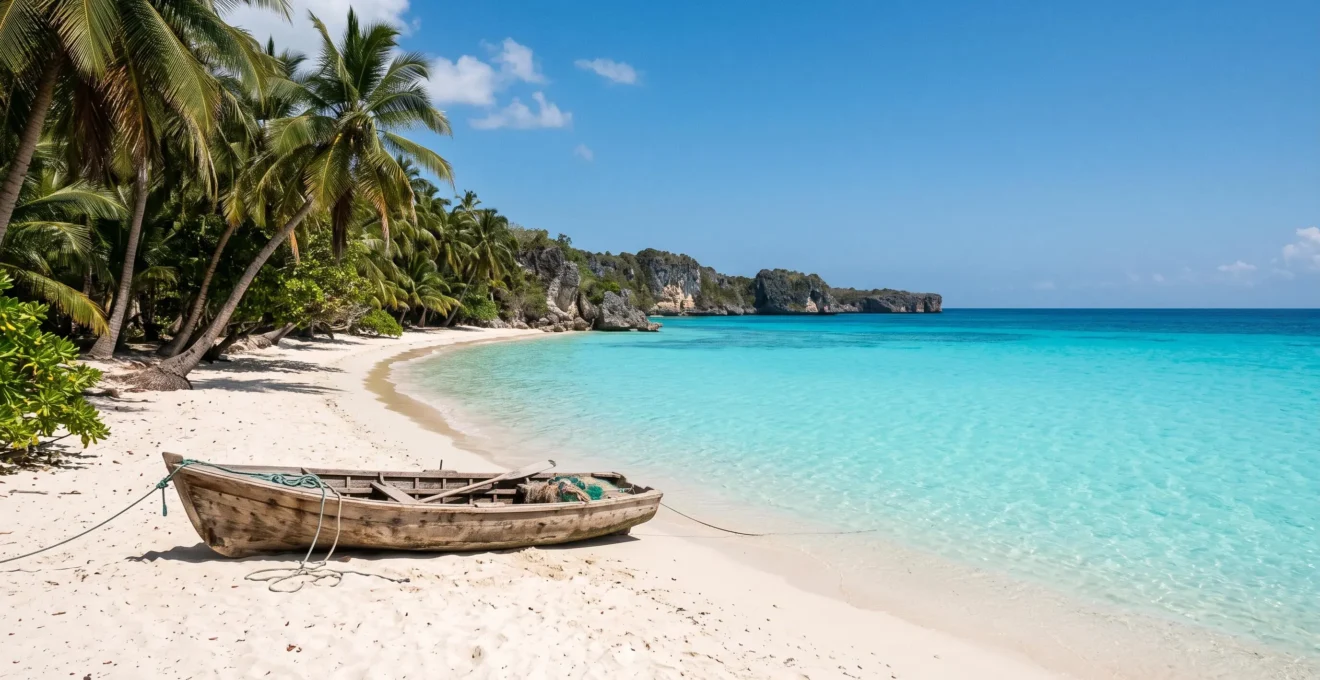
You’ve seen the postcard photos, but the reality of Dominican beaches is that vibrant turquoise water isn’t a given—it’s a science. Contrary to marketing hype, the most stunning water colour isn’t just about location; it’s a precise combination of a white sand « canvas, » specific water depth, and calm atmospheric conditions. This guide moves beyond generic lists to teach you the visual cues and environmental factors, empowering you to find genuinely pristine water and sidestep the over-marketed disappointments.
For any UK traveller dreaming of the Caribbean, the image is crystal clear: a stretch of powder-white sand meeting an impossibly turquoise sea. You’ve scrolled through hundreds of photos, each promising a slice of paradise in the Dominican Republic. But a nagging question remains: will the beach you book actually look like the brochure? The travel industry is filled with idyllic shots, but the on-the-ground reality can sometimes involve murky water, crowds, or unexpected seaweed.
The common advice is to simply pick a highly-rated beach in Punta Cana and hope for the best. You might read about popular spots like Bavaro Beach or take a chance on an excursion to Isla Saona. But this approach leaves too much to chance. What if the key to finding that authentic, soul-stirring turquoise wasn’t just about picking a name from a list, but about understanding the very optics of the water itself? What if you could learn to predict where and when the most vivid colours will appear?
This is where we move beyond the tourist map. As a specialist who has photographed over a hundred beaches across the island, I can tell you that the most breathtaking turquoise is a predictable phenomenon. It’s born from a unique interplay between geology, light, and weather. This guide will not just list beaches; it will deconstruct the very formula for perfect Caribbean water. We’ll explore the science behind water colour, the crucial difference between regions, and the environmental factors like wind and sargassum that can make or break your postcard moment. You’ll learn to see the coast not as a tourist, but as a connoisseur of clarity.
By understanding these core principles, you’ll be equipped to make an informed choice, ensuring the beach you select delivers on its promise of authentic, mesmerising turquoise waves.
Summary: Finding Your Perfect Dominican Beach
- Why Do Some Dominican Beaches Have Brown Water While Others Are Turquoise?
- How to Capture the Most Vivid Turquoise Water Colour at Dominican Beaches?
- Punta Cana or Samaná: Which Has the Clearest Turquoise Caribbean Waves?
- The Seaweed Problem That Ruins 40% of Dominican Beach Photos
- When Do Dominican Beaches Show Their Calmest, Clearest Turquoise Colour?
- How to Find the Exact Bavaro Beach Spots With Powder-Fine White Sand?
- How to Spot Fake « Reef-Safe » Claims on Sunscreen Labels?
- Which Punta Cana All-Inclusive Resort Matches Your Relaxation Style?
Why Do Some Dominican Beaches Have Brown Water While Others Are Turquoise?
The iconic turquoise hue of Caribbean water isn’t magic; it’s a matter of water optics. The colour you see is determined by how sunlight interacts with the water and, most importantly, what lies beneath it. Pure water absorbs longer wavelengths of light (reds, oranges, yellows) and reflects shorter ones (blues, greens). When this light hits a shallow, bright white seabed made of calcium carbonate sand, the effect is amplified. The sand acts like a brilliant geological canvas, reflecting the blue-green light back up through the water, creating the vibrant turquoise shade.
Conversely, beaches with darker, murky, or brownish water often have a different underwater landscape. This can be caused by several factors:
- River Estuaries: Nearby rivers carry dark sediment and tannins from decaying vegetation into the sea, staining the water.
- Seabed Composition: A darker, muddier, or rockier seabed absorbs more light instead of reflecting it, resulting in a less vibrant, deeper blue or even brown appearance.
- Water Depth: In very deep water, more light is absorbed, and the colour shifts to a dark, inky navy blue.
This explains why a single coastline can have drastically different water colours. A protected cove with a pristine coral sand base will glow, while a bay near a river mouth will appear dull. The health of the coastal ecosystem is also a critical factor. For instance, the official tourism board points to Playa Bávaro, where turquoise waters and a protected coral reef create a perfect synergy. The reef acts as a natural barrier, keeping the water calm and clear, and constantly produces the white sand needed for that radiant colour. It’s a perfect case study in how a healthy reef sustains the very visual appeal that draws travellers in.
As this visual contrast shows, the shoreline’s geology is the primary determinant of water colour. A beach’s beauty is literally built from the ground up, starting with the composition of its seabed. Understanding this principle is the first step to identifying beaches that have the raw materials for a truly turquoise experience.
How to Capture the Most Vivid Turquoise Water Colour at Dominican Beaches?
Seeing that perfect turquoise is one thing; capturing it in a photo that does it justice—or simply experiencing it at its peak vibrancy—requires understanding another key element: light. The most brilliant colour appears when the sun is high in the sky, typically between 10 AM and 3 PM. During these hours, sunlight penetrates the water most directly, illuminating the white sand seabed and creating maximum light reflection. In the early morning or late afternoon, the angled light reflects more off the water’s surface, muting the colours below.
The clarity and depth of the water are just as crucial. Shallow water allows more light to reach the sandy bottom and bounce back. This is why some of the most photogenic spots in the Dominican Republic are not deep swimming areas but vast, shallow sandbars and calm bays. These locations act as natural infinity pools, their entire expanse glowing with an almost supernatural light.
A prime example of this phenomenon is Isla Saona. It is widely considered a photographer’s dream precisely because of its unique underwater topography. As Royal Caribbean highlights, Isla Saona is a tropical paradise with bright white sand and waist-deep turquoise water. This vast, shallow, and uninterrupted white seabed is the perfect natural amplifier for sunlight. The light doesn’t have to travel far, it hits a perfectly reflective surface, and the result is the most saturated, vivid turquoise imaginable. It’s a real-world demonstration of the « geological canvas » theory in action, making it one of the most reliable destinations for travellers seeking that picture-perfect moment.
Therefore, to find the most intense colours, you should seek out beaches known for their extensive shallow areas and plan your visit for the middle of the day. This simple timing strategy ensures you see the beach’s water optics performing at their absolute peak.
Punta Cana or Samaná: Which Has the Clearest Turquoise Caribbean Waves?
When choosing a base in the Dominican Republic, travellers often face a choice between two iconic but very different regions: the resort-heavy coast of Punta Cana and the wild, verdant peninsula of Samaná. Both offer stunning turquoise water, but they deliver it in completely different contexts. Your choice depends on whether you prefer « accessible turquoise » or « wild turquoise. »
Punta Cana, and its upscale neighbour Cap Cana, excel at providing manicured, easily accessible beaches with reliably calm and clear water. These are the shores you see in resort brochures—long, sweeping stretches of sand lined with palm trees and all-inclusive hotels. The water here is often protected by the long offshore reef, making it ideal for swimming and relaxation. This is the heart of « accessible turquoise. »
The Samaná Peninsula, in contrast, offers a more adventurous and dramatic experience. Its coastline is punctuated by secluded coves, dramatic cliffs, and lush hills that tumble down to the sea. Reaching its best beaches, like the famed Playa Rincón, often requires a boat trip or a drive down rural roads. This is « wild turquoise »—raw, untouched, and rewarding for those willing to explore. For the ultimate purist, however, the country’s undisputed champion of clarity is found in the remote southwest. The official tourism authority describes Bahía de las Águilas as recognized as the most beautiful beach in the Dominican Republic, boasting crystal clear turquoise waters with a five-mile stretch of diamond-white sand completely free of hotels or shops. It’s the insider’s choice for pristine, untouched beauty.
This table breaks down the fundamental differences between the main regions, helping you match a destination to your travel style.
| Region | Signature Beaches | Water Character | Access Profile |
|---|---|---|---|
| Punta Cana / Cap Cana | Playa Blanca, Isla Saona | Calm, transparent turquoise, excellent swimming | Boat access or resort-adjacent, highly maintained |
| Dominicus / La Romana area | Dominicus Beach | Clean sand, calm seas, Blue Flag certified | Resort-adjacent, easy access |
| Samaná Peninsula | Playa Rincón | Lush, dramatic, secret-feeling coves | Requires hiking or boat trip, more exposed bays |
Ultimately, there is no single « best » region. The decision comes down to your priorities: do you want the convenience and reliable calm of the Punta Cana area, or the breathtaking, secluded beauty of Samaná’s hidden gems? Both offer world-class turquoise, just with a different journey to get there.
The Seaweed Problem That Ruins 40% of Dominican Beach Photos
Let’s be honest: nothing shatters the turquoise dream faster than arriving at a beach choked with thick, brown mats of sargassum seaweed. This is the sargassum reality, a major ecological challenge across the Caribbean that marketing materials rarely show. Once a seasonal occurrence, massive blooms have become more frequent and intense. In fact, scientists tracking the phenomenon are concerned about the growing scale; one recent report noted that in a single year, a record amount of Atlantic sargassum was detected, signalling a trend that is not going away. As one scientist grimly noted in an interview with ABC News, after a period of calm, the seaweed « came out of the drought with a vengeance. »
Sargassum typically affects the eastern and southern coasts of the Dominican Republic, which face the open Atlantic and Caribbean Sea where the blooms originate. The northern coast is often, but not always, less affected. The worst months are generally from late spring to late summer (April to September), but significant events can happen outside this window. When it washes ashore, it can pile up several feet high, decompose with an unpleasant smell, and turn the near-shore water brown, completely ruining the turquoise aesthetic.
However, you are not powerless against it. Proactive monitoring can help you anticipate conditions and adjust your plans. Instead of just hoping for the best, you can use scientific tools and direct inquiry to significantly reduce your risk of a sargassum-spoiled holiday.
Your Action Plan: How to Proactively Track Sargassum
- Identify Official Tracking Tools: Start with the joint NOAA and University of South Florida (USF) sargassum inundation risk index. These are the primary scientific sources for forecasting.
- Check Current Satellite Maps: Visit the USF Optical Oceanography Lab’s website. They issue monthly satellite bulletins that visually track the location and density of sargassum blooms across the Atlantic.
- Analyze Historical Data: Use the forecasting tools to compare current readings against historical baselines for the same time of year. This helps you understand if the current situation is normal or an exceptional event.
- Monitor the Trend Direction: Look for patterns over several weeks. Is the sargassum concentration in your target region increasing, decreasing, or stable? A single day’s report is just a snapshot; the trend is more informative.
- Inquire Directly with Resorts: Before booking, email the resort and ask pointed questions: « What is your specific sargassum cleanup protocol? » and « Do you have floating barriers in place? » Their answer (or lack thereof) reveals how prepared they are.
By treating sargassum as a predictable factor rather than a random misfortune, you can take control and make smarter decisions about where and when you travel.
When Do Dominican Beaches Show Their Calmest, Clearest Turquoise Colour?
Beyond the threat of sargassum, the second major atmospheric factor controlling the « look » of the water is wind. A strong onshore wind whips up the surface, creating waves and chop that scatter light and churn up sand from the seabed. This reduces water clarity and dulls the turquoise glow. Conversely, a calm day with little to no wind allows the water to settle into a glassy, transparent state, offering a perfectly clear view of the sandy bottom below. This is when the water optics are at their most spectacular.
The key to finding this atmospheric calm is understanding the difference between windward and leeward coasts. The Dominican Republic is a large island, and the wind almost always blows from a prevailing direction (typically from the east). This means that on any given day, one side of the island will be windy (the windward coast), while the opposite side will be sheltered and calm (the leeward coast).
You can use this to your advantage by checking daily marine forecasts. Modern tools allow you to:
- Consult a dedicated marine forecast tool like Windfinder, which provides detailed wind, wave, and weather predictions.
- Check forecasts multiple times a day, as they are refreshed every six hours for up to ten days out.
- Note the wind direction on the map; the arrows show which coast will be exposed and which will be sheltered.
- Match the forecast to your beach choice. For example, a strong east wind hitting Punta Cana’s coast might mean the south-facing beaches near La Romana are perfectly calm.
For travellers who want to minimize the gamble altogether, some beaches are naturally more protected than others. Dominicus Beach, located on the southern coast near La Romana, is a prime example. It holds a Blue Flag certification, known for clean sand and calm seas. Its geographical orientation often shelters it from the strongest trade winds, making it a reliable bet for calm, clear water when other parts of the island might be choppy. Choosing a beach based on its orientation and the daily wind forecast is a pro-level move for guaranteeing that serene, mirror-like surface.
How to Find the Exact Bavaro Beach Spots With Powder-Fine White Sand?
Bavaro Beach is arguably the most famous stretch of coastline in the Dominican Republic, but « Bavaro » is a vast area, not a single monolithic beach. The quality of the sand can vary significantly along its length. While most of it is beautiful, true connoisseurs seek out the specific spots known for having the most powder-fine, talcum-like white sand. This premium sand quality not only feels better underfoot but also enhances the water’s turquoise hue by providing a brighter, more reflective canvas.
The most coveted sand is often found in the more exclusive or protected areas. The southern end of the greater Punta Cana area, in the gated community of Cap Cana, is particularly renowned for its sand quality. While much of this area is private, there are still publicly accessible points that offer a taste of this luxury. Juanillo Beach is a perfect example. Even though it sits beside luxury properties, it remains open to the public and is celebrated for its exceptional sand. Travel bloggers often note that its soft, powdery sand and shallow turquoise waters make it a top choice, especially for families who appreciate the gentle entry into the sea.
To help you navigate the options, it’s useful to compare the different sand profiles in the broader Bavaro region. While some beaches are known for classic white sand, others, like Playa Dorada on the north coast, have a distinct golden hue.
| Beach | Sand Description | Water Character |
|---|---|---|
| Playa Dorada | Golden, glistening sand | Calm turquoise waters |
| Playa Juanillo | Fine white sand bordered by greenery | Serene turquoise, publicly accessible |
| Bavaro Beach | Breathtakingly clean, white sandy stretch | Crystal-clear, palm-lined shore |
For travellers based in the Bavaro resort strip, the best strategy is to walk the shoreline. Head south towards the Cap Cana area or north towards Macao. You’ll often find that the sand becomes finer and less crowded as you move away from the main resort hubs. Seeking out these specific zones of powdery sand is the final touch in curating the ultimate Dominican beach experience.
Key Takeaways
- Authentic turquoise water is a science, not a lottery. It depends on a shallow, white-sand seabed to reflect blue-green light.
- Environmental factors are critical. Check sargassum forecasts before you book and check daily wind direction to find the calmest, glassiest water.
- Location dictates the experience. Choose the resort-heavy Punta Cana coast for « accessible turquoise » or the remote Samaná and southwest regions for « wild turquoise. »
How to Spot Fake « Reef-Safe » Claims on Sunscreen Labels?
Once you’ve found your perfect turquoise sanctuary, the next step is to help protect it. The same coral reefs that create the white sand and calm waters are incredibly vulnerable to chemical pollution from sunscreens. This has led to a surge in products labelled « reef-safe, » but this term is dangerously unregulated. Many brands use it as a marketing buzzword without adhering to any scientific standard.
The core of the problem is the lack of a legal definition. As one leading scientist in the field, Craig Downs, PhD, states, « Without a legal definition, consumers are being misled into purchasing products that contain ingredients proven to be damaging in aquatic ecosystems. » Many brands simply remove one or two well-known harmful chemicals like oxybenzone and call their product « reef-safe, » while still including other damaging ingredients.
So, how can you make a genuinely responsible choice? You need to look past the marketing claims on the front of the bottle and become an ingredient detective. Here’s what to look for:
- Look for Mineral-Based Formulas: True reef-safe sunscreens use non-nano zinc oxide or titanium dioxide as their active ingredients. These are physical blockers that sit on top of the skin rather than chemical blockers that are absorbed.
- Avoid the « Awful Eight »: Steer clear of products containing oxybenzone, octinoxate, octocrylene, PABA, parabens, triclosan, and any form of microplastic spheres or beads. Remember, « oxybenzone-free » is not enough.
- Favor Short Ingredient Lists: The best and safest formulas often have very few ingredients. The top-rated option in independent lab testing, for example, contains just four ingredients and provides excellent water resistance.
- Seek Third-Party Certification: The most rigorous standard currently available is the « Protect Land + Sea » certification from the Haereticus Environmental Laboratory. While few brands meet this high bar, those that do are a reliable choice.
By choosing a truly reef-safe, mineral-based sunscreen, you are taking a crucial step in preserving the very underwater ecosystem that creates the beautiful turquoise water you travelled so far to see.
Which Punta Cana All-Inclusive Resort Matches Your Relaxation Style?
Choosing the right all-inclusive resort is the final piece of the puzzle, and it’s about more than just amenities—it’s about matching the resort’s beach « personality » to your ideal holiday. The vast Punta Cana coastline is not uniform; it’s a collection of micro-environments, each offering a different vibe. Understanding these archetypes is key to finding your perfect match.
Are you seeking a quiet, exclusive escape, or a vibrant social scene with endless activities? The character of the beach right outside your hotel room will define your daily experience. A resort on a lively, crowded stretch of Bavaro Beach will feel completely different from one tucked away in a serene corner of Cap Cana.
This table outlines the main beach archetypes along the coast to help you align your choice with your relaxation style.
| Archetype | Representative Beach | Typical Vibe |
|---|---|---|
| The Private Fortress | Juanillo Beach, Cap Cana | Less crowded, family-friendly, powdery sand |
| The Social Hub | Bavaro Beach | Lively, watersports, dense resort strip |
| The Scenic Favorite | Macao Beach, Punta Cana | Wide open, natural charm, popular with surfers |
Beyond the vibe, there’s a critical, practical question you must ask any potential resort, tying directly back to the sargassum problem: « What is your cleanup strategy? » The battle against sargassum has created a regional « arms race » among hotels. As tourism authorities note, much of the burden falls on hotels, and the most proactive ones invest heavily in daily cleanup crews and expensive floating barriers to protect their shoreline. Others do the bare minimum. A resort’s investment in sargassum defense is a powerful indicator of its overall commitment to guest experience. A resort that can give you a clear, confident answer about its sargassum protocol is one that takes your turquoise-water dream seriously.
By combining your understanding of water optics, environmental factors, and beach archetypes, you can now select a resort with the confidence that it aligns perfectly with your vision of a Caribbean paradise. Your perfect beach day is no longer a matter of luck, but a result of informed, strategic choices.