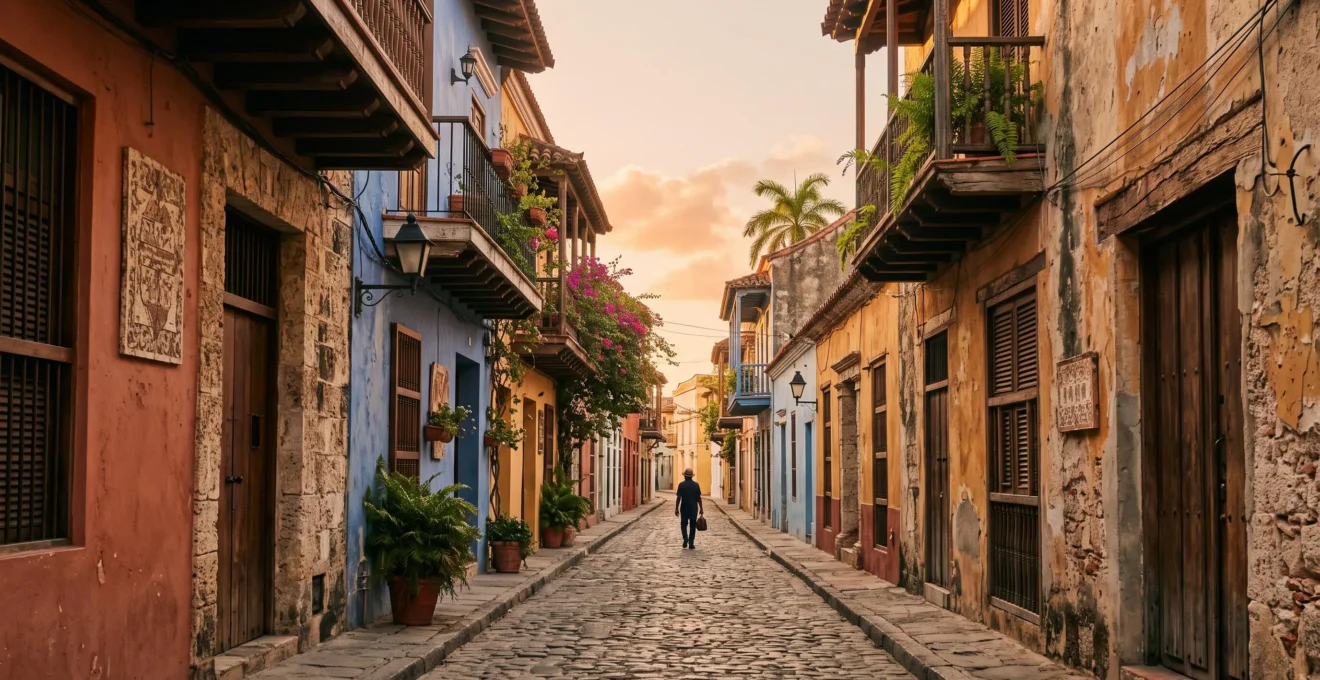
To truly understand Santo Domingo, you must learn to read its architecture as a historical text, not just visit a checklist of sites.
- The city’s history is layered, with 16th-century Spanish Gothic structures forming the base for later additions and contrasting with 20th-century districts like Gazcue.
- Authenticity lies in understanding the materials (like coral limestone), identifying key structural markers, and appreciating both restored and « lived-in » buildings.
Recommendation: Use the architectural features—from Gothic arches to Art Deco lines—as a guide to peel back the layers of the city’s past, turning your visit into a historical investigation.
For the discerning history enthusiast, a trip to Santo Domingo promises a journey to the very genesis of European presence in the Americas. Yet, many visitors leave with little more than a collection of photos of the same key monuments, following a well-trodden path through the Zona Colonial. They see the cathedral, the fortress, and the colonial-era homes, but they often miss the story the city is telling. The common advice to « wear comfortable shoes » and « see the main sights » treats the city like a museum, a static collection of artifacts to be ticked off a list. This approach overlooks the dynamic, living history embedded in the very fabric of its buildings.
But what if the city wasn’t just a collection of sights, but an architectural palimpsest—a manuscript where centuries of history have been written, erased, and rewritten? The real key to unlocking Santo Domingo’s past isn’t about seeing more buildings, but about seeing them differently. It’s about learning to read the material vernacular, to distinguish a 16th-century Isabelline Gothic arch from a 19th-century Republican addition, and to understand why the layout of a courtyard house reveals so much about colonial society. This guide is designed for the traveler who wants to move beyond the superficial tour and engage in an architectural dialogue with the city.
We will delve into the foundational importance of Santo Domingo, compare its historic districts to understand its evolution, and provide you with the tools to identify the chronological markers in its architecture. We will also uncover practical tips on how to experience the area more authentically, from dining to timing your visit. By the end, you won’t just have seen Santo Domingo; you will have begun to understand the intricate narrative written in its stone and plaster.
This article provides a structured path to understanding the city’s architectural DNA. The following sections will guide you from the city’s foundational history to the specific details that reveal its layered past.
Summary: A History Enthusiast’s Guide to Santo Domingo’s Architectural Soul
- Why Is Santo Domingo Considered the Americas’ First Permanent European Settlement?
- Zona Colonial, Gazcue, or Ciudad Nueva: Which Santo Domingo District Reveals Deepest History?
- How to Distinguish 16th-Century Spanish Colonial Buildings From Later Additions?
- The Zona Colonial Dining Mistake That Costs Tourists Double Local Prices
- When Is Zona Colonial Least Crowded by Cruise Tourists?
- Why Did Zona Colonial Receive UNESCO World Heritage Recognition in 1990?
- Where Can You See the Most Authentic Spanish Colonial Architecture in the Dominican Republic?
- Which Zona Colonial Buildings Are UNESCO-Listed and Why Do They Matter?
Why Is Santo Domingo Considered the Americas’ First Permanent European Settlement?
Santo Domingo’s claim as the « first » city in the Americas isn’t just a marketing slogan; it represents a pivotal shift in the Spanish colonial project from fragile exploration to permanent administration. While earlier settlements existed, like La Isabela further up the coast, they were short-lived and ultimately failed. Santo Domingo, founded in 1496 by Bartholomew Columbus, was the first to achieve permanence and become the blueprint for colonial urbanism in the New World. It was here that the Spanish Crown established the institutions that would govern its burgeoning empire.
The key to this permanence was the establishment of formal, durable administrative structures. A prime example is the Museo de las Casas Reales. Its story illustrates this transition perfectly; the original structure was built shortly after Nicolás de Ovando moved the city to the Ozama River’s west bank after a devastating hurricane in 1502. The swift construction and its role as the seat of the Royal Audiencia (the first high court in the Americas) demonstrate a clear intent to create a lasting administrative nerve center. This focus on building a durable capital, as detailed in a historical overview of the Casas Reales complex, marked the transition from a temporary foothold to a permanent seat of power.
This institutional foundation is what separates Santo Domingo from its predecessors. It wasn’t just a place to live; it was the first city where a cathedral, a hospital, a university, and a customs house were planned and built as the cornerstones of a European-style society. This model of urban and institutional development, born in Santo Domingo, would be replicated across the continent for centuries, solidifying its status as the genuine starting point of permanent European colonization in the Americas.
Zona Colonial, Gazcue, or Ciudad Nueva: Which Santo Domingo District Reveals Deepest History?
While the Zona Colonial is rightly the epicentre of 16th-century history, limiting your exploration to its walled confines provides an incomplete picture of Santo Domingo’s evolution. To read the city’s full story, you must look at the adjacent neighbourhoods of Gazcue and Ciudad Nueva, which act as sequels to the colonial core’s original narrative. Each district reveals a distinct and equally important layer of the city’s architectural and social palimpsest.
The Zona Colonial is the cradle, representing the initial burst of Spanish imperial power. Its `traza`, or grid plan, and its Isabelline Gothic structures speak of a society built on order, defence, and faith. This is where you find the deepest roots of the Americas’ colonial history. However, Ciudad Nueva, which developed just outside the western wall, tells the story of the city’s 19th-century expansion and the emergence of a Dominican merchant class. Its architecture is more modest and vernacular, reflecting a different social and economic reality.
The most dramatic contrast, however, is found in Gazcue. Developed in the early 20th century, it became the preferred residential area for the nation’s elite during the Trujillo era. Its leafy streets are lined with elegant mansions that showcase a fascinating blend of architectural styles, from Neoclassical and Victorian to stunning examples of Tropical Art Deco. Exploring Gazcue reveals the story of a modernizing nation and the aesthetic tastes of its 20th-century powerful, a stark departure from the fortified, function-driven architecture of the 16th-century core. It represents a different kind of power—one based on modern wealth and politics, not colonial conquest.
How to Distinguish 16th-Century Spanish Colonial Buildings From Later Additions?
To the untrained eye, the Zona Colonial can appear as a uniform collection of « old buildings. » However, for the history enthusiast, it’s a living textbook of architectural evolution. Distinguishing the original 16th-century structures from later modifications requires looking for specific chronological markers in the materials, forms, and decorative elements. The earliest buildings carry the DNA of late Spanish Gothic and early Renaissance styles, adapted to the Caribbean environment.
The first and most telling marker is the material. The signature material of the early colonial period is coral limestone, or `piedra coralina`. This dense, fossil-rich stone was quarried locally and used for the most important constructions. Its texture, patina, and the way it has weathered over 500 years are unmistakable. Look for thick, solid walls and robust, often unadorned, archways. Another key is the architectural style. As ICOMOS noted in its evaluation for UNESCO, the city’s early buildings are a testament to the influence of the European Gothic style, particularly the « Isabelline » variant, which blends late Gothic forms with Mudéjar (Moorish) influences. Look for pointed or ogee arches and decorative details that feel more medieval than classical.
Later additions, from the 18th and 19th centuries, often use different materials like brick and stucco. Architecturally, they feature more classical elements: rounded arches, symmetrical facades, and wrought-iron balconies (`balcones`) characteristic of the Republican era. A classic spot to see this is on the Calle Las Damas, the oldest paved street in the Americas, where pristine 16th-century facades stand beside buildings with 19th-century modifications. By training your eye to spot these differences, you can start to peel back the layers and read the city’s timeline in its walls.
Your Field Checklist: Reading 16th-Century Colonial Architecture
- Material Check: Identify the primary construction material. Is it the textured, pockmarked coral limestone of the 16th century, or smoother stucco and brick from later periods?
- Arch Analysis: Examine the shape of arches over doorways and windows. Are they pointed or slightly flattened (Gothic/Isabelline), or are they perfectly rounded (later, Classical/Renaissance influence)?
- Wall Thickness: Observe the depth of windows and doorways. The earliest buildings, often with a defensive purpose, feature exceptionally thick, fortress-like walls.
- Fenestration and Openings: Look at the windows. Are they small, deep-set, and irregularly placed (early period), or are they larger, more symmetrical, and feature elaborate ironwork or wooden shutters (18th century and later)?
- Decorative Elements: Search for Plateresque details around portals—intricate, low-relief carvings resembling silversmith work. Their presence is a strong indicator of early- to mid-16th-century construction.
The Zona Colonial Dining Mistake That Costs Tourists Double Local Prices
After a day of architectural investigation, the allure of a picturesque dinner on the Plaza de España or Parque Colón is strong. These squares, lined with beautifully lit historic buildings, seem to offer the perfect dining experience. However, this is where the savvy traveler can make a costly mistake. The restaurants with prime locations on the main plazas almost universally cater to a captive tourist audience, and their prices reflect that. You are paying a premium for the view, and often the food quality does not match the price tag.
The most common error is to equate location with authenticity. While the setting is historic, the menus are often internationalized, and the experience can feel generic. The true flavour of Dominican cuisine and the city’s local life is found just a few streets away. The principle of looking deeper, which applies to architecture, is just as relevant to dining. The goal is to escape the « tourist bubble » that exists within a one-block radius of the main squares.
The solution is simple: walk two blocks in any direction away from the plaza. Venture down the quieter, less-trafficked side streets. Here you will find smaller, often family-run restaurants and `colmados` (corner stores that often serve simple, delicious meals) where local office workers and residents eat. The prices are often half of what you would pay on the plaza, and the food is far more representative of authentic Dominican fare. Look for places with hand-written menus or a crowd of locals at lunchtime. By making this small effort, you not only save money but also exchange a manufactured tourist experience for a genuine slice of Santo Domingo life.
When Is Zona Colonial Least Crowded by Cruise Tourists?
The charm of the Zona Colonial’s narrow, cobbled streets can be quickly diminished when thousands of people descend upon them simultaneously. A major factor in the ebb and flow of crowds is the cruise ship schedule. Santo Domingo is a popular port of call, and the arrival of a large ship can transform the district from a tranquil historic site into a bustling tourist hub in a matter of hours. Understanding this dynamic is key to planning a more contemplative and enjoyable visit.
The impact of a single ship is significant. For instance, a vessel like the Costa Fascinosa can disembark over 3,617 passengers in a single morning. A large portion of these passengers head directly for the Zona Colonial on organized shore excursions. These groups typically move along a predictable route, visiting the main highlights between approximately 9:00 AM and 3:00 PM on port days. This creates a noticeable « human tide » that peaks mid-day.
To avoid the crush, the strategy is twofold. First, check the port schedule online before your visit to see which days ships are docked. If your schedule is flexible, choose a day with no ships or smaller vessels. Second, if you must visit on a cruise day, structure your time to swim against the tide. Use the peak hours (9 AM – 3 PM) to explore the outer edges of the Zona Colonial or visit the adjacent districts of Gazcue or Ciudad Nueva. The main plazas and landmark interiors will be most crowded during this time. Plan to visit the most popular sites like the Cathedral and Fortaleza Ozama either early in the morning (before 9 AM) or late in the afternoon (after 3:30 PM), after the majority of tour groups have returned to their ships. This simple temporal shift can dramatically improve your experience, allowing you to appreciate the historic atmosphere without the crowds.
Why Did Zona Colonial Receive UNESCO World Heritage Recognition in 1990?
The 1990 inscription of the Colonial City of Santo Domingo on the UNESCO World Heritage List was a formal international recognition of its « Outstanding Universal Value. » This designation is not merely an honorific; it is based on specific criteria that affirm the city’s unparalleled role in world history. UNESCO’s decision was rooted in the fact that Santo Domingo was the site of the first cathedral, hospital, customs house, and university in the Americas, and its urban layout became the model for nearly all new town planners in the New World.
The core of the recognition rests on two main criteria. Firstly, the city represents a masterpiece of human creative genius, being the first tangible expression of a European-style grid-plan city in the Americas. This `traza`, or grid, laid down by Governor Nicolás de Ovando in 1502, was a deliberate act of urban planning that would be copied for centuries. Secondly, the site exhibits an important interchange of human values, having been the first seat of Spanish power in the New World and the gateway for the dissemination of European culture, architecture, and religion across the continent.
The physical area recognized by UNESCO is substantial; the inscribed site spans 106 hectares, encompassing the entire walled city and its collection of 16th-century buildings. However, this status is not without its challenges. Advisory missions from bodies like ICOMOS have highlighted the constant threat that modern development and tourism pressures pose to the site’s integrity. The recognition in 1990 was both a celebration of its past and a call to action to protect its fragile legacy, making its preservation an ongoing global concern.
Where Can You See the Most Authentic Spanish Colonial Architecture in the Dominican Republic?
While the Zona Colonial is undoubtedly the epicentre, the question of « authenticity » is more complex than simply finding the oldest buildings. For the architectural purist, authenticity can be a double-edged sword. It can mean a building meticulously restored to its original 16th-century state, or it can mean a structure that shows the honest marks of time, adaptation, and continuous human use over 500 years. Both have a powerful story to tell.
For pristine, museum-quality authenticity, the major monuments managed by the state offer the best examples. Buildings like the Museo de las Casas Reales or the Catedral Primada de América have undergone extensive and historically rigorous restoration. Here, you can see the architectural forms as the original builders intended, with clean lines and structural clarity. This is the « official » version of authenticity—a carefully preserved snapshot of a specific moment in time.
However, a different, perhaps more compelling, form of authenticity can be found by wandering the residential streets away from the main tourist axis. Look for the houses that haven’t been perfectly restored. These are the buildings with faded paint, slightly crooked wooden shutters, and laundry hanging from a balcony. These structures are a living palimpsest, showing layers of paint, minor repairs from different eras, and the adaptations made by generations of families. They are not frozen in the 16th century; they are a continuous narrative of Santo Domingo’s history. The contrast between a perfectly restored government building and the weathered, lived-in home next to it tells a richer story than either building could alone. True authenticity, therefore, is not a single state but a spectrum, and the most rewarding experience comes from appreciating both ends of it.
Key Takeaways
- Santo Domingo’s importance lies in being the first permanent administrative and institutional hub for Spain in the Americas, a model for future cities.
- A deep understanding of the city’s history requires exploring beyond the Zona Colonial into adjacent districts like Gazcue, which reveal later architectural and social eras.
- Learning to identify key architectural markers—such as coral limestone, Gothic arches, and wall thickness—is essential to distinguish original 16th-century structures.
Which Zona Colonial Buildings Are UNESCO-Listed and Why Do They Matter?
The UNESCO designation for the Colonial City is not just for the area as a whole, but for the collection of monumental buildings within it that embody its « Outstanding Universal Value. » Each of these structures served a critical function in the new colonial society, and understanding their original purpose is key to grasping why they matter so profoundly. They were not just buildings; they were the physical embodiment of the pillars of Spanish colonial power: administration, military, and religion.
Founded in 1496 by Bartholomew Columbus, Christopher Columbus’s younger brother, it was originally called « La Nueva Isabela »
– GPSmyCity Editorial Team, Santo Domingo Introduction Walking Tour
The administrative heart was the Museo de las Casas Reales. Commissioned in 1511, it housed the Royal Audiencia, the first court of justice in the New World, making it the central nervous system for Spanish governance across its American territories. Militarily, the Fortaleza Ozama is the oldest military fortress in the Americas, built to defend the city and the port that was the gateway to the empire. Its imposing Tower of Homage served as both a lookout and a symbol of unconquerable royal authority.
Religiously, the Catedral Primada de América was the first cathedral in the New World, the seat of the first archdiocese, and the epicentre of the Catholic Church’s mission in the Americas. Its construction, blending Gothic and Renaissance elements, reflects its immense importance. As one historical summary notes, the fact that a cathedral, customs house, university, and hospital were all established here for the first time in the Americas was a deliberate act of creating a complete European society. These keystone buildings were more than just stone and mortar; they were the very architecture of a new world order, and their survival is what makes Santo Domingo a site of global historical significance.
Now that you are equipped with the tools to read the city’s architectural narrative, the next logical step is to plan your own historical investigation. Go beyond the surface, apply these principles on the ground, and uncover the layers of history for yourself.