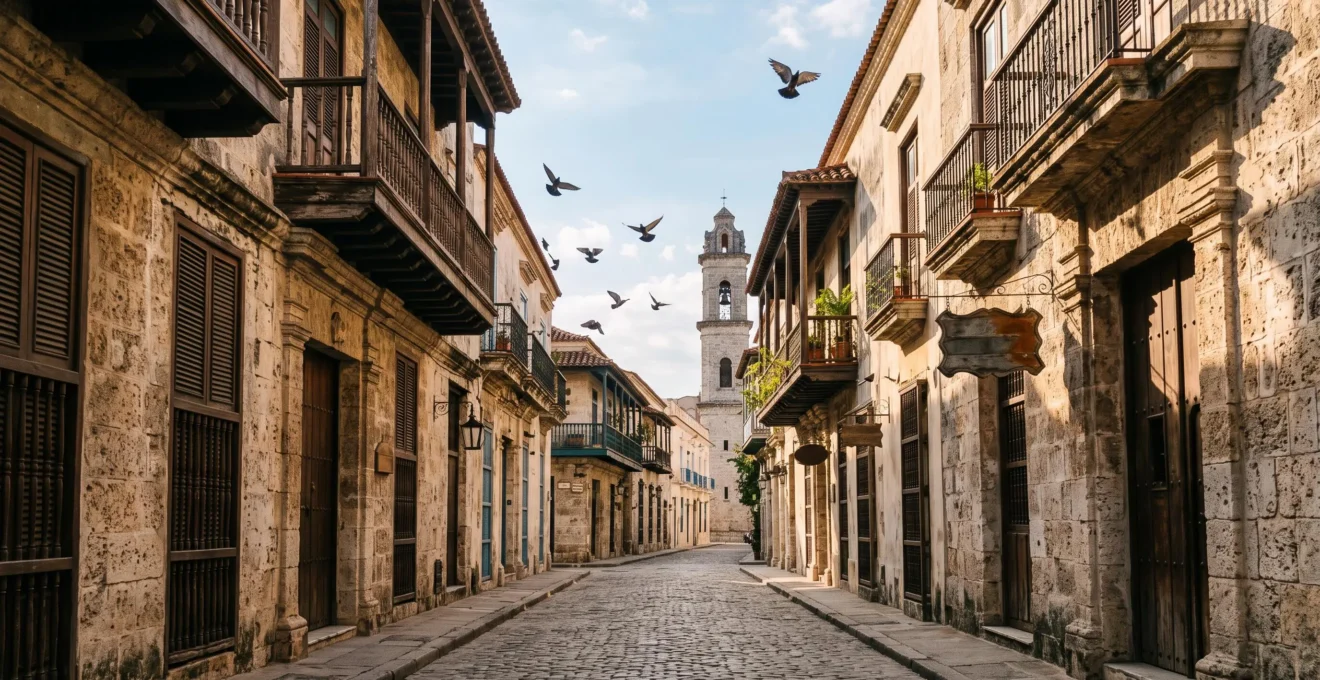
Understanding the Zona Colonial’s UNESCO status isn’t about ticking off a list of sights; it’s about learning to read a 500-year-old story written in coral stone.
- The site’s significance lies in its role as the urban blueprint for the Americas and its unique fusion of European architectural styles adapted for a new hemisphere.
- Key structures like the Cathedral and the Alcázar represent the dual pillars of religious and viceregal power that shaped the New World.
Recommendation: Prioritise your visit by focusing not just on the grand monuments, but on the specific architectural details and the living history that earned this district its protected status.
For the discerning UK traveller, the Zona Colonial in Santo Domingo presents a fascinating puzzle. It’s lauded as a UNESCO World Heritage site, a cradle of the Americas, yet it can feel like a labyrinth of cobblestone streets and colonial facades. The common advice is to simply wander, but this approach risks missing the profound historical narrative embedded in its architecture. Many visitors walk past crucial buildings, unaware of the specific reasons—the architectural innovations, the political statements, the very materials used—that make them globally significant. They see old walls, but they don’t see the evidence that convinced a UNESCO committee.
This is not another generic travel guide. This is an assessment, a deconstruction of the Zona Colonial through the lens of a heritage expert. We will move beyond the surface-level « what » to explore the critical « why. » Why was this specific collection of buildings granted World Heritage status? What is their « Outstanding Universal Value »? We will analyse the architectural DNA, from the Gothic vaults of the first cathedral to the imposing might of its fortresses, to understand how this small grid of streets became the prototype for colonial urban planning across two continents.
The true value of this district lies not in a random stroll, but in a curated understanding of its historical weight. This guide provides that curation, empowering you to see the Zona Colonial not as a mere tourist attraction, but as a living document of a pivotal moment in world history. You will learn to distinguish authentic structures from modern restorations and understand the ongoing struggle to preserve this fragile legacy, ensuring your visit is both efficient and deeply meaningful.
To help you navigate this rich historical landscape, this article is structured to build your understanding layer by layer. We will begin with the foundational history, move through the specific UNESCO criteria, analyse key architectural features, and provide a practical framework for exploring these significant sites.
Summary: A UNESCO Expert’s Deconstruction of the Zona Colonial’s Heritage
- Why Is Santo Domingo Considered the Americas’ First Permanent European Settlement?
- Why Did Zona Colonial Receive UNESCO World Heritage Recognition in 1990?
- Where Can You See the Most Authentic Spanish Colonial Architecture in the Dominican Republic?
- Catedral Primada or Alcázar de Colón: Which Is Zona Colonial’s Most Significant Site?
- When Does Zona Colonial’s Architecture Look Most Photogenic in Natural Light?
- How to See Zona Colonial’s Top 8 UNESCO Sites in Four Hours?
- The Zona Colonial Sites Currently Closed That Guidebooks Still List
- How to Explore Santo Domingo’s Historic Districts Beyond the Standard Tourist Walk?
Why Is Santo Domingo Considered the Americas’ First Permanent European Settlement?
The designation of Santo Domingo as the « first » European city in the Americas is not a casual title; it is a statement of profound historical and urban significance. While earlier settlements like La Isabela were established, they were ultimately abandoned. Santo Domingo, however, is recognised as the oldest continuously inhabited European settlement in the Americas, having been formally established on the Ozama River’s western bank in 1502. This continuity is the bedrock of its heritage status. It wasn’t just a camp or a fort; it was conceived from the outset as a permanent seat of colonial power and a base for further conquest.
Its importance was cemented by its role as a city of ‘firsts’. As the official UNESCO documentation highlights, Santo Domingo became the site of the first cathedral, the first hospital (Hospital de San Nicolás de Bari), the first customs house, and the first university (Universidad Santo Tomás de Aquino) in the New World. This concentration of institutional power established it as the administrative, religious, and commercial heart of the Spanish Empire in its nascent stages. It was from here that the colonization of Mexico, Peru, and other mainland territories was planned and launched.
Crucially, the city’s layout itself was a revolutionary act. Governor Nicolás de Ovando implemented a grid plan (or ‘traza’)—a checkerboard of straight, perpendicular streets. This rational, ordered design stood in stark contrast to the organic, winding streets of medieval European cities. The Santo Domingo grid became the urban blueprint for hundreds of new towns and cities across the Americas, from Havana to Cartagena. Seeing this grid today is to witness the master plan that shaped the urban landscape of an entire hemisphere, making the city a living artifact of colonial ambition and design theory.
Why Did Zona Colonial Receive UNESCO World Heritage Recognition in 1990?
The inscription of the Colonial City of Santo Domingo on the UNESCO World Heritage List in 1990 was not a simple acknowledgment of its age. It was a rigorous assessment of its « Outstanding Universal Value » (OUV), based on specific criteria that few sites in the world can meet. The city was inscribed in 1990 under criteria (ii), (iv), and (vi), which, in a heritage context, represent a trifecta of historical and cultural significance. Understanding these criteria is key to appreciating why these buildings matter beyond their aesthetic appeal.
Criterion (ii) refers to a site exhibiting « an important interchange of human values. » For Santo Domingo, this means its grid plan and architectural models were the primary vehicle for transmitting European urban planning and Renaissance design principles to the New World. The city was a laboratory where ideas were tested before being exported across the continent.
Criterion (iv) marks a site as « an outstanding example of a type of building, architectural or technological ensemble or landscape which illustrates (a) significant stage(s) in human history. » The collection of early 16th-century buildings in the Zona Colonial—the cathedral, the fortress, the hospital—forms an unparalleled ensemble of the very first wave of European construction in the Americas. They represent a distinct, unrepeatable moment in architectural history.
Finally, Criterion (vi) is met by sites « directly or tangibly associated with events or living traditions, with ideas, or with beliefs, with artistic and literary works of outstanding universal significance. » Santo Domingo is inextricably linked to the pivotal event of the encounter between Europe and the Americas and the subsequent colonization of the continent. It is the physical manifestation of that historical turning point. Together, these criteria affirm that the Zona Colonial is not just a collection of old buildings, but a cohesive and irreplaceable testament to a major chapter of human history.
Where Can You See the Most Authentic Spanish Colonial Architecture in the Dominican Republic?
For the purist, the search for « authenticity » in a 500-year-old city is paramount. While the entire Zona Colonial is a treasure, the most authentic examples of Spanish colonial architecture are found in the structures that best preserve their original form, materials, and stylistic integrity. This authenticity is not just about age; it’s about seeing the architectural solutions devised by the first European builders in a new, tropical environment. They brought with them the dominant styles of late-medieval and early-Renaissance Spain—Gothic and Mudéjar—but had to adapt them using local materials and for different climatic needs.
This created a unique architectural synthesis. You can see the Isabelline Gothic style, a late Spanish Gothic, in the ribbed vaults and pointed arches of the Catedral Primada. Simultaneously, the influence of Mudéjar style—a tradition of Moorish craftsmen in Spain—is visible in the intricate geometric brickwork, decorative plaster, and the use of alfiz (a rectangular moulding around an arch). These builders had to innovate, using local coral limestone (piedra coralina) for its availability and durability, resulting in thick, resilient walls that also helped keep interiors cool.
One of the finest examples of this early, authentic style is the Casa del Cordón. Often overlooked by tourists rushing to grander monuments, it is considered the first stone house in the Americas. Its name comes from the carved stone cord of the Franciscan order above its doorway, a detail that is both a religious symbol and a mark of its early provenance. Another key site is the Hospital de San Nicolás de Bari, now in ruins but perhaps more authentic for it. Its collapsed arches and exposed foundations allow you to see the raw construction techniques and the sheer scale of this first hospital, unmarred by later restorations. These sites, less polished than others, offer a more direct and honest connection to the city’s 16th-century origins.
Catedral Primada or Alcázar de Colón: Which Is Zona Colonial’s Most Significant Site?
Pitting the Catedral Primada de América against the Alcázar de Colón is like asking which pillar of a bridge is more important. Both are profoundly significant, but they represent the two distinct and often competing foundations of Spanish colonial power: the Cross and the Crown. From a heritage assessor’s perspective, their importance is not relative but complementary. Together, they tell the complete story of the new society’s structure.
The Catedral Primada de América is the ultimate symbol of spiritual conquest. With its first stone set in 1514, it is the oldest standing cathedral in the Western hemisphere. Architecturally, it is a masterpiece of synthesis, a primarily Gothic structure with three naves and soaring ribbed vaults, yet its facade incorporates Renaissance elements, marking a transition in European art. Its very existence was a statement: a monumental house of God built to last an eternity, anchoring the Catholic faith firmly in new soil. Its significance lies in its primacy and its role as the mother church for the entire continent for decades.
In contrast, the Alcázar de Colón represents temporal, political, and dynastic power. Completed around 1512, this fortified palace was the home of Diego Columbus, son of Christopher Columbus, and the seat of the first viceregal court in the Americas. Its style is a powerful blend of Spanish Gothic and Mudéjar, evident in its elegant loggias and distinctive double-arched windows. It was not a church but a seat of governance, a fortress-residence from which the sprawling colonial administration was managed. Its significance is as the first physical embodiment of a European aristocratic court in the New World, a symbol of the Crown’s authority. One cannot be understood without the other; they are the two keystones of the colonial project.
When Does Zona Colonial’s Architecture Look Most Photogenic in Natural Light?
From a preservationist and photographic standpoint, the time of day you view the Zona Colonial dramatically alters your perception of its architecture. The key to its unique aesthetic is the primary building material: piedra coralina, or coral limestone. This stone, quarried locally, is filled with fossilised coral and shells, giving it a porous, tactile texture. Understanding how light interacts with this surface is essential for truly appreciating—and capturing—the district’s character.
The most dramatic and revealing light occurs during the « golden hours« : the first hour after sunrise and the last hour before sunset. During these times, the sun is low in the sky, casting a warm, raking light across the stone facades. This low-angle light is critical because it creates long, soft shadows that pick out the intricate details of the stone carvings, the texture of the fossils, and the imperfections accumulated over 500 years. Midday sun, by contrast, is harsh and direct, flattening these details and bleaching out the warm, golden hues of the coral stone.
An early morning walk, around 7:00 AM, is particularly rewarding. The streets are quiet, the air is cooler, and you can watch as the soft light gradually illuminates the eastern-facing walls of buildings along Calle Las Damas. The late afternoon, from about 5:00 PM onwards, offers a similar magic, bathing the Plazas in a deep golden glow. This is the time to observe the intricate details on the facade of the Cathedral or the Casa del Cordón. The warm light makes the centuries-old coral stone feel alive and warm to the touch. It’s at these moments that the architecture transcends its historical function and becomes an object of pure, textural beauty.
How to See Zona Colonial’s Top 8 UNESCO Sites in Four Hours?
For the traveller with limited time, a prioritised itinerary is essential to cover the most significant UNESCO-listed structures without feeling rushed. A four-hour window is sufficient to see the exteriors of the core sites and enter one or two, provided you follow a logical route. The goal is not just to see them, but to understand their relationship to one another. This walking plan is designed around a narrative arc, moving from defence and governance to religion and daily life. Wear comfortable shoes; the cobblestones are authentic and unforgiving.
Start your tour early, around 8:30 or 9:00 AM, to avoid the peak midday heat and the largest tour groups. Begin at the eastern edge of the district on the Ozama River.
- Fortaleza Ozama: The oldest military fortress in the Americas. Start here to grasp the defensive imperative of the new city. The central Tower of Homage offers a strategic view of the river and port.
- Calle Las Damas: Walk north along the first paved street of the New World. Imagine it as the main artery connecting the fortress to the seats of power.
- Panteón Nacional: View this former Jesuit church from the outside. Its neoclassical facade is a later addition, but it stands on a site of immense historical importance. (Note: Check for restoration closures).
- Alcázar de Colón: Continue to the Plaza de España. This is the symbol of viceregal power. If you choose to enter only one museum, this is a strong contender for its historical weight and restored interior.
- Parque Colón: Cut west into the heart of the district. This is the main social square, anchored by a statue of Columbus.
- Catedral Primada de América: Dominating the southern side of Parque Colón, this is the spiritual anchor of your tour. Allocate time to go inside to see its magnificent Gothic vaults.
- Casa del Cordón: A brief walk from the cathedral, find this first stone house for a glimpse of early residential architecture.
- Monasterio de San Francisco (Ruins): End your tour at these evocative ruins. They offer a powerful sense of the city’s age and resilience.
This route covers approximately 3-4 kilometres and can be completed in about four hours, including brief stops and entry into one or two sites. It provides a comprehensive overview of the architectural and historical layers that constitute the Zona Colonial’s Outstanding Universal Value.
The Zona Colonial Sites Currently Closed That Guidebooks Still List
A critical aspect of heritage preservation is the ongoing work of restoration, which can be a source of frustration for visitors relying on outdated guidebooks. Several key sites in the Zona Colonial are periodically subject to extensive restoration projects, meaning interior access can be limited or impossible. This is a delicate balance: the work is essential to protect the structures for future generations, but it temporarily removes them from the visitor experience. It is always wise to check for the most recent information before planning your day.
Case Study: The Panteón Nacional Restoration
A common point of confusion is the Panteón Nacional. For years, it has undergone intermittent restoration. Recent visitors have reported that while the impressive neoclassical facade and the changing of the guard ceremony are still visible from Calle Las Damas, the interior, which houses the tombs of Dominican heroes, is often inaccessible. This highlights the importance of managing expectations: the exterior remains a significant landmark, but the full experience may not be available.
This issue of preservation versus access is a serious concern for heritage bodies. The constant pressure from tourism and urban development, combined with the natural decay of 500-year-old materials, puts the site at risk. In fact, a recent mission report noted that if conservation challenges are not adequately addressed, the World Heritage Committee could evaluate the option of placing the property on the List of World Heritage in Danger. This underscores the fragility of the site and the vital importance of the restoration work you may encounter.
| Site | Current Status | Visitor Note |
|---|---|---|
| Panteón Nacional | Restoration works reported at times; interior access can be limited | Neoclassical limestone facade still viewable from Calle Las Damas |
| Catedral Primada de América | Open, active place of worship | Small entry fee applies outside Sunday mass hours |
| Alcázar de Colón | Open as a museum | Regular visiting hours, Gothic-Mudéjar residence of Diego Columbus |
The most pragmatic approach for a visitor is to remain flexible. If a primary site is closed, treat it as an opportunity to explore a secondary one, such as the Museo de las Casas Reales or the Convento de los Dominicos, which are often less crowded but equally steeped in history.
Key takeaways
- The Zona Colonial’s UNESCO status is based on specific criteria valuing its role as an urban blueprint and an unparalleled ensemble of early 16th-century architecture.
- Authenticity is found in the architectural synthesis of Gothic, Mudéjar, and Renaissance styles, adapted with local coral limestone.
- Understanding the site requires recognising the dual power structures symbolised by the Catedral Primada (Church) and the Alcázar de Colón (Crown).
How to Explore Santo Domingo’s Historic Districts Beyond the Standard Tourist Walk?
To truly understand the Zona Colonial, one must look beyond the silent stones of its monuments and engage with it as a living, breathing neighbourhood. The UNESCO designation protects not just the buildings but the « ensemble, » which includes the human element that has given it continuous life for five centuries. Exploring beyond the standard tourist circuit means tuning your senses to the contemporary rhythms of the district, where history and modern life are in constant dialogue.
This means observing how the historic fabric is being repurposed. Restored colonial buildings are not just museums; they house boutique hotels, contemporary art galleries where local artists display their work, and innovative restaurants where a new generation of chefs reimagine Dominican cuisine in centuries-old kitchens. This juxtaposition of old and new is not a corruption of the district’s integrity; it is the very definition of a living heritage site. The sounds of merengue and bachata drifting from a doorway are as much a part of the area’s authentic character as the tolling of the cathedral’s bells.
To access this deeper layer, you must intentionally step off the main tourist thoroughfares like Calle El Conde. Wander into the quieter residential streets to the north and west, where you’ll find children playing, neighbours chatting on their stoops, and the local colmados (corner stores) buzzing with activity. This is where the grid plan ceases to be an abstract historical concept and becomes the framework for a vibrant community, with over 300 colonial buildings still standing across the district, many of them private homes. It requires a shift in mindset from a tourist consuming sights to an observer experiencing a place.
A Sensory Plan for Experiencing the Living Colonial Zone
- Listen for the Music: Follow the sound of merengue or bachata drifting from open doorways and small bars, especially in the late afternoon. This is the city’s true soundtrack.
- Observe the Social Rhythm: Step into a local colmado for a cold drink or find a quiet plaza to watch a game of dominoes. Notice the pace and patterns of daily neighbourhood life.
- See the Old in the New: Visit contemporary art galleries or boutique hotels housed inside historic buildings. Pay attention to how modern design elements interact with original stone walls and wooden beams.
- Taste the History: Seek out small, family-run restaurants away from the main plazas. Ask about traditional dishes to connect with the culinary heritage of the area.
- Feel the Textures: As you walk, run your hand over the different surfaces: the cool, porous coral stone of a 16th-century wall, the smooth, worn wood of a colonial-era door, and the uneven cobblestones underfoot.
By shifting your perspective from that of a tourist to that of a temporary resident, you gain a richer, more authentic appreciation for the Zona Colonial. Your next step is to take this knowledge and apply it, allowing you to walk these historic streets with a deeper understanding and a more discerning eye.