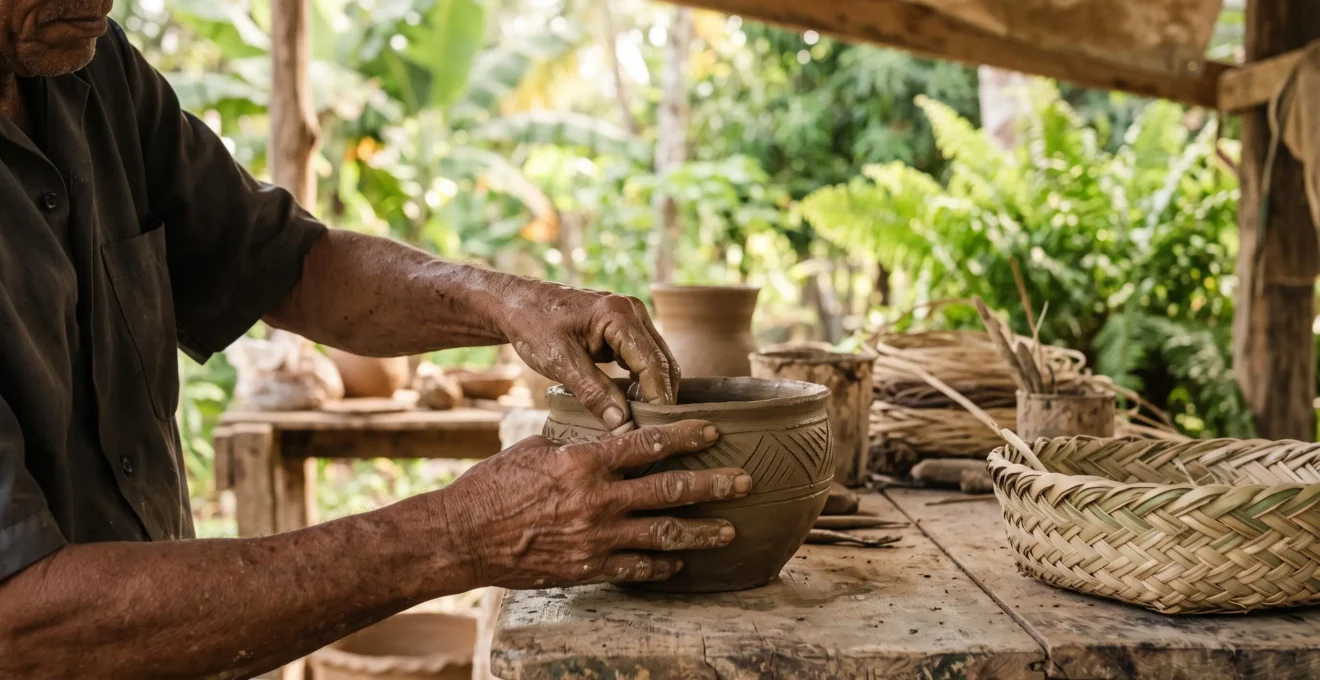
True engagement with Taíno culture comes from hands-on learning in an artisan-led workshop, not from buying souvenirs.
- Basket weaving is more practical and beginner-friendly for a single-session experience.
- Identifying authentic crafts requires looking for handmade imperfections and avoiding machine-made uniformity.
- The national embrace of the name ‘Quisqueya’ is a living testament to the survival and resonance of Taíno heritage.
Recommendation: Start your search by visiting a cultural hub like Centro León in Santiago to gain vital context before seeking out local artisan cooperatives.
As a cultural traveller, you’ve likely seen them in the colourful markets of the Dominican Republic: small, stylised ceramic figures and woven baskets labelled as « Taíno art. » There’s an undeniable pull to connect with the island’s pre-colonial soul and take a piece of it home. But a question quickly follows: Is this real? Are you supporting a genuine tradition or just a production line? This uncertainty is a common frustration for those who seek a deeper connection than a simple transaction.
Many guides will point you towards bustling souvenir stalls or tell you to simply « buy local. » But this advice often misses the point. The true value isn’t in the object you can carry home, but in the knowledge you can carry within. The most profound way to honour this living heritage is to shift your mindset from being a customer to becoming a student. It’s about understanding the process over the product, and engaging in the act of cultural transmission itself.
This guide is designed from my perspective as a workshop coordinator, here to distinguish authentic cultural immersion from simple tourist demonstrations. We won’t just list places to buy things. Instead, we will explore the history that shaped these crafts, teach you how to find genuine artisan-led workshops, help you choose the right craft for your skill level, and provide the tools to navigate the market with respect and discernment. Let’s begin your journey into the hands and heart of Dominican craftsmanship.
To navigate this journey effectively, this article is structured to build your understanding step-by-step, from the history of the crafts to the practical details of finding and participating in a workshop. The following summary outlines the path we will take together.
Summary: A Guide to Learning Taíno Pottery & Weaving from Dominican Artisans
- Why Did Taíno Basket Weaving Survive Whilst Ceremonial Pottery Nearly Disappeared?
- How to Find Dominican Artisan Cooperatives Offering Taíno Craft Workshops?
- Taíno Pottery or Basket Weaving: Which Workshop Suits Complete Beginners?
- The Souvenir Scam Where Mass-Produced Items Are Sold as Artisan Crafts
- What Should Handmade Taíno-Style Crafts Actually Cost to Pay Artisans Fairly?
- Why Do Dominicans Call Their Island ‘Quisqueya’ Instead of Its Colonial Name?
- How Did the Taíno Name « Quisqueya » Survive 500 Years of Spanish Dominance?
- The Souvenir Mistake That Supports Dominican Illegal Mahogany Logging
Why Did Taíno Basket Weaving Survive Whilst Ceremonial Pottery Nearly Disappeared?
To understand the crafts available to you today, you must first understand their divergent histories. There’s a common and tragic misconception that the Taíno people and their culture were completely extinguished after colonisation. As the Smithsonian Magazine notes, « The Native people of Hispaniola were long believed to have died out. » Yet, the truth is one of resilience and adaptation, and this is perfectly reflected in the fates of their two primary crafts: weaving and pottery.
The key to this divergence lies in their function. Basket weaving was an unbroken, daily necessity. Taíno communities used woven fibers for everything from clothing and hammocks to baskets for carrying food. This utilitarian tradition was passed down through generations, primarily within families, because it was continuously needed for survival. It never stopped. Ceremonial pottery, on the other hand, was deeply tied to spiritual practices and a social structure that was systematically dismantled by the Spanish. The intricate pots used for rituals lost their immediate context and purpose, causing the specific techniques to fall dormant.
As craft historians point out, the story of Dominican pottery is also more complex. Later, a different, more functional ceramic tradition was introduced by African slaves, focused on utilitarian objects. This created a new layer of influence, distinct from the dormant Taíno ceremonial styles. Therefore, while modern artisans are reviving Taíno pottery techniques based on archaeological findings, it is a conscious act of cultural recovery. Basket weaving, in contrast, represents an act of cultural continuity—a living heritage that never truly went away.
How to Find Dominican Artisan Cooperatives Offering Taíno Craft Workshops?
Finding a genuine, hands-on workshop is not like booking a standard tourist excursion. You won’t find them advertised on big international travel sites. The search requires a more thoughtful approach, one that prioritizes context and direct connection. My first piece of advice is always the same: start with a museum, not a market. Specifically, make a visit to the Centro León in Santiago de los Caballeros your first stop.
Think of Centro León not just as a museum, but as a gateway. It houses one of the most significant collections of Taíno artifacts, including stunning examples of pre-colonial ceramics. By spending time there, you accomplish two crucial things. First, you train your eye. You learn to recognise the authentic shapes, patterns, and symbols of Taíno art, making you a much more discerning observer. Second, it serves as a credible hub for information. The staff and resources there can provide context and often have connections to or knowledge of the reputable artisan communities in the surrounding Cibao region, which is a heartland for many crafts.
Once you have this foundation, you can begin searching for cooperatives or individual artisans. Look for communities that are proud to be a taller (workshop) as much as a tienda (shop). When you find a potential workshop, don’t just ask about the price. Follow the advice to « ask the artists about the inspiration behind their work to learn more about the Taíno influence. » An artisan engaged in true cultural transmission will be eager to share the meaning of the patterns, the source of the materials, and the story behind their craft. Their willingness to teach is the clearest sign that you’ve found an authentic experience.
Taíno Pottery or Basket Weaving: Which Workshop Suits Complete Beginners?
Once you locate a cooperative, you’re faced with a wonderful choice: do you work with the earth or with the fiber? Both pottery and basket weaving offer a deep connection to Taíno traditions, but they provide very different experiences, especially for a complete beginner participating in a single-day workshop. Basket weaving is often the more practical and immediately rewarding choice for a first-timer.
The primary reason is the process. Basket weaving is a single-session craft. You can learn a tying or weaving technique with natural fibers like palm fronds and, within a few hours, create a small, tangible object—a simple mat, a small basket, or a decorative piece. The process is rhythmic and meditative. Pottery, while incredibly tactile and sculptural, is a multi-stage commitment. The clay must be kneaded, shaped, and then left to dry, which can take days. The final, crucial step is firing, a specialised process that cannot be completed in a short visit. You may shape a pot, but you will not see the finished product emerge from the kiln.
The following table, based on information from resources like the Dominican CraftEncyclopedia, breaks down the key differences to help you decide which experience aligns better with your travel style and expectations.
| Criteria | Basket Weaving | Pottery |
|---|---|---|
| Time to a finished object | Often achievable in a single session | Multi-stage process: kneading, shaping, drying, firing |
| Raw material access | Palm fronds and natural fibers, widely available | Requires specific clay sources and firing know-how |
| Sensory experience | Rhythmic, meditative, pattern-focused | Tactile, sculptural, more physical |
| Travel practicality | Lightweight and durable to pack | Fragile, heavier, may need special packing |
Ultimately, your choice depends on your goal. If you want the satisfaction of creating something from start to finish and taking it with you, choose weaving. If you are more fascinated by the sculptural process and the feel of working with clay, and don’t mind leaving your piece behind for firing, then a pottery workshop will be a deeply rewarding sensory experience.
The Souvenir Scam Where Mass-Produced Items Are Sold as Artisan Crafts
Nothing disconnects you from an authentic experience faster than realizing the « handmade » craft you purchased was mass-produced in a factory. This is a common pitfall in tourist-heavy areas, where stalls are filled with items that mimic artisan work but lack its soul. As your guide, I feel it’s my duty to arm you with the knowledge to distinguish genuine handicrafts from clever fakes. It’s not about being cynical; it’s about being a conscious consumer who can direct your support to the real artisans.
The key difference is uniformity versus uniqueness. A human hand is not a machine. It creates slight variations, imperfections that are signs of authenticity. Mass production relies on moulds and machines to create thousands of identical items. Your trained eye is your best tool. Look at a group of similar items on a shelf. Are the patterns identical down to the millimeter? Are the shapes perfectly symmetrical with no variations? These are red flags for mould-based production. In weaving, look for plastic threads mixed with natural fibers, or the tell-tale glint of staples or glue where hand-tied knots should be.
The most powerful tool, however, is conversation. An artisan is connected to their work. They can tell you what a symbol means, where the clay or fibers came from, and how long it took to make. Silence, vague answers, or a purely transactional attitude are often signs that the seller has no connection to the item’s creation. To help you in the moment, here is a checklist of signals to watch for.
Your checklist to spot inauthentic crafts
- Check pottery for perfect symmetry and identical repeated patterns, often signs of mould-based mass production.
- Look for uniform, glassy glazes across multiple ‘different’ pieces, a sign of industrial batch finishing.
- Inspect woven items for plastic threads mixed with natural fiber, or staples/glue replacing hand-tied knots.
- Favour stalls or cooperatives where you can purchase directly from the person who made the piece.
- Ask the seller to describe the process or meaning behind the item; silence or vague answers are a warning sign.
What Should Handmade Taíno-Style Crafts Actually Cost to Pay Artisans Fairly?
This is a delicate but essential question. You want to pay a fair price that honours the artisan’s skill and time, but you also know that in many markets, bargaining is part of the culture. As Lonely Planet mentions, « When shopping for jewelry, handicrafts, artwork or other souvenirs, bargaining is common. » The key is to understand when and how to negotiate respectfully, and when to accept the listed price as a fair reflection of the work’s value.
The first rule is to differentiate the context. Firm bargaining is generally expected and acceptable in large, open-air tourist markets where dozens of vendors sell similar items. It is a transactional environment. However, this etiquette does not apply when you are buying from an artisan cooperative or directly from an artist in their workshop. Prices in these settings are rarely inflated. They are calculated based on the cost of materials, the time invested, and a small margin to sustain the cooperative and the artisan’s livelihood. In these spaces, treating the listed price with respect is paramount.
Your approach matters. Dressing modestly and being polite can significantly improve the tone of any interaction. Rather than seeing a price as an obstacle, try to understand the value behind it. A small, simple woven bracelet might take an hour to make, while a large, intricately decorated ceramic vessel could represent weeks of work—from sourcing and preparing the clay to the detailed shaping and complex firing. Think of a major piece not as a cheap souvenir, but as an investment in a piece of art, comparable to what you might pay for a fine dining experience or another unique cultural activity. Here are a few guidelines for fair negotiation:
- Reserve firm bargaining for open-air flea markets, not for cooperative or direct-from-artisan sales.
- Dress and behave modestly and politely, as this generally improves the tone of negotiation.
- Respect listed prices at cooperative-run shops, since they are typically calculated to sustain artisan livelihoods.
- View a heavily decorated, larger pottery piece as an investment comparable to a fine dining experience rather than a mass-market souvenir.
Why Do Dominicans Call Their Island ‘Quisqueya’ Instead of Its Colonial Name?
As you spend time in the Dominican Republic, you will inevitably hear the island referred to as « Quisqueya. » You’ll see it in business names, hear it in songs, and find it woven into the fabric of national pride. You might wonder why this name is used so often, sometimes in place of « Dominican Republic » or the historical « Hispaniola. » The answer is a powerful statement of identity and a direct link to the island’s pre-colonial Taíno soul.
Simply put, ‘Hispaniola’ is the name given by the colonisers; ‘Quisqueya’ is the name that comes from the land itself. While Hispaniola is a geographic and political term for the island shared by the Dominican Republic and Haiti, it carries the weight of colonial history. Quisqueya, on the other hand, is a word of indigenous origin. It is embraced by Dominicans as an emotional and poetic term for their homeland, a name that evokes a sense of belonging that predates European arrival. It’s a way of claiming an identity rooted in the island’s own history, not one imposed upon it.
This is not just a casual nickname. The word is deeply enshrined in the nation’s most sacred expression of identity: the national anthem. As nationalanthems.info points out, the anthem « never refers to the nation or its people by the name ‘Dominican’, but rather uses the poetic term ‘Quisqueyano’ throughout. » To call oneself a Quisqueyano is to identify with the very essence of the island, the « Mother of all Lands. » Understanding this distinction is a key insight for any cultural traveller seeking a deeper connection with the Dominican people.
How Did the Taíno Name « Quisqueya » Survive 500 Years of Spanish Dominance?
The survival of the name « Quisqueya » is a remarkable feat of cultural memory. While the Taíno population was decimated and its social structures were shattered, its language did not vanish completely. It seeped into the Spanish spoken on the island, leaving behind hundreds of words still in everyday use for local plants, animals, and places. But ‘Quisqueya’ did more than just survive as a vocabulary word; it became an emblem of national identity, kept alive through oral tradition and, most powerfully, through its formal adoption in the national anthem.
The Himno Nacional is the primary vessel that has carried this name through centuries. Every time a Dominican sings their anthem, they reaffirm this connection. The lyrics explicitly invoke the Taíno heritage, with the opening line « Quisqueyanos valientes, alcemos nuestro canto. » (Valiant Quisqueyanos, let’s raise our song). As documented on Wikipedia, in the anthem, the indigenous word for the island, « Quisqueya », is used twice, and its derivative demonym, « quisqueyanos », is used once. This was a deliberate choice by the lyricist, Emilio Prud’Homme, in the late 19th century to forge a national identity distinct from its colonial past.
Academic research confirms this linguistic survival as a marker of Taíno resilience. Studies on 21st-century Dominican culture document that the country uses ‘Quisqueya’ as a common national referent. This is not ancient history; it is a living, breathing part of the culture. By being enshrined in the anthem and used in everyday life, the name was protected from erasure, transforming from a simple place-name into a potent symbol of independence and enduring heritage.
Key takeaways
- Authentic cultural connection is achieved through active participation in workshops, not passive purchasing.
- The survival of a craft like basket weaving depended on its continuous, practical use in daily life, unlike ceremonial pottery.
- Identifying genuine crafts involves looking for handmade uniqueness and engaging directly with the artisans about their process.
The Souvenir Mistake That Supports Dominican Illegal Mahogany Logging
As we focus on supporting authentic and ethical crafts, we must address a critical issue that extends to souvenirs made of wood. Many visitors are drawn to beautiful, dark-red wooden carvings, often advertised as being made from mahogany (caoba). While this wood is part of the island’s natural heritage, it is also highly protected. Purchasing certain wooden items can inadvertently support illegal logging and environmental damage, a mistake any conscious traveller would want to avoid.
West Indian mahogany is an endangered species, and its trade is heavily restricted. While there are legal, sustainable sources, much of the wood sold in informal souvenir markets comes from illicit logging operations that harm the Dominican Republic’s fragile forest ecosystems. The problem is so significant that official travel guidance warns that mahogany products may be confiscated at departure. This is not a risk you want to take, nor is it a practice you want to support. Ignorance is not an excuse when the environmental stakes are this high.
The solution is to be deliberate in your choices. Instead of being tempted by generic wooden statues, you can support Dominican craftsmanship in ways that are both beautiful and sustainable. The island is rich in other unique, ethically sourced materials that make for wonderful keepsakes. By choosing these alternatives, you directly contribute to the preservation of the country’s natural resources. Here are some sustainable alternatives to consider:
- Avoid figurines and statues explicitly advertised as mahogany or ‘caoba’ without provenance information.
- Ask sellers whether wood pieces are made from recycled wood, coconut shell, or fast-growing species instead of protected hardwoods.
- Prioritize larimar or amber jewelry, which come from Dominican-specific mineral sources rather than endangered timber.
- Choose natural-fiber basketry or clay pottery as a wood-free way to support authentic Dominican craftsmanship.
Your journey into the living heritage of the Dominican Republic begins not with a purchase, but with the decision to learn. By choosing to become a student of the craft, you forge a connection that is far more lasting than any object. Start planning your immersive craft experience today, and carry home not just a souvenir, but a skill, a story, and a genuine piece of Quisqueya’s soul.
Frequently asked questions about Quisqueya
What does the word ‘Quisqueya’ mean?
Quisqueya is a term of Ciguayo origin originally used to refer to the island of Hispaniola, sometimes translated poetically as ‘Mother of all Lands’.
Is ‘Quisqueya’ the same as ‘Haití’?
Both are indigenous names historically applied to the island, but over time ‘Haití’ became specifically associated with the neighboring nation while ‘Quisqueya’ was embraced by Dominicans as a poetic name for their own national identity.
Why isn’t ‘Hispaniola’ used in everyday Dominican identity?
‘Hispaniola’ is the historical Spanish colonial name for the island, whereas ‘Quisqueya’ carries an emotional, pre-colonial resonance that Dominicans have embraced as a symbol of belonging rather than administrative geography.