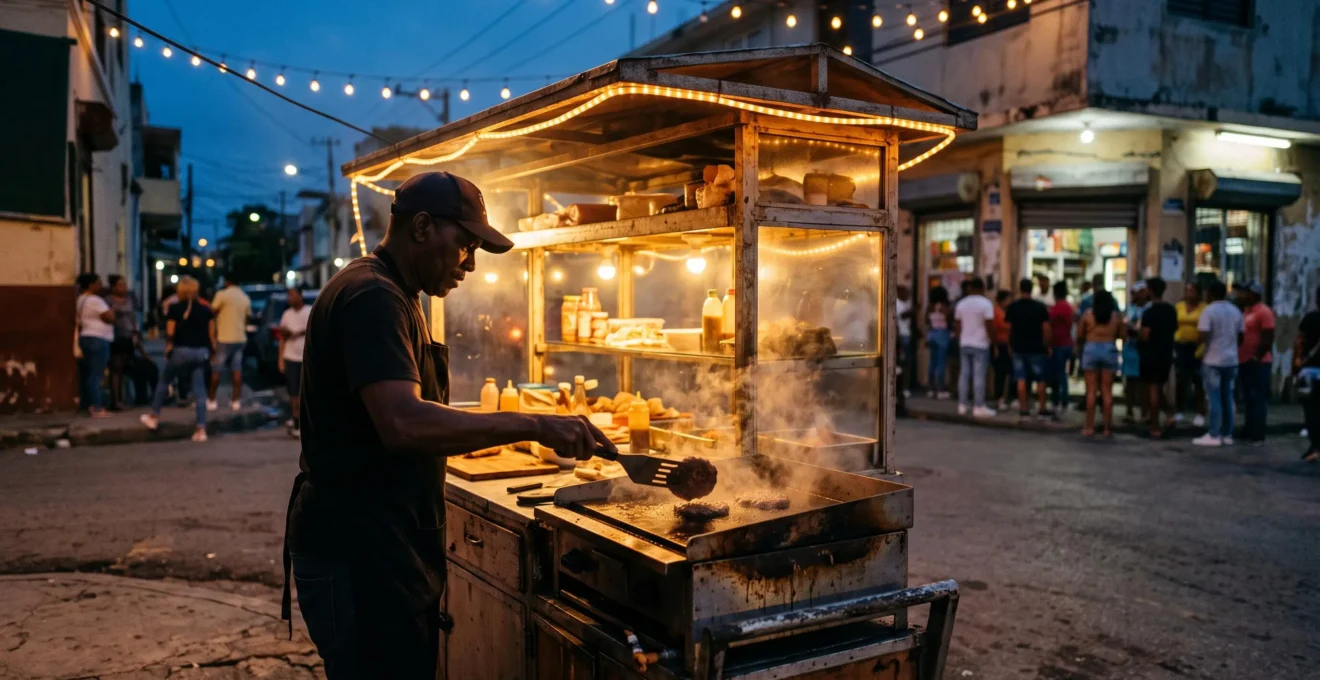
Finding an authentic Dominican Chimi isn’t about finding a burger; it’s about decoding a series of street-level signals that most tourists miss.
- The name is a historical accident; the « Chimi » is a sandwich, completely distinct from the Argentinian sauce.
- Authenticity lies in specific ingredients like crusty pan de agua and the vendor’s unique sauce, not a generic burger bun and ketchup.
Recommendation: Prioritise stands with high turnover and a visible, clean workflow over fancy-looking but empty spots. The best flavour and safety are found where the crowd is.
The tropical night air in the Dominican Republic carries a specific symphony of sounds and smells. The distant pulse of a dembow beat, the cheerful chatter from a corner colmado, and then, the most enticing of all: the sizzle of seasoned meat hitting a hot plancha grill. This is the call of the chimichurri, or « chimi, » the undisputed king of Dominican street food. For the uninitiated traveller, especially one from the UK accustomed to a different kind of late-night bite, the world of chimis can seem like a delicious but daunting mystery. You’ve heard the advice a thousand times: « eat where the locals eat. » But what does that really mean?
That advice is a starting point, not a strategy. It ignores the crucial fact that locals aren’t just following crowds; they are reading a complex set of signals. They know how to distinguish a stand that serves a sublime, flavour-packed sandwich from one slinging subpar ingredients. They can spot the subtle red flags that might lead to an upset stomach. This isn’t about finding just any chimi; it’s about understanding the craft behind a great one.
Forget everything you think you know about a « burger. » We’re about to move beyond the tourist traps and resort buffets. This guide will equip you with the eyes and palate of a seasoned street food journalist. You will learn to decode the chimi-verse, from recognising the right bread and proper ingredients to understanding the critical hygiene cues that separate a memorable meal from a regrettable mistake. We will delve into the regional rivalries and unpack the cultural DNA that makes this sandwich so much more than the sum of its parts.
To fully appreciate the journey ahead, this guide breaks down the essential knowledge needed to navigate the world of Dominican chimis like a true connoisseur. Follow along to transform from a curious tourist into an informed adventurer.
Summary: Your expert guide to authentic Dominican chimis
- Why Is Dominican « Chimichurri » a Burger When Elsewhere It’s a Sauce?
- How to Recognise a Properly Made Dominican Chimichurri by Ingredients?
- Santo Domingo or Santiago: Which City Makes Superior Chimichurris?
- The Street Food Red Flag That Predicts Stomach Problems Within 6 Hours
- When Do Dominican Chimichurri Stands Serve the Freshest Food?
- Which Dominican Street Foods Are Most Likely to Cause Stomach Problems?
- Why Do Dominican Colmados Operate Until Midnight When Supermarkets Close at 8 PM?
- What Makes Dominican Creole Food Different From Other Caribbean Cuisines?
Why Is Dominican « Chimichurri » a Burger When Elsewhere It’s a Sauce?
The first and most crucial piece of cultural orientation for any chimi-seeker is understanding the name. If you arrive in the Dominican Republic expecting the parsley-and-garlic-based Argentinian chimichurri sauce, you’re in for a surprise. The Dominican « chimi » is unequivocally a sandwich, a glorious, messy, and flavourful one. The shared name is one of Caribbean culinary history’s most charming mysteries, a classic case of linguistic drift that resulted in two entirely different, yet equally delicious, creations.
The most widely accepted origin story points to a case of culinary adaptation and a catchy name that simply stuck. This theory adds a layer of authenticity to the experience, transforming the sandwich from a simple meal into a piece of living history.
The Juan Abrales origin theory of the Dominican chimi
One widely cited account traces the sandwich to 1970s Santo Domingo, crediting an Argentine immigrant cook, Juan Abrales, who ran a street cart. He was reportedly adapting Argentine-style choripanes with chimichurri sauce, which is how customers began asking for the ‘sandwich with chimichurri.’ Over time, Dominican vendors reportedly swapped the chorizo for cheaper ground beef patties and added local touches like shredded cabbage, turning it into an affordable, hearty meal. This theory coexists with other folk explanations, reinforcing the idea that the chimi’s naming is a genuine culinary mystery rather than a settled fact.
To avoid any confusion at the food cart, it’s helpful to see the two concepts side-by-side. The differences are not subtle; they are fundamental, spanning format, ingredients, and the very context in which they are enjoyed.
| Aspect | Dominican Chimi | Argentinian Chimichurri |
|---|---|---|
| Format | A grilled meat sandwich on pan de agua | An herb-based liquid condiment |
| Core protein | Ground beef or pork patty | Not applicable (used on grilled meats) |
| Signature sauce | Pink ‘salsa golf’ (ketchup-mayonnaise blend) | Parsley, garlic, oil and vinegar sauce |
| Typical consumption time | Late night, social street-food staple | Daytime, meal-enhancing table condiment |
| Serving context | Sold from carts and stands | Poured over asado (grilled meats) at home or restaurants |
Understanding this distinction is the first step. It allows you to approach the chimi stand with the right expectations, ready to appreciate the sandwich for what it is: a uniquely Dominican creation with a fascinating, if fuzzy, backstory.
How to Recognise a Properly Made Dominican Chimichurri by Ingredients?
Once you’ve made peace with the name, the real detective work begins. A truly great chimi is a masterclass in texture and flavour balance, and it all starts with the quality of its core components. A seasoned observer can assess the potential of a stand long before the first bite. Your first and most important mission is to evaluate the bread. This is the non-negotiable foundation of an authentic chimi.
The correct choice is pan de agua, a local water-based bread roll with a characteristically crusty exterior and a light, airy interior. If you see a vendor using soft, generic, pre-packaged hamburger buns, walk away. They have failed the first and most important test of authenticity. The pan de agua is engineered to absorb the juices and sauce without disintegrating into a soggy mess.
Beyond the bread, a series of sensory cues will guide you. Listen for the sizzle of the patty on a well-seasoned plancha. The meat itself should be seasoned before it hits the grill, often giving it a distinct reddish hue from spices. Finally, the toppings are not an afterthought; they are integral. Fresh, thinly shredded cabbage provides a crucial, crunchy counterpoint to the soft bread and savoury meat, while the vendor’s secret ‘salsa golf’ (a mayonnaise-ketchup base) ties everything together. Some of the best stands even feature a ‘repollo agrio,’ a tangy, fermented cabbage that adds a layer of acidic complexity.
A proper chimi is a symphony of these elements working in harmony. Here are the key signals to look for:
- The Bread: It must be pan de agua. Look for a crusty, slightly rustic-looking roll, not a smooth, uniform burger bun.
- The Grill: The traditional beef patty is seasoned and gets its distinct red colour from spices before it even hits the hot plancha.
- The Sizzle: The sound of the seasoned flat-top grill and the vendor’s rhythmic chopping and flipping is a sign of a well-practised operation.
- The Sauce: Every stand has its own secret recipe. A good vendor takes pride in their unique variation, which goes far beyond a simple mayo-ketchup mix.
- The Cabbage: Look for fresh, crisp shredded cabbage. If they have a fermented version, it’s a sign of a more advanced operation.
Santo Domingo or Santiago: Which City Makes Superior Chimichurris?
The chimi is a national passion, but like any great dish, it has distinct regional personalities. The two epicentres of chimi culture are the capital, Santo Domingo, and the country’s second-largest city, Santiago de los Caballeros, the heart of the fertile Cibao region. Asking which city makes a « superior » chimi is like asking a Brit whether they prefer tea from Yorkshire or PG Tips—it’s a matter of fierce regional pride and subtle, but significant, differences in philosophy.
The Santo Domingo chimi is often seen as the classic, archetypal street-cart version. It’s an urban workhorse, designed for late-night crowds, with a focus on the perfect balance between the bread, the well-seasoned ground beef patty, and the signature pink sauce. It’s the standard-bearer, the version most people first encounter.
Santiago, on the other hand, often showcases a more meat-forward and seasoning-centric approach. Here in the Cibao region, you are more likely to find chimis made with seasoned pork, or a mix of pork and beef, reflecting local culinary traditions. Santiago is also famous for the ‘Chimi Especial’, an amplified version that might feature double the meat, extra toppings, and even a side of fried plantains (tostones), turning the sandwich into a full-blown platter.
The debate is a friendly but serious one among Dominicans. Neither is definitively « better, » but they are different. Experiencing both is essential for any serious chimi enthusiast. This table breaks down the key stylistic differences you can expect to find.
| Criteria | Santo Domingo (Capital-Style) | Santiago (Cibao-Style) |
|---|---|---|
| Primary protein | Seasoned ground beef patty | Often seasoned pork, sometimes mixed |
| Flavor focus | Balanced interplay of bread, sauce and meat | More meat-forward, seasoning-centric |
| Signature variation | Classic street-cart chimi | ‘Chimi Especial’ with extra meat and toppings |
| Cultural role | Urban late-night workhorse | Regional pride dish reflecting Cibao traditions |
Rather than seeking a winner, the adventurous eater should embrace the variety. Try the classic beef chimi in the capital’s Gazcue or Mirador Sur areas, then head north to Santiago to experience the pork-driven, ‘especial’ versions. It’s a delicious journey through the heart of Dominican regional identity.
The Street Food Red Flag That Predicts Stomach Problems Within 6 Hours
Let’s address the elephant in the room for any adventurous eater: food safety. The fear of « Montezuma’s Revenge » or traveler’s stomach is real, and street food is often unfairly blamed. The truth is, you can get sick from a fancy hotel restaurant just as easily as a street cart if you don’t know what to look for. The key isn’t avoidance; it’s education. As a street food journalist, my stomach is my most valuable tool, and I protect it by being a vigilant observer.
The single biggest red flag, the one that predicts trouble more than any other, is poor temperature control. This applies to both raw ingredients and cooked food. Meat patties that are sitting out in the tropical heat instead of in a cooler are a major warning sign. Likewise, condiments like mayonnaise-based sauces or shredded cabbage left uncovered and unrefrigerated are breeding grounds for bacteria. A reputable vendor maintains a clear « cold chain » for their raw ingredients and protects their condiments.
This isn’t just speculation; medical studies confirm the risk. While the experience is overwhelmingly positive for most, a peer-reviewed study of international travelers found that consumption of street food was a risk factor associated with increased odds of reporting traveler’s diarrhea. But this risk is manageable. You can dramatically reduce your chances of a problem by watching the vendor’s process. The best stands are a model of efficiency and cleanliness. The meat goes directly from a cooler to the hot plancha. The vendor uses separate utensils for raw meat and cooked food. They have a system for handling money that doesn’t involve contaminating their food-prep hands.
Ultimately, a busy stand is a safer stand. High turnover means ingredients are fresh, and the food is cooked to order, not sitting around. Follow the crowd, but more importantly, watch the process. Here are the critical checks from the US Centers for Disease Control and Prevention (CDC) adapted for the chimi stand:
- Condiment Storage: Are sauces and toppings kept in clean, covered containers, and ideally chilled?
- Raw Meat Handling: As the CDC advises, raw or undercooked meat can be contaminated, so patties should go directly from a cooler to the hot grill.
- Vendor Hygiene: Watch their hands. Is there a clear separation between handling cash and handling food? Do they use tongs or gloves?
- High Turnover: A queue is your friend. It signifies a popular, trusted vendor where food is constantly being refreshed.
When Do Dominican Chimichurri Stands Serve the Freshest Food?
Timing is everything, and in the world of chimis, this is especially true. Unlike a restaurant with a fixed all-day menu, the chimi stand operates on a specific rhythm dictated by Dominican social life. Understanding this rhythm is key to getting the best possible product. You wouldn’t show up to a pub at 9 AM expecting a perfect Sunday roast, and similarly, you shouldn’t expect a prime chimi in the middle of the afternoon.
The chimi is, fundamentally, a creature of the night. It is the quintessential late-night meal, the perfect fuel after a night of dancing, a social gathering with friends, or simply a satisfying end to a long day. As Mecho’s Kitchen aptly puts it, « Dominicans often head to a chimi stand for a satisfying late-night meal. » This is not just a cultural quirk; it has a direct impact on freshness and quality.
Most chimi stands begin to set up in the early evening, as the sun goes down and the workday ends. The prime time for a chimi is generally from 8 PM until the early hours of the morning. This is when the grills are hottest, the ingredients are at their freshest, and the turnover is highest. The vendor has just prepped their fresh cabbage, mixed their secret sauce for the evening, and portioned out their meat. Arriving during this peak period ensures you are getting a sandwich made from ingredients that haven’t been sitting out for hours.
A stand that is open and trying to sell chimis at 2 PM is a potential red flag. The ingredients may be from the night before, and the low customer traffic means your sandwich might be the only one they’ve made in hours. For the optimal chimi experience—combining the best flavour, the freshest ingredients, and the most vibrant atmosphere—plan your visit for the evening. Find a stand that is just hitting its stride as the city’s nightlife begins to stir. The sandwich you receive will be a direct reflection of this perfect timing.
Which Dominican Street Foods Are Most Likely to Cause Stomach Problems?
While the chimi is king, it’s part of a larger, vibrant street food ecosystem that includes everything from fried snacks (frituras) to refreshing fruit juices. Applying your newfound « Hygiene IQ » across the board is essential. While no food is inherently « dangerous, » some formats carry a higher risk than others, especially for a traveler’s digestive system, which is unaccustomed to the local microbes. The potential for issues is real; medical literature indicates that the percentage of international travelers who develop traveler’s diarrhea can range from 10% to 70% depending on the destination.
The primary risk factor, again, comes down to temperature and preparation. The two main cooking methods you’ll see on the street are ‘a la plancha’ (on the griddle) and ‘fritura’ (deep-fried). A chimi patty, cooked to order ‘a la plancha’, is generally a very safe bet. The high, direct heat kills off most pathogens effectively.
The higher-risk items are often found at ‘fritura’ stands. The danger isn’t the frying itself—the hot oil is sterile—but what happens *after*. Items like fried chicken pieces, kipes (bulgur wheat patties), or empanadas are often cooked in large batches and then left sitting in a warming tray or, worse, at ambient temperature for extended periods. This « danger zone » between hot and cold is where bacteria can thrive. Another area for caution is with fresh juices or ‘batidas’ (smoothies). Unless you can see the vendor using sealed, bottled water and clean ice, it’s wise to be cautious, as tap water can be a common source of trouble for visitors.
Your safest bet is always food that is cooked hot, fresh, and directly in front of you. This simple rule will allow you to explore a wider range of street food with confidence.
Your Action Plan for Safer Street Food Selections
- Favor ‘a la Plancha’: Prioritise items cooked to order on a hot griddle (like a chimi) over pre-cooked items sitting in a warming tray at a fritura stand.
- Assess Raw Ingredients: Be cautious with any food containing raw or visibly undercooked ingredients, as these are more likely to carry contaminants.
- Question the Juice: Skip fresh-squeezed juices or smoothies at street stands unless you can explicitly confirm they are made with bottled water and safe ice.
- Stick to Sealed Beverages: When in doubt about a stand’s water source, opt for factory-sealed bottled drinks like water, sodas, or Presidente beer.
- Observe the Workflow: Always apply the principles of vendor hygiene—clean hands, separate utensils, and high turnover—to any stand you consider.
Why Do Dominican Colmados Operate Until Midnight When Supermarkets Close at 8 PM?
As you explore the chimi landscape, you’ll inevitably notice their frequent proximity to another cornerstone of Dominican life: the colmado. These small, neighbourhood corner stores are much more than just a place to buy essentials. Understanding the colmado is key to understanding the rhythm of Dominican society and why late-night street food culture thrives.
A colmado is not a supermarket. A supermarket sells groceries. A colmado sells groceries, but it also functions as a bank, a post office, a social club, and an informal neighbourhood bar. As the publication TouristSecrets notes, « Colmados serve not only as places to stock up on everyday essentials but also as social hubs. » They stay open late because their social function is just as important as their commercial one, especially after the formal economy of supermarkets and banks has shut down for the day.
This dual role is what makes them indispensable to the community and explains their late hours. They provide a vital infrastructure that goes far beyond selling rice and beans.
The Colmado as Neighborhood Financial and Social Infrastructure
It is common to see groups playing dominoes while sipping cold Presidente beers at a local colmado during the day, with some colmados turning into bars or even karaoke spots at night. Because colmados are central to daily life, they serve purposes beyond shopping, such as topping up mobile phone credit or paying utility bills. This allows residents, especially in more remote areas, to avoid long trips to a city centre or a bank. This dual role as both a centre of commerce and a community hub explains why colmados stay open far later than conventional supermarkets, filling a crucial social and logistical gap in the evening hours.
This late-night social gravity of the colmado creates the perfect ecosystem for the chimi stand. People gather at the colmado for a beer and conversation, and when hunger strikes, the glowing light of the nearby chimi cart is a natural, convenient, and delicious destination. The two businesses exist in a symbiotic relationship, feeding off the same nocturnal social energy. The colmado provides the crowd, and the chimi stand provides the sustenance.
Key Takeaways
- Authenticity Test: A real chimi uses crusty ‘pan de agua,’ not a soft hamburger bun. This is the first and most important signal of quality.
- Safety First: Prioritise busy stands with high turnover. Food cooked to order in front of you is always safer than food that’s been sitting out.
- It’s a Night Food: For the freshest ingredients and best experience, visit a chimi stand after 8 PM, when they are in full swing for the evening rush.
What Makes Dominican Creole Food Different From Other Caribbean Cuisines?
After you’ve navigated the regional rivalries and mastered the art of spotting a quality stand, you might be left with a bigger question. What is it about this sandwich that feels so distinctly… Dominican? The chimi is the perfect case study for understanding what sets Dominican Creole (Criollo) cuisine apart from its Caribbean neighbours.
The difference lies in a unique history of adaptation and synthesis. Dominican food is a rich tapestry woven from Taíno, Spanish, and African influences, and it has a remarkable ability to absorb foreign concepts and transform them into something entirely its own. The chimi itself—a sandwich format likely inspired by American or European models—is a prime example. It was adopted, but not copied. Instead, it was completely remade with local flavours and ingredients. The « beef mixture, perfumed with traditional sofrito elements, meets tangy-sweet golf sauce in perfect harmony, » as Ambrosia Craft describes it, is a flavour profile you won’t find in Jamaica or Cuba.
This process of ‘Dominican-ization’ is the hallmark of the island’s Creole cuisine. It’s a culinary philosophy that embraces external influence not as a threat, but as an opportunity for creative fusion.
The Chimi as a Synthesis of Spanish and African Culinary Influence
The Dominican chimi stands apart through its seasoned ground beef mixture flavored with adobo and Worcestershire sauce, reflecting Spanish and English/African culinary influences layered onto a foreign sandwich format. This blending of imported technique (the grilled sandwich), Spanish-derived seasoning (adobo), and African-influenced flavour building illustrates how Dominican Creole cuisine repeatedly transforms outside influences into something locally distinct. This pattern mirrors the same fusion process seen in the island’s iconic music (merengue) and its unique dialect of Spanish.
So, when you take a bite of a chimi, you’re tasting more than just a sandwich. You are tasting a story of cultural resilience and creativity. You’re experiencing a delicious piece of evidence that shows how Dominican culture has consistently taken ideas from around the world and made them profoundly, unmistakably its own. It’s not just fast food; it’s a bite-sized lesson in Creole identity.
Now that you are armed with this knowledge, you are ready. Go out into the Dominican night, follow the sizzle of the plancha, apply your new-found expertise, and discover the magic of a truly authentic chimichurri. Your adventure in Dominican flavour awaits.