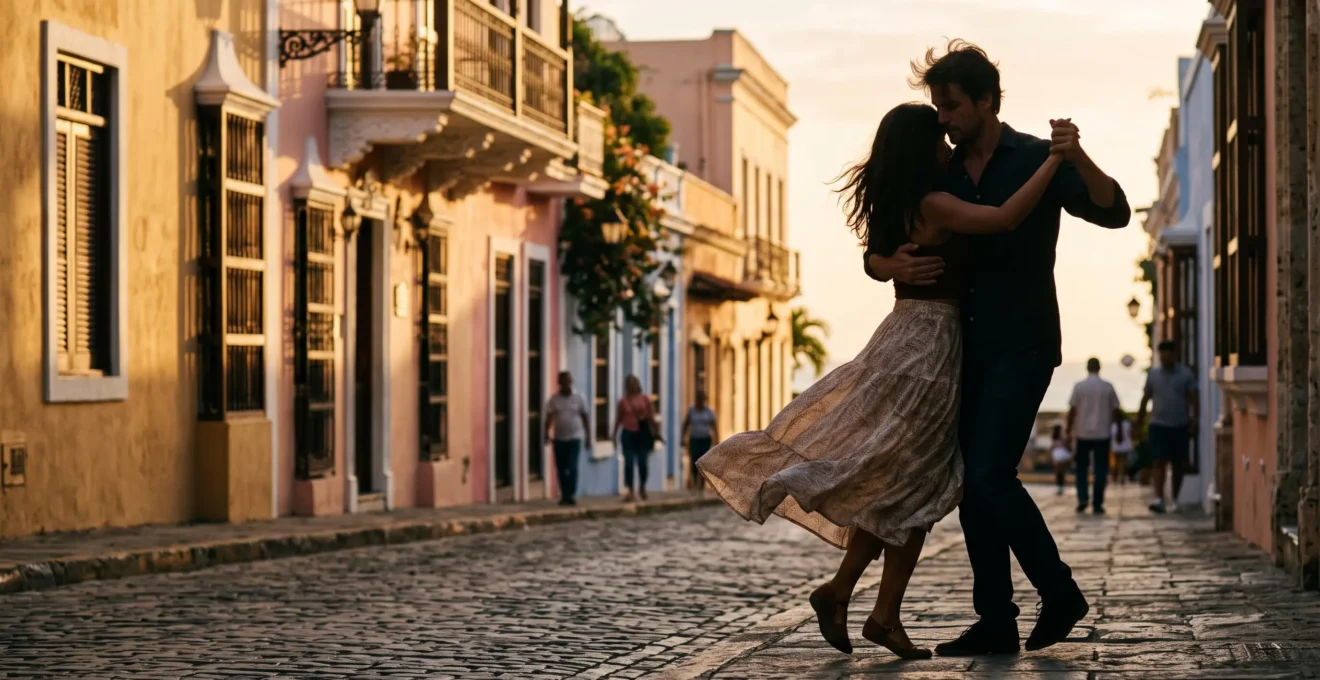
You’re excited for your trip to the Dominican Republic but dread the thought of being asked to dance, feeling like you have two left feet.
- The secret isn’t learning complex routines from online videos, but mastering a few simple, social « survival steps » that allow you to participate without pressure.
- Authentic Dominican dancing is about connection and fun, not technical perfection; it happens in local spots, not just in tourist shows.
Recommendation: Focus on learning the basic side-to-side weight transfer and, more importantly, the cultural confidence to say « yes » when invited to the dance floor.
The thought of your trip to the Dominican Republic brings images of turquoise waters and swaying palms. But for many, another image pops up: a bustling local bar, the sweet sound of a guitar, and a hand extended with the question, « Care to dance? » For a self-proclaimed « non-dancer, » this scenario can trigger more anxiety than excitement. You’ve probably glanced at online videos, seen impossibly fast footwork and intricate turns, and decided it’s a world you can’t enter. You just want to soak in the culture, not feel embarrassed or be a wallflower.
Most guides will point you to formal dance classes or tell you to watch choreographed resort shows. They treat bachata like a performance to be memorized. But what if that’s the wrong approach entirely? What if the key to unlocking Dominican social dancing isn’t about becoming a great dancer, but simply about becoming a willing participant? This isn’t about memorizing routines; it’s about understanding the heart of the music and the simple social code that governs the dance floor.
This guide is your antidote to dance floor anxiety. We will strip away the intimidating layers of performance and focus on what truly matters: the foundational feeling of the music, the handful of « survival steps » you actually need, and the cultural context that will give you the confidence to not just watch, but to join in. Forget perfection; your goal is participation.
This article breaks down everything you need to feel comfortable and ready to engage with the Dominican Republic’s most famous dance. From its historical roots to the simple steps and the unwritten social rules, you’ll discover how to experience bachata like a local, not a tourist on the sidelines.
Summary: Your Guide to Social Bachata in the Dominican Republic
- Why Did Bachata Develop in the Dominican Republic Rather Than Other Caribbean Islands?
- What Are the 3 Essential Bachata Steps Every Tourist Should Master?
- Tourist Bachata Shows or Local Dance Halls: Where Do Dominicans Actually Dance?
- The Cultural Mistake of Declining Bachata Invitations in Dominican Social Settings
- When Do Dominican Cities Host the Biggest Bachata Dance Gatherings?
- The Tourist Show Mistake Where Merengue Becomes a Choreographed Performance
- When Should Foreign Visitors Use « Quisqueya » Without Seeming Performative?
- Why Is Merengue the Dominican Republic’s National Music Despite Bachata’s Global Fame?
Why Did Bachata Develop in the Dominican Republic Rather Than Other Caribbean Islands?
To understand bachata, you have to understand its soul. It wasn’t born in a sterile dance studio; it grew from the countryside’s heartache and hope. Bachata is a uniquely Dominican story, a musical response to a specific history of isolation and social upheaval. Unlike the more state-sponsored rhythms of the Caribbean, bachata was the music of the people, for the people, developing in the margins of society. It was the sound of the rural poor, expressing themes of love, loss, and daily struggle with a raw, emotional honesty.
For decades, especially during the Trujillo dictatorship, this music was suppressed and stigmatized. It was considered crude, the sound of bars and brothels, far from the polished image the state wished to project. This very suppression, however, is what preserved its authenticity. As music producer Édgar Barrera notes, this background is inseparable from its identity. In a conversation with Mitu, he explains:
Bachata is a tropical interpretation of bolero. Originally it was known as ‘bolero campesino.’
– Édgar Barrera, mitú — Bachata Backstories: How Brothels and a Dictatorship Helped the Genre Survive
This « countryside bolero » was a blend of Latin and Caribbean influences, but its development was shaped by Dominican reality. It was an intimate, guitar-driven sound that could be played with few instruments in any backyard or corner store. This accessibility is why it thrived in the grassroots, passed down through generations. The global recognition came much later, and a major milestone was reached when Dominican bachata was declared an Intangible World Heritage Asset in December 2019 by UNESCO. This was not just an award, but a global acknowledgment of its deep cultural significance and its journey from a marginalized folk music to a symbol of Dominican identity.
What Are the 3 Essential Bachata Steps Every Tourist Should Master?
Here is the single most important piece of advice you will get: forget everything you’ve seen in flashy online bachata tutorials. The complex turns, dramatic dips, and intricate footwork belong to « Bachata Moderna » or « Sensual, » styles popular in international dance congresses. Authentic, social Dominican bachata is infinitely simpler, more subtle, and focused on connection. You do not need a choreographed routine. You only need a few « survival steps » to feel the rhythm and participate confidently.
The core movement is a simple weight transfer from side to side. It’s more of a feeling than a step, a subtle sway of the hips that responds naturally to the shifting of your weight. The goal is not to perform a big, exaggerated hip movement, but to relax and let it happen. This basic movement is the foundation for everything else and is more than enough to enjoy a full song on the dance floor.
Instead of trying to memorize a sequence, internalize the feeling of the three core skills below. They are all you need to get by and have fun. These aren’t steps for a show; they are tools for social connection in a real Dominican dance setting.
Your Bachata Survival Checklist: The Only 3 Skills You Need
- The Basic Weight Transfer: Focus on mastering the basic step as a subtle weight transfer with a natural hip response. It’s a simple « side-together-side-tap. » Don’t force a big, performative hip sway; let it be a natural reaction to your movement.
- « El Cierre » (The Close): Learn the simple forward-and-back rocking motion. This is your go-to move when the dance floor is crowded or the music gets slower. It’s used in a close embrace and is all about feeling the rhythm with your partner, not traveling.
- The « Mambo » Ear: Train your ear to recognize the syncopated instrumental break in the music. When you hear this, Dominicans often switch to simple, on-the-spot footwork. Knowing this allows you to do the same, or even just tap your feet in place, instead of freezing up or feeling like you’ve lost the beat.
Tourist Bachata Shows or Local Dance Halls: Where Do Dominicans Actually Dance?
The bachata you see in a resort’s « Dominican Night » show is a performance. It’s choreographed, polished, and designed for tourists. It’s entertaining, but it’s not where the real heart of Dominican dance culture beats. To find that, you need to step outside the resort walls and look for the places where Dominicans dance with each other. The good news is, these places are everywhere and are far more welcoming than you might think.
The capital, Santo Domingo, is a hotspot for live music, with famous venues like the JetSet Club offering a more formal experience. You can also find free public performances in the Colonial Zone, which are great for observing. However, the true, unfiltered soul of social dancing is found in a more humble setting: the local colmado. A colmado is a neighborhood corner store, a combination of a small grocery, a bar, and a community hub. On any given evening, you’ll find people pulling up plastic chairs, a speaker playing bachata and merengue, and couples dancing on the pavement right there on the street.
This is the most authentic experience you can have. It’s not a show; it’s life. For a beginner, this environment is perfect. The pressure is zero. To find a good spot, take a walk in the early evening. Look for a colmado with a small crowd and music playing. A key tip for the anxious beginner is to watch from the edge of the floor first. Observe. You’ll notice that the dancing isn’t flashy. It’s relaxed, intimate, and joyful. Favor spots that show a visible mix of ages, from teenagers to grandparents, all dancing together. This is a clear sign of a true community gathering, and the perfect place for you to take your first, simple, social dance step.
The Cultural Mistake of Declining Bachata Invitations in Dominican Social Settings
You’re at a colmado, the music is playing, and you’ve been mentally practicing your simple side-step. Then, it happens. A local smiles and extends a hand, inviting you to dance. In this moment, all the self-consciousness you felt back in the UK can come rushing back. Your first instinct might be to politely decline with a « No, thank you, I don’t know how. » In many cultures, this is a perfectly acceptable response. In the Dominican social dance context, it’s a cultural misstep.
In the Dominican Republic, an invitation to dance is not a test of your skills. It is not an audition. It is an act of inclusion. It’s a way of saying, « You are here with us, be part of our moment. » When you decline, especially with the reason « I can’t dance, » you are unintentionally rejecting that social offering. The person who asked you isn’t looking for a professional dance partner; they are looking to share a three-minute connection over a song. Your skill level is completely irrelevant to the invitation. The fact that you are a foreigner often makes locals even more eager to share their culture with you.
The correct response, even if your heart is pounding, is to smile, say « yes, » and step onto the floor. No one expects you to be an expert. Your partner will lead, and they will immediately adjust to your skill level. If all you can do is the simple side-to-side weight transfer we talked about, that is perfectly fine. In fact, it’s expected. The goal is not a flawless performance; it’s a shared experience. By accepting the dance, you are honouring the gesture of inclusion and opening yourself up to a genuine cultural exchange. Declining closes that door. Saying yes, no matter how nervously, is the single most important step you can take.
When Do Dominican Cities Host the Biggest Bachata Dance Gatherings?
While spontaneous dancing erupts nightly in colmados across the country, there are specific times of the year when the nation’s passion for music and dance culminates in massive public celebrations. Timing your visit to coincide with one of these festivals can offer an incredible, high-energy immersion, though they often celebrate merengue and bachata side-by-side. It’s important to remember that for Dominicans, these are not separate worlds but two sides of the same celebratory coin.
The largest and most famous event is the Santo Domingo Merengue Festival, which, despite its name, is a massive celebration of all Dominican music. It typically runs from late July into early August each year, turning the city’s famous seafront boulevard, the Malecón, into a colossal open-air dance floor with multiple stages and live bands. A second major festival takes place in the northern city of Puerto Plata, usually around the third week of October, offering a similar experience on a slightly smaller scale.
However, you don’t need a major festival to find a large-scale dance gathering. For a more regular and less overwhelming experience, look for the weekly events. A wonderful tradition for visitors and locals alike are the weekly Sunday-evening gatherings on the Malecón in Santo Domingo. As the sun sets, the boulevard comes alive with music, and people of all ages come out to dance. These gatherings offer a lower-key, recurring alternative to the massive annual festivals and are a perfect opportunity for a visitor to experience the joy of mass social dancing in a beautiful oceanside setting. It’s the perfect place to practice saying « yes » to a dance.
The Tourist Show Mistake Where Merengue Becomes a Choreographed Performance
Just as with bachata, your first exposure to merengue might be at a resort show. You’ll see dancers in bright, matching costumes performing synchronized high kicks and complex, spinning lifts. It’s a dazzling display of athleticism and choreography. It is also a complete misrepresentation of what social merengue actually is. This is a critical distinction for a visitor to understand, as merengue is arguably even more fundamental to the Dominican social fabric than bachata.
At its heart, social merengue is about joy and simplicity. As the Salsavida Dancepedia puts it, real merengue has a « fun, social feel. » It is not a performance; it is a conversation between two people. The basic step is a simple marching step with a subtle hip sway, even easier than the bachata basic. The beauty of social merengue is in its accessibility. It’s fast-paced and energetic, but the movements are small, contained, and led with a gentle, clear connection.
Watching a tourist show and thinking « I could never do that » is the wrong takeaway. The correct takeaway is « That’s not what I’m being asked to do. » When a local asks you to dance merengue in a colmado, they are not expecting the synchronized acrobatics from the stage show. They are inviting you to share in a moment of simple, unadulterated fun. The goal is to laugh, to move to the infectious rhythm, and to connect. The gap between the tourist show performance and the joyful reality of social merengue is vast. Understanding this difference is key to overcoming intimidation and embracing the island’s true national dance.
When Should Foreign Visitors Use « Quisqueya » Without Seeming Performative?
As you spend time in the Dominican Republic, you may hear the word « Quisqueya. » You’ll see it on signs, hear it in songs, and even find it in the opening lines of the national anthem itself, « Quisqueyanos valientes » (« Valiant Quisqueyans »). This beautiful, poetic name for the island holds deep historical and emotional weight. It is the name the indigenous Taíno people are believed to have called their homeland, and using it can be a way of showing a deeper appreciation for the island’s pre-colonial heritage.
The name Quisqueya is rooted in the indigenous Taíno language, and while its exact translation is debated, many sources suggest it is believed to mean ‘mother of all lands’ or ‘great land.’ This reflects the Taíno people’s profound reverence for their homeland. Today, for Dominicans, using the name is an expression of national pride, affection, and a connection to a history that predates Columbus. It’s a term of endearment, much like a person might use a beloved nickname for their home country.
So, when is it appropriate for a foreign visitor to use it? The key is context and sincerity. Dropping it into conversation to show off that you know it can feel performative and awkward. However, using it in the right context can show genuine respect. For example, if a Dominican is telling you with pride about their country, responding with « Quisqueya is truly beautiful » can be a heartfelt and appreciated gesture. The best rule of thumb is to use it as a response, not an opener. Use it when you are genuinely moved by the beauty of the island or the warmth of its people. Let it be an echo of the pride you are witnessing, rather than a word you are trying to display. Sincerity, not vocabulary, is what builds connections.
Key Takeaways
- Focus on Social Steps: The goal is participation, not performance. Master the simple side-to-side weight transfer and forget intimidating routines.
- Seek Authentic Venues: The real Dominican dance culture is found in local ‘colmados’ (corner stores), not in choreographed tourist shows.
- The Golden Rule is « Yes »: Accepting a dance invitation is a crucial act of social inclusion. Your skill level is irrelevant; your willingness is everything.
Why Is Merengue the Dominican Republic’s National Music Despite Bachata’s Global Fame?
A visitor might be forgiven for thinking that bachata is the one and only music of the Dominican Republic, given its massive global popularity. However, to understand the nation’s cultural identity, it’s crucial to know that merengue holds the official title of the country’s national music and dance. This distinction isn’t just a historical footnote; it reveals the different journeys each genre has taken from the countryside to the world stage and their different roles in the Dominican heart.
Merengue’s story is one of state-sanctioned identity. It’s older than bachata, with roots in the 19th century, and was actively promoted, particularly by the dictator Rafael Trujillo, as a unifying symbol of « Dominican-ness. » It was cleaned up, standardized, and taught in schools. Its fast, joyful 2/4 rhythm, driven by accordion, tambora, and güira, became the official soundtrack of the nation. This long history of official promotion is why in 2016 UNESCO declared it an Intangible Cultural Heritage of Humanity, three years before bachata received the same honor.
Bachata’s path was the opposite. It was the rebellious, sentimental younger sibling, born in the 1960s and stigmatized for decades as the music of the urban poor and marginalized. While merengue was played at official state functions, bachata was the sound of the back-alley bar. The table below, drawing from analyses like those at Go Beyond Travel Agency, highlights these contrasting identities.
| Aspect | Merengue | Bachata |
|---|---|---|
| Origin era | 19th century, rural blend of European and African influences | 1960s, urban folklore born in bars and brothels |
| Tempo & feel | Fast-paced, joyful 2/4 rhythm | Slower, romantic, guitar-led bolero rhythm |
| Core instruments | Accordion, tambora, güira | Lead guitar (requinto), bongo/tambora, güira |
| Historical status | Promoted by the state as national symbol | Once censored and stigmatized as music of the poor |
| Social role today | Official, celebratory, taught in schools | Intimate, emotional, danced in bars and homes |
| UNESCO recognition | 2016 | 2019 |
Today, both are essential. Merengue is the dance of the big, joyous celebration—the wedding, the national holiday. Bachata is the dance of intimacy and emotion—the courtship, the shared drink at the colmado. Understanding that merengue is the official, celebratory face while bachata is the popular, emotional heart is the final piece of the puzzle for any visitor wanting to truly grasp Dominican culture.
So, stop practicing complex turns in front of a mirror and start practicing the courage to smile and say ‘yes.’ The real rhythm of the Dominican Republic isn’t in your feet, but in your willingness to connect. Your authentic dance floor experience awaits.