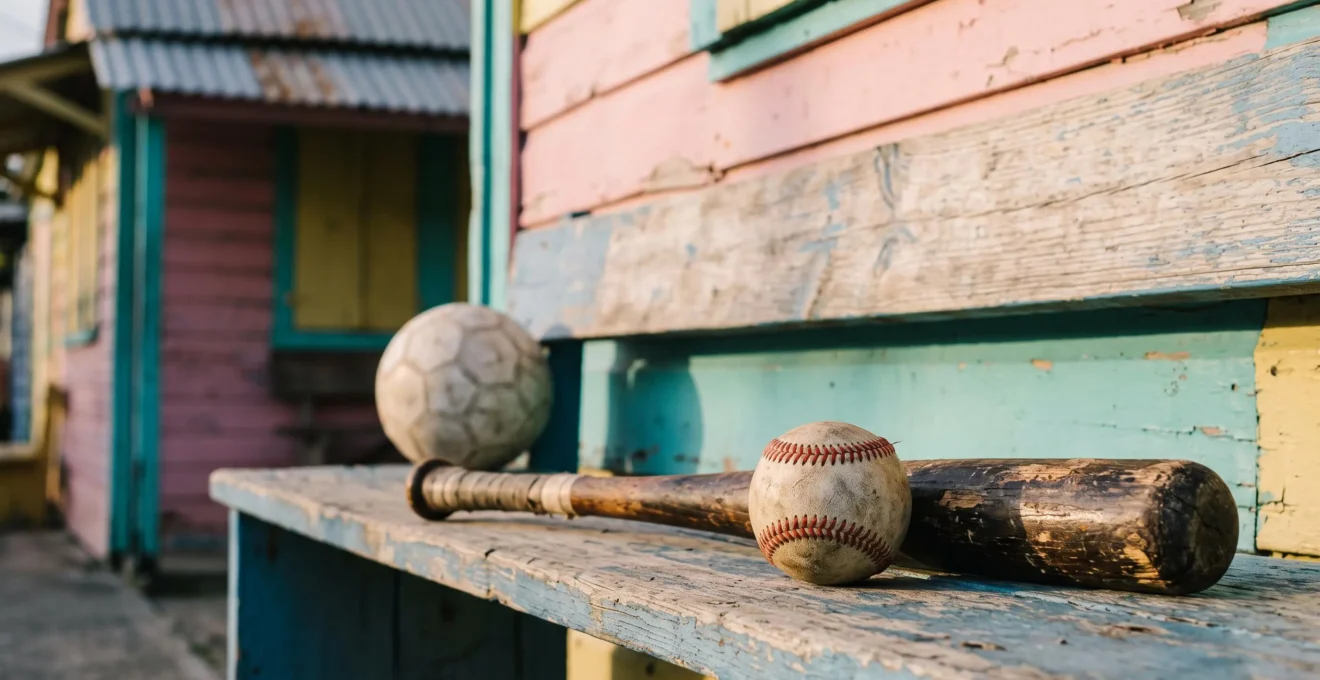
Many assume baseball is just another American sport the Dominican Republic adopted. The truth is far deeper. Baseball became the island’s soul through a unique blend of economic necessity in sugar towns and a post-colonial drive for national identity. It’s not just a game; it’s the primary stage for the Dominican dream, a communal ritual played out from dusty streets to roaring stadiums.
For a British sports enthusiast, the world often revolves around the singular drama of a leather football. It’s the global language, a source of national pride from Manchester to Madrid. To arrive in the Dominican Republic, then, is to witness a cultural realignment. Here, the thwack of a wooden bat against a stitched leather ball—not the roar of a football crowd—is the nation’s true heartbeat. The obsession with *béisbol* can seem bewildering. Why, in a region dominated by footballing giants, did this particular American pastime take such deep, unshakeable root?
The easy answers point to Major League Baseball’s star-studded rosters, heavily featuring Dominican talent, or to the historical influence of the United States. While true, these are merely chapters in a much richer saga. To see baseball as a simple cultural import is to miss the story of how it was absorbed, transformed, and woven into the very fabric of national identity. Its real origins are not in corporate boardrooms but in the dusty cane fields of 19th-century sugar mills, where it served as both a distraction and a means of organization for migrant labourers.
This is a story of how a sport became a post-colonial counter-narrative; a vehicle for social mobility in a country of limited opportunities; and a daily ritual that binds communities together. It’s a passion that transcends the professional stadiums and spills into every neighbourhood, defining social life in ways that even the ubiquitous local corner store, the *colmado*, reflects and amplifies. This article will trace that journey, from the historical roots of the game to its modern-day expression, to understand not just that baseball is popular, but why it became the soul of a nation.
To fully grasp this cultural phenomenon, we will explore the key facets of Dominican baseball, from the infrastructure that produces its stars to the very language of the game. The following sections break down this national passion into its essential components.
Summary: The Unofficial Religion: Deconstructing Dominican Baseball Culture
- Why Do Dominican Players Dominate Major League Baseball Rosters?
- How to Experience Authentic Dominican Baseball at Quisqueya Stadium?
- Santo Domingo or San Pedro de Macorís: Which Has Deeper Baseball Heritage?
- The Baseball Stadium Visit Mistake When No Games Are Scheduled
- What Spanish Baseball Terms Should You Know for Dominican Games?
- Why Do Many Dominicans Identify More Strongly With Spanish Than African Ancestry?
- Why Do Dominican Colmados Operate Until Midnight When Supermarkets Close at 8 PM?
- Why Are Colmados Central to Dominican Daily Life Beyond Just Selling Groceries?
Why Do Dominican Players Dominate Major League Baseball Rosters?
The sheer prevalence of Dominican talent in North American professional baseball is no accident; it is the result of a highly structured and sophisticated system. The Dominican Republic functions as the single most important international incubator for Major League Baseball (MLB). The numbers are staggering: a 2023 analysis revealed that over a tenth of MLB rosters were Dominican-born, a figure that doesn’t even include the hundreds more playing in the minor leagues. This dominance is not just about raw talent, but about a targeted, industrial-scale development pipeline.
The core of this system is the baseball academy model. A Michigan State University analysis explains that a profound shift occurred when every single one of the 30 MLB teams established its own dedicated academy on the island. These facilities are more than just training grounds; they are residential compounds where promising young players, some signed as young as 16, are housed, fed, educated, and drilled in the fundamentals of the game. This infrastructure represents a massive redirection of investment and scouting focus away from the US mainland and squarely onto Latin America, with the Dominican Republic as its epicentre.
These academies create a powerful incentive structure. For countless Dominican boys, baseball is not merely a sport but one of the few viable pathways out of poverty. The dream of « making it » fuels an intense, nationwide focus on the game from a very early age. This creates a hyper-competitive environment where only the most dedicated and talented can hope to secure a coveted spot in an academy, which in turn feeds a constant, seemingly endless supply of elite players to the global stage. It is a system built on hope, discipline, and immense economic pressure.
How to Experience Authentic Dominican Baseball at Quisqueya Stadium?
To truly understand Dominican baseball, you must experience it live, and there is no better cathedral for this secular religion than the Estadio Quisqueya Juan Marichal in Santo Domingo. Home to two fierce rivals, the Tigres del Licey and the Leones del Escogido, a game here is an immersion in pure, unadulterated passion. This is not the polite, reserved atmosphere of a cricket match; it is a vibrant, loud, and joyous spectacle. The air is thick with the sounds of merengue and bachata from the stadium speakers, the smell of roasted pork and cold Presidente beer, and the constant, roaring energy of the crowd.
The experience is a sensory overload in the best possible way. As one traveler who attended a Dominican Winter League game recalled, the thrill wasn’t just in watching the home team win, but in the communal energy of the fans, the dancing in the aisles, and the constant, good-natured chatter. It’s an environment that is both electric and welcoming. To prepare, you should embrace the local customs: wear the team colours, learn a few chants, and be ready to celebrate every hit and every run with the thousands around you.
The Dominican Winter League (LIDOM) runs from October to January, and attending a game is the single most authentic way to plug into the country’s cultural current. It’s more than just a sporting event; it’s a social gathering, a family outing, and a fierce display of local pride all rolled into one. Forget everything you know about quiet spectating; here, you are part of the show.
Your Game Day Action Plan: Mastering the Quisqueya Stadium Experience
- Points of Contact: Check official LIDOM websites and team social media channels for game schedules, times, and ticket availability well in advance.
- Collect: Secure tickets online before the game or at the stadium box office on the day. Remember to have cash (Dominican Pesos) for food, drinks, and souvenirs inside.
- Coherence: To truly feel like a local, wear the team colours. For a game at Quisqueya, that means bright blue for Tigres del Licey or scarlet red for Leones del Escogido.
- Memorability/Emotion: Arrive at least an hour early. This allows you to soak in the incredible pre-game atmosphere, hear the music, and feel the energy build before the first pitch.
- Plan for Integration: Plan your transportation back to your accommodation beforehand. Taxis and ride-sharing services are available, but can be in high demand after the final out.
Santo Domingo or San Pedro de Macorís: Which Has Deeper Baseball Heritage?
While Santo Domingo is the modern nerve centre of Dominican baseball, with its grand stadium and league headquarters, the historical and spiritual heart of the game lies an hour to the east, in the city of San Pedro de Macorís. To ask which has a deeper heritage is to compare the brain to the soul. Santo Domingo is where the business of baseball happens; San Pedro is where the legend was born. The city is affectionately known as « The Cradle of Shortstops » for its uncanny ability to produce world-class infielders.
The numbers are astonishing. Despite being a fraction of the size of the capital, an analysis on Dominican destinations shows the city has produced 99 Major League players. This phenomenon has its roots in the late 19th and early 20th centuries, when San Pedro was the bustling centre of the nation’s sugar industry. American sugar companies built baseball fields to entertain their workers, and Cuban migrants who came to work in the mills brought with them a burgeoning passion for the game. Baseball became the primary form of recreation and social organization in the *bateyes* (sugar-mill towns), creating a culture of intense competition and skill development that has been passed down through generations.
Mark Kurlansky’s seminal book, *The Eastern Stars*, documents how this small, impoverished sugar town became a global baseball powerhouse, noting that by 2008, roughly one in six Dominican big leaguers traced their roots to this single region. The following table breaks down the distinct roles these two cities play in the nation’s baseball narrative.
| Aspect | Santo Domingo | San Pedro de Macorís |
|---|---|---|
| Role | Business and media capital of professional baseball | Historical, grassroots heartland of player development |
| Signature Trait | LIDOM headquarters and Estadio Quisqueya | Nicknamed ‘The Cradle of Shortstops’ |
| Origin Story | Modern MLB academy and league infrastructure | 19th-century sugar mill teams founded by Cuban migrants |
| MLB Talent Output | Largest national hub for academies and scouting | 99 Major League players despite a far smaller population |
| Visitor Focus | Professional games, academies, baseball museum | Estadio Tetelo Vargas, sugar mill ruins, informal training grounds |
The Baseball Stadium Visit Mistake When No Games Are Scheduled
A common mistake for visitors is assuming that if the professional league isn’t playing, there is no baseball to be seen. This could not be further from the truth. The soul of Dominican baseball is not confined to its stadiums; it thrives in the streets, parks, and empty lots of every neighbourhood. This informal version of the game is known as *vitilla*, a form of stickball that serves as the first entry point into the sport for almost every child.
The game is a masterpiece of improvisation. In place of a baseball, players use the plastic cap from a 5-gallon water jug, a *vitilla*. Instead of a bat, they use a simple broomstick. The cap’s aerodynamic properties make it dip and swerve unpredictably, training a young player’s eye and reflexes to an extraordinary degree. As Fox News Sports noted in a feature on the game, if you ask any Dominican professional player, « They’ll tell you Vitilla or Dominican stickball is the first game they’ve ever played. » Though it evolved from street games in the 1970s, its popularity is so immense that the first organized tournament for vitilla was held in 2009, cementing its cultural status.
So, if there are no games at the stadium, the real experience is to take a walk through a residential area in the late afternoon. You will inevitably hear the tell-tale *clack* of a broomstick hitting a bottle cap. Watching a game of *vitilla* is to witness the pure, unadulterated joy of the sport and the very first step on the long journey that might one day lead a child from that dusty street to the bright lights of a major league stadium.
What Spanish Baseball Terms Should You Know for Dominican Games?
While you can certainly enjoy a game without speaking the language, knowing a few key Spanish baseball terms will transform your experience from that of a passive observer to an engaged participant. Dominican Spanish is fast, colourful, and filled with unique baseball slang. Shouting the right word at the right time will earn you nods of approval from the fans around you and deepen your connection to the action on the field.
The vocabulary is a mix of direct Spanish translations and « Spanglish » adaptations of English terms. The most important thing to know is that baseball itself is simply called *pelota*, or « ball. » This is the universal term you will hear everywhere. From there, you can begin to build a lexicon that will help you follow the intricate drama of each inning. Don’t be shy; the atmosphere is loud and forgiving, and any attempt to join in the local vernacular will be appreciated.
Here are some essential terms to get you started:
- Jonrón: The king of all hits, a home run. The « j » is pronounced like an « h » (hon-RON).
- Ponche / Ponchao: A strikeout. You’ll hear the umpire yell it and the crowd groan or cheer it.
- Carrera: A run. *Una carrera* is one run.
- Pelotero: A ballplayer. This is a term of respect.
- ¡La sacó!: « He hit it out! » The explosive cry for a home run.
- Out / Au: Pronounced « ow, » this is the universal call for an out.
- Hit / Jit: A base hit. You’ll hear the announcer call it out with a rolling « r » sound.
- Inning: Often pronounced *ini*, dropping the « ng » sound at the end.
Why Do Many Dominicans Identify More Strongly With Spanish Than African Ancestry?
This is a profoundly complex and sensitive question, deeply rooted in the Dominican Republic’s colonial history and nation-building projects. For an outsider, particularly one from a society with different racial constructs, the Dominican approach to identity can be perplexing. While genetic studies show the population has significant African ancestry, many Dominicans do not identify as Black (*negro*). Instead, they often use the unique term *Indio* (Indian) to describe their skin colour, a label that does not refer to the indigenous Taíno people, who were largely wiped out by Spanish colonialism.
This phenomenon is the legacy of a centuries-long process of *blanqueamiento*, or « whitening. » After independence, the nation’s elites sought to culturally and racially align the Dominican Republic with Europe—specifically Catholic Spain—and distance it from its African heritage. This was partly a reaction against Haiti, its neighbour on the island of Hispaniola, which was founded by formerly enslaved Africans and became the world’s first Black republic. Dominican national identity was constructed in opposition to Haitian identity, which was often racialized as « Black » and « African. »
This ideology was aggressively promoted during the dictatorship of Rafael Trujillo (1930-1961), who championed a Hispanic-centric identity and actively suppressed African cultural expressions. He popularized the use of *Indio* as a census category to minimize the country’s Blackness. Today, these historical forces continue to shape racial identity. Identifying as *Indio* or Hispanic is not necessarily a denial of African roots, but rather a reflection of a distinct national and cultural identity forged in a unique and often traumatic historical context. It is a nuanced conversation that resists easy categorization and speaks to the lasting impact of colonialism on the collective psyche.
Why Do Dominican Colmados Operate Until Midnight When Supermarkets Close at 8 PM?
To an outsider, the operating hours of a Dominican *colmado*, or corner store, seem to defy standard retail logic. While large supermarkets close their doors at a conventional hour, the local colmado often remains a beacon of light and activity late into the night. It is not uncommon for them to stay open until 10 PM or later, seven days a week. This is because a colmado’s function extends far beyond simply selling groceries; it operates as the social and logistical hub of its immediate neighbourhood.
Their extended hours are a direct response to the rhythms of Dominican life. They serve as the go-to spot for a last-minute cooking ingredient, a cold beer after a long day’s work, or a snack during a late-night baseball game. The colmado is built on convenience and immediacy, serving a clientele that may not have the transportation to visit a distant supermarket or the storage space for bulk purchases. It provides what is needed, when it is needed.
Furthermore, the colmado is an essential part of the informal economy. A case study on their role highlights how they function as micro-financial centres, especially in remote areas. Beyond selling goods, they are places where people can buy mobile phone credit and pay utility bills, saving them a trip to a bank. This multifaceted role makes the colmado indispensable. They stay open late because they are not just stores; they are vital, on-demand service providers woven into the daily fabric of the community.
Fiao is everywhere. It is part of the fabric of Dominican society.
– Christine Hippert, anthropologist, The Racquet Press
Key Takeaways
- Baseball’s Dominican roots are not a modern US import but are deeply embedded in the 19th-century sugar mill economy, where it was a tool for social life.
- The modern MLB academy system is a highly organized talent pipeline that has transformed the Dominican Republic into a global baseball superpower.
- Authentic baseball culture is found not only in professional stadiums during the Winter League but also in the daily, informal street games of *vitilla*.
- The *colmado* (corner store) functions as a crucial social hub, mirroring the communal role of baseball and operating as the neighbourhood’s « clubhouse. »
Why Are Colmados Central to Dominican Daily Life Beyond Just Selling Groceries?
The central role of the colmado in Dominican life cannot be understood by looking at its inventory alone. Its true power lies in its function as a centre of social gravity and its foundation in a system of mutual trust. This is most powerfully embodied in the practice of *fiao*, or buying on credit. A formal study on this « moral economy » describes how *fiao* is not a simple financial transaction but an act that links customers and shopkeepers in extensive social networks built on a borrower’s reputation for being *’gente responsable’* (responsible people).
This trust-based system is something a supermarket can never replicate. The *colmadera* (shopkeeper) knows their customers by name, knows their families, and keeps a running tab in a simple notebook. This allows families to get through tough times when cash is short, ensuring they can always put food on the table. As anthropologist Christine Hippert starkly puts it, « People are buying food in Dominican Republic more often than not without money. » This creates a profound bond of loyalty and interdependence.
Beyond this, the colmado is the neighbourhood’s living room and its news ticker. It’s where neighbours gather on plastic chairs to escape the heat, share gossip, debate politics, and, most importantly, argue passionately about last night’s baseball game. It is the de facto community clubhouse, a place of connection and communication. Its value is not in what it sells, but in the social fabric it weaves every single day.
Now that you understand the ‘why’ behind the Dominican passion for baseball and the cultural pillars that support it, the next logical step is to experience it for yourself. Whether planning a trip to Quisqueya Stadium or simply striking up a conversation about *pelota* at a local colmado, you now hold the key to connecting with the true heart of the Dominican Republic.