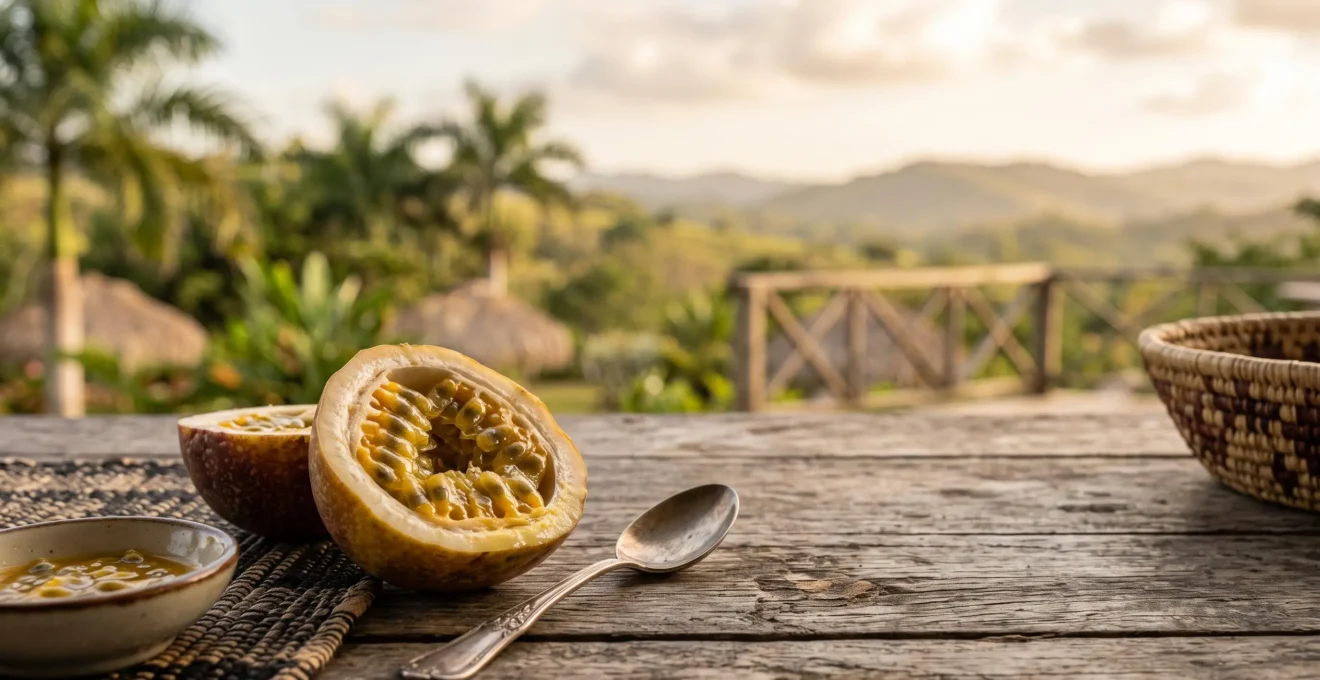
The use of « chinola » for passion fruit in the Dominican Republic isn’t just a linguistic quirk; it’s a window into the island’s unique agricultural identity and social fabric. This name, distinct from the common « maracuyá, » reflects a specific cultural context where the fruit’s journey from backyard vine to a refreshing juice served at the local colmado has shaped the very words used to describe it, revealing a story of local pride and everyday life.
For many English speakers, particularly a tropical fruit enthusiast from the UK, the passion fruit is a familiar, if exotic, pleasure. Its tangy pulp and distinctive aroma are unmistakable. Yet, upon arriving in the Dominican Republic, you’ll ask for a *jugo de maracuyá*—the common Spanish term used across much of Latin America—and be met with a friendly correction: « Ah, you mean *chinola*. » This moment of linguistic divergence is more than a simple translation; it’s an invitation into a deeper layer of Dominican culture.
It’s easy to dismiss this as a mere regionalism, another entry in a long list of varied Spanish vocabulary. But as a specialist in agricultural linguistics, I can assure you the story is far more fascinating. The persistence of « chinola » is not accidental. It is tied to the specific varieties grown on the island, the way the fruit is woven into the national diet, and its role within the unique socio-economic ecosystem of the neighbourhood corner store, or *colmado*.
To truly understand why a Dominican sips *jugo de chinola* and not *jugo de maracuyá*, we must look beyond the dictionary. We need to explore the soil where it grows, the kitchens where it’s prepared, and the communities that have made it their own. This is not just a story about a word, but a story about how a culture tastes, speaks, and lives.
This guide will take you on that journey. We will examine the specific type of passion fruit that flourishes in the Dominican climate, debate the perfect amount of sugar for its iconic juice, and settle the score between fresh and bottled versions. More importantly, we’ll uncover the culinary secrets, like the value of its crunchy seeds, and see how this humble fruit connects to the very heart of Dominican daily life: the ever-present, all-important colmado.
Summary: The Cultural Significance of Chinola in the Dominican Republic
- What Type of Passion Fruit Thrives in the Dominican Republic’s Climate?
- How Much Sugar Should You Add to Fresh Dominican Chinola Juice?
- Does Bottled Chinola Juice Taste Like Freshly Squeezed Passion Fruit?
- The Chinola Mistake Where You Throw Away the Edible Crunchy Seeds
- How to Select Ripe Chinola at Dominican Markets Without Getting Underripe Fruit?
- Why Do Cassava, Plantains, and Yuca Dominate Dominican Creole Dishes?
- Why Do Dominican Colmados Operate Until Midnight When Supermarkets Close at 8 PM?
- Why Are Colmados Central to Dominican Daily Life Beyond Just Selling Groceries?
What Type of Passion Fruit Thrives in the Dominican Republic’s Climate?
The passion fruit most commonly known as chinola in the Dominican Republic is typically the yellow variety, Passiflora edulis f. flavicarpa. This variety is perfectly suited to the island’s tropical climate, which provides the warmth, humidity, and abundant sunlight necessary for the vines to flourish and produce prolifically. While its purple cousin (P. edulis f. edulis) is more common in other parts of the world, the yellow chinola is celebrated for its larger size and a distinctly tarter, more acidic flavour profile, making it ideal for juices.
These vines are a common sight, climbing over fences in residential backyards and sprawling across structured trellises on commercial farms. This dual existence—as both a casual garden fruit and a serious agricultural product—is key to its cultural importance. For many Dominicans, chinola is a taste of home, picked fresh from a family member’s plant.
Simultaneously, chinola has grown into a significant cash crop. Beyond local consumption, the Dominican Republic produces passion fruit for export to markets in the United States, Europe, and Puerto Rico. This commercial cultivation ensures a steady supply, but it also highlights the fruit’s economic value. The official season runs from spring through summer, which is when you’ll find the most abundant and flavourful fruit in local markets, bursting with the vibrant pulp that defines its character.
How Much Sugar Should You Add to Fresh Dominican Chinola Juice?
Asking for a definitive recipe for the amount of sugar in *jugo de chinola* is like asking for the precise amount of milk in a British cup of tea—it’s a deeply personal and culturally nuanced affair with no single right answer. The quantity of sugar is a moving target, dependent on three key factors: the ripeness of the fruit, personal preference, and the context of the meal. A very ripe, wrinkled chinola is naturally sweeter and requires less sugar, while a smoother, less ripe one will have a sharp tartness that needs more balancing.
Just as the ideal sweetness is a matter of local taste, the very name of the fruit is a testament to regional identity. This linguistic diversity across the Spanish-speaking world highlights how each culture has formed its own unique relationship with the fruit.
| Country | Local Name for Passion Fruit |
|---|---|
| Dominican Republic | Chinola |
| Puerto Rico | Parcha |
| Colombia & Mexico | Maracuyá |
| Venezuela | Parchita |
| Spain | Fruta de la Pasión |
The traditional Dominican method involves blending the pulp (with or without seeds) with water and then adding sugar « al gusto » (to taste). This often happens in small increments, tasting and adjusting until the perfect equilibrium between sweet (*dulce*) and tart (*agrio*) is achieved. Some prefer it bracingly tart to cut through the heat of the day, while others like a sweeter, more dessert-like beverage. It is this very process of personalization that makes fresh chinola juice a household staple.
Does Bottled Chinola Juice Taste Like Freshly Squeezed Passion Fruit?
In a word: no. To a Dominican palate, and to any enthusiast who has tasted the real thing, comparing bottled chinola juice to its freshly squeezed counterpart is like comparing a postcard of a beach to feeling the sand between your toes. While bottled juices, often found in supermarkets, offer convenience, they fundamentally lack the vibrant, complex, and explosive character of fresh juice. The process of pasteurization and the addition of preservatives and often high-fructose corn syrup inevitably dull the fruit’s bright, acidic notes and fragrant aroma.
The cultural preference is overwhelmingly for fresh. As one local culinary source puts it, « In the Dominican Republic, if you’re looking to cool off and refuel on a hot day, order one of our fruit juices—and among them, passion fruit juice is definitely a favorite. » This sentiment almost exclusively refers to the version made moments before consumption, either at home, at a restaurant, or from a roadside juice stand. The taste is electric and alive, a sensory experience that bottled versions simply cannot replicate.
The difference lies in the volatility of the aromatic compounds. The moment a chinola is cut open, its signature tropical fragrance begins to dissipate. Freshly blended juice captures this peak moment. Bottled juice, by contrast, offers a flattened, more homogenous, and typically much sweeter flavour profile that misses the delightful interplay of tart and sweet that makes fresh chinola so refreshing and memorable.
The Chinola Mistake Where You Throw Away the Edible Crunchy Seeds
One of the most common practices when preparing *jugo de chinola* is to strain it meticulously, creating a smooth, pulp-free liquid known as *jugo colado*. While this is a popular style, from a nutritional and textural standpoint, discarding the seeds is a significant mistake. The small, black, crunchy seeds are not only edible but are also a powerhouse of nutrients that are unfortunately often lost in the straining process.
Many visitors and even some locals are unaware of the benefits they’re tossing away. The seeds provide a delightful textural contrast to the smooth pulp and, more importantly, are packed with dietary fibre. Indeed, a 2025 food-science study on passion fruit seeds found that their inclusion « markedly increased the dietary fiber content » of the juice. This fibre is crucial for digestive health and helps to moderate the absorption of sugar from the juice.
Beyond fibre, the seeds contain valuable micronutrients. They are a notable source of piceatannol, a polyphenol with recognized health benefits. A human clinical trial found that participants taking 20 mg of piceatannol daily for 8 weeks had improved metabolic health, including better insulin sensitivity. This powerful compound is concentrated in the very seeds that are so frequently strained out. Opting for a *jugo batido* (blended juice with seeds) or simply scooping the pulp and seeds directly onto yogurt or into a smoothie ensures you receive the full nutritional spectrum of this incredible fruit.
How to Select Ripe Chinola at Dominican Markets Without Getting Underripe Fruit?
Walking through a Dominican market or stopping at a roadside fruit stand presents a beautiful but potentially confusing array of chinolas. For the uninitiated, the instinct is to grab the most visually perfect fruit: smooth, shiny, and uniformly yellow. This, however, is the primary mistake. A truly ripe, flavourful chinola destined for a perfect glass of juice is often the one that looks past its prime. The key is to engage multiple senses.
The most important visual cue is the skin. Look for a fruit that is deeply coloured and, crucially, wrinkled. A wrinkled, slightly shriveled skin indicates that the fruit has reached peak maturity, its water content has slightly decreased, and the sugars inside have concentrated, intensifying the flavour and aroma. A smooth-skinned chinola is likely underripe and will be excessively tart. Another key indicator is weight; a ripe chinola should feel heavy for its size, which signals that it is still full of juicy pulp and hasn’t dried out.
Finally, trust your nose. Bring the fruit close and smell it, especially near the stem. A ripe chinola will emit a strong, sweet, and unmistakable tropical fragrance. If there’s little to no scent, it’s not ready. By prioritizing wrinkles, weight, and aroma over superficial smoothness, you will consistently choose a fruit that delivers the authentic, complex taste of the Dominican Republic.
Action Plan: Selecting the Perfect Chinola
- Sensory Contact: Engage all your senses. Use your eyes to look for deep color and wrinkles, your hands to feel for heaviness, and your nose to check for a strong, sweet aroma.
- Data Collection: Don’t just grab the first one. Pick up several candidates from the vendor’s pile to compare their relative weights and fragrances.
- Consistency Check: Ensure the fruit’s appearance (wrinkled) matches its feel (heavy for its size). This confirms it’s full of pulp and not just a dried-out, empty shell.
- Aromatic Confirmation: The most reliable sign of peak flavor is a powerful, sweet, tropical fragrance. A scentless chinola is an unripe chinola.
- Final Selection: Based on the combination of weight and aroma, make your choice. Actively avoid any fruit that feels light, has perfectly smooth skin, or shows signs of mold or soft spots.
Why Do Cassava, Plantains, and Yuca Dominate Dominican Creole Dishes?
To understand the place of chinola in Dominican cuisine, one must first understand the foundation upon which the entire flavour palate is built: the starchy staples known as *víveres*. Cassava (yuca), plantains (plátanos), and other root vegetables like ñame and yautía are the bedrock of countless Creole dishes, from the breakfast staple *mangú* (mashed plantains) to the hearty stew *sancocho*. Their dominance is not accidental; it is a direct result of agricultural history, caloric efficiency, and culinary function.
These crops were staple foods for the indigenous Taíno people and have remained central to the Dominican diet for centuries due to their hardiness and ability to thrive in the island’s climate. Yuca, in particular, is described as « a root vegetable that’s a major staple food in the Dominican Republic, » deeply embedded in the nation’s cultural and culinary identity. These tubers and starchy fruits provide a satisfying, calorically dense base for meals. Their flavour is generally mild, earthy, and subtle.
This is precisely why chinola is such a perfect companion. The mild, starchy canvas of the *víveres* cries out for a contrasting element. The bright, sharp acidity and intense fragrance of a fresh chinola juice cuts through the richness of a plate of fried plantains or a creamy yuca mash, cleansing the palate and adding a vibrant, refreshing counterpoint. This culinary symbiosis—the pairing of a neutral base with a high-acid, aromatic element—is a classic principle of gastronomy, and it is practiced instinctively in Dominican kitchens every day.
Why Do Dominican Colmados Operate Until Midnight When Supermarkets Close at 8 PM?
The difference in operating hours between a supermarket and a *colmado* reveals the fundamental difference in their roles within Dominican society. A supermarket is a transactional space for planned, bulk purchases. A *colmado*, on the other hand, is an integral part of the neighborhood’s social fabric, operating on the rhythm of daily life, not a corporate schedule. Their late hours, often extending to midnight or beyond, cater to this role as the community’s de facto pantry and social hub.
Life in the Dominican Republic doesn’t stop at 5 PM. Evenings are for socializing, with neighbors gathering on front stoops or in local parks. A *colmado* with its plastic chairs and tables outside becomes an impromptu gathering spot. The late hours accommodate those returning from a late shift, needing a few last-minute items for dinner, or simply wanting a cold Presidente beer or a shot of rum to share with friends. It serves an immediate, spontaneous need that a supermarket, with its rigid closing times, cannot.
Furthermore, the *colmado* model is built on hyper-local convenience. As one observer of Dominican life noted, « People can call their local colmado for a delivery. » This service, often for an order as small as a single bottle of soda or a few eggs, highlights their deep integration into the community’s daily flow. You can be cooking and realize you’re out of oil or, indeed, need a few more chinolas for juice, and a quick phone call solves the problem. This level of service and flexibility is why they remain essential long after the supermarket doors have locked.
Key Takeaways
- The name « chinola » is a distinct Dominican cultural marker, setting it apart from the more common « maracuyá » and reflecting local pride.
- The edible seeds of the chinola are a nutritional powerhouse, rich in fiber and beneficial compounds, making it a mistake to strain them out.
- The entire chinola experience, from buying the fruit to enjoying the juice, is deeply intertwined with the social and economic ecosystem of the local colmado.
Why Are Colmados Central to Dominican Daily Life Beyond Just Selling Groceries?
The *colmado* is the heart of the Dominican neighborhood, and its importance extends far beyond the simple act of selling groceries. It functions as a bank, a social club, a delivery service, and a vital thread in the community’s safety net. This multifaceted role is built on a foundation of personal relationships and, most importantly, trust, a concept beautifully illustrated by the informal credit system known as *fiao*.
In her ethnographic work on Dominican corner stores, anthropologist Dr. Christine Hippert examines this very practice of buying food on credit. Many families, especially those with fluctuating incomes, rely on their local *colmadego* (store owner) to extend them credit for daily necessities. This is all tracked not with a credit card machine, but in a simple notebook—the famous *libreta*. As one writer aptly put it, « The notebook (*libreta*) is the unofficial paper credit system of the Dominican Republic. » A customer might get their daily rice, beans, and the chinolas for their afternoon juice, with the total being jotted down to be settled on payday.
This system is impossible for a large, impersonal supermarket to replicate. It requires the *colmadego* to have an intimate knowledge of their customers, their families, and their situations. The *colmado* is therefore not just a business; it’s a social institution built on reciprocity and long-term relationships. It’s the place you go when you need to break a large bill, ask for directions, or just catch up on the local gossip. It is this deeply human connection that makes it truly central to Dominican life.
By understanding that « chinola » is more than a word and the *colmado* is more than a store, you begin to see the intricate connections that define Dominican culture. So on your next visit, listen for these details, taste the difference in a freshly made juice, and appreciate the rich stories that exist in the most everyday things.