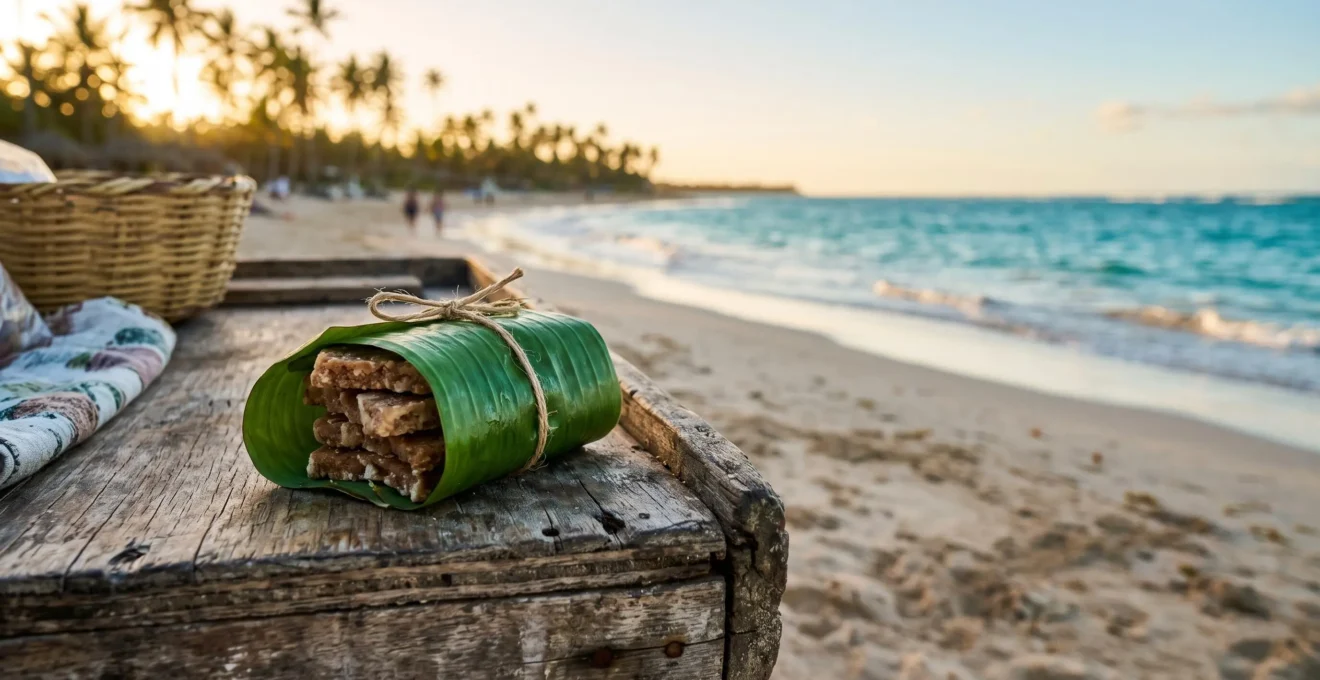
The banana leaf on Dominican dulce de coco isn’t just tradition; it’s a key part of a sophisticated culinary and economic system.
- It signals an authentic, handmade sweet, distinct from factory-produced versions.
- It connects you to a local, informal economy where your purchase directly supports families.
Recommendation: Always choose the beach vendor or colmado over the resort shop for the true taste and a more meaningful cultural experience.
If you’ve ever walked along a Dominican beach, you’ve seen it: a smiling vendor offering small, glistening parcels wrapped in unassuming dried banana leaves. This is dulce de coco, the ubiquitous coconut sweet that seems to be a mandatory part of the island’s landscape. For many travellers, the initial thought is simple—it’s just a local candy. But this treat is far more than a simple confection of coconut and sugar. The real story isn’t just about the taste; it’s a narrative woven from precise culinary techniques passed down through generations, the specific properties of the coconut used, and the vital social role these sweets play in the local economy.
Most discussions stop at the recipe, but they miss the point. The secret to understanding dulce de coco lies in appreciating the details that separate the authentic from the artificial. Why that specific wrapper? How can you tell a handmade batch from a factory-produced one? This is not just a sweet; it is a cultural artifact. To truly understand it, we must look beyond the ingredients and explore the craft, the context, and the community that brings it to life. This guide delves into the techniques of preparation, the social significance of its sale, and the broader cultural fabric—from Taíno weaving to the economics of the local corner store—that gives this humble sweet its profound meaning.
This article unpacks the layers of technique and tradition behind this iconic Dominican treat. Follow along as we explore the ingredients, the artisans, the cultural variations, and the wider context that makes dulce de coco so much more than just a beachside snack.
Summary: Unwrapping the Tradition of Dominican Dulce de Coco
- What Ingredients and Technique Create Authentic Dominican Dulce de Coco?
- How Can You Tell Handmade Dulce de Coco From Factory-Produced Versions?
- Which Dulce de Coco Flavour Variation Is Most Traditional?
- The Dulce de Coco Storage Error That Ruins Texture Within 48 Hours
- Should You Buy Dulce de Coco From Beach Vendors or Resort Shops?
- Why Did Taíno Basket Weaving Survive Whilst Ceremonial Pottery Nearly Disappeared?
- Why Do Dominican Colmados Operate Until Midnight When Supermarkets Close at 8 PM?
- Where Can You Learn Authentic Taíno Pottery or Weaving in the Dominican Republic?
What Ingredients and Technique Create Authentic Dominican Dulce de Coco?
The soul of authentic dulce de coco lies not in a long list of ingredients, but in the mastery of a simple, yet precise, process. The core components are elemental: grated coconut, sugar (often brown for a deeper flavour), evaporated milk, and sometimes a hint of cinnamon or vanilla. However, the real artistry is in the coconut processing and the cooking technique. Artisans distinguish between using dried, grated coconut (coco seco) for a chewier texture and fresh, tender coconut (coco tierno) for a softer, more luscious confection. This choice fundamentally alters the final product.
The cooking process is a patient one, done over very low heat. The goal is to slowly coax the sugar into a state of perfect caramelisation without burning, while allowing the coconut to release its oils and flavour. Constant stirring is essential. The most critical moment is determining doneness. Artisans don’t use timers; they use sensory cues. The mixture must reach a thick, pudding-like consistency where a wooden spoon can draw a line at the bottom of the pot. An even more precise method is the « thread test, » where a small amount is lifted and should form a thin, syrupy thread as it cools.
This attention to texture and consistency is what creates the sublime mouthfeel of a true handmade dulce de coco. The following steps, detailed by Dominican culinary experts, outline this traditional method. According to the chefs at Dominican Cooking, a leading authority on the island’s cuisine, you must bring the ingredients to a boil over very low heat, stir regularly, and cook for up to 40 minutes until the right consistency is achieved. It’s this slow, deliberate technique—not a fancy recipe—that defines authenticity.
How Can You Tell Handmade Dulce de Coco From Factory-Produced Versions?
For a traveller with a sweet tooth, distinguishing a truly artisanal dulce de coco from a mass-produced imitation is key to an authentic experience. The first clue is often the texture and appearance. Handmade versions have a more irregular, rustic look. The grated coconut is visibly fibrous and unevenly distributed, a sign of manual preparation. Factory-produced sweets, in contrast, are often perfectly uniform in shape, colour, and texture, with finely processed coconut that lacks the satisfying chewiness of the real thing.
The type of coconut used is another major differentiator. As culinary experts note, there are popular versions made from both « coco seco » (dry grated coconut) and « de coco tierno » (fresh coconut). Artisanal producers often specialize in one or the other, and the texture will reflect this choice—chewy and dense for dry, or soft and creamy for fresh. Industrial versions typically use desiccated coconut powder, resulting in a homogenous and often gritty texture that misses this nuance entirely.
However, the most reliable indicator is context. Where are you buying it? Authentic dulce de coco is rarely found in the polished, air-conditioned gift shops of resorts or airports. As a study of local foodways in Samaná highlights, the best versions are found at roadside stands, in neighbourhood colmados (corner stores), or directly from street vendors. These sellers are often the artisans themselves or are closely connected to them, ensuring the product is fresh and made with traditional methods. A factory-produced bar will have printed packaging and a long shelf life, while a handmade sweet is often simply wrapped in a banana leaf, intended to be eaten within a day or two. Choosing the latter is choosing the authentic taste of the Dominican Republic.
Which Dulce de Coco Flavour Variation Is Most Traditional?
While the classic dulce de coco made with just coconut, milk, and sugar is the most widespread, Dominican culinary tradition is rich with regional and familial variations. Asking which one is « most » traditional is like asking for the single « correct » way to make a Sunday roast in the UK; the answer lies in a spectrum of beloved local practices. The variations are not modern inventions but are deeply rooted in the agricultural landscape of the island.
One of the most authentic and celebrated variations is dulce de coco con batata. This version incorporates mashed sweet potato into the coconut mixture. The batata adds a natural, earthy sweetness, a creamier, denser texture, and a beautiful orange hue. This isn’t a new-age fusion; it’s a classic example of Dominican resourcefulness, combining two of the island’s most abundant crops into a single, harmonious dessert. Today, you can still find home vendors who specialize in this specific recipe, a testament to its enduring popularity as a Dominican favourite.
Other traditional flavourings are more subtle. A stick of cinnamon or a splash of Dominican rum might be added to the pot during the slow cooking process. In some regions, a few gratings of ginger lend a spicy warmth that cuts through the sweetness. The key is that these additions are natural and complement the coconut rather than overpowering it. The most traditional variations are therefore not those with artificial flavourings, but those that creatively use the island’s own pantry—sweet potato, spices, and rum—to enhance the star ingredient: the coconut.
The Dulce de Coco Storage Error That Ruins Texture Within 48 Hours
For a tourist who has purchased a few pieces of authentic, handmade dulce de coco, there is one critical error that can turn a delicious treat into a sticky, grainy disappointment: improper storage. The humid, tropical climate of the Dominican Republic is the enemy of this sugar-based confection. The biggest mistake is leaving it exposed to the open air, even in an air-conditioned hotel room. Sugar is hygroscopic, meaning it attracts and absorbs moisture from the atmosphere.
When left out, the dulce de coco will begin to « weep, » becoming overly soft and sticky. The delicate crystal structure of the cooked sugar breaks down, leading to a grainy mouthfeel. Within 48 hours, what was a perfectly chewy or creamy sweet can become an unappealing mess. The banana leaf wrapper, while excellent for short-term transport and adding aroma, is not an airtight seal and offers little protection against prolonged exposure to humidity.
The solution is simple and follows the advice of local cooks. As culinary historian Tía Clara of Dominican Cooking advises, « Once cooled, place in an airtight container and chill or store in the refrigerator. » For the traveller, this means transferring the sweets from their charming banana leaf wrapper into a sealed container or even a simple zip-lock bag as soon as possible. Storing them in the hotel mini-fridge is an excellent option. This prevents moisture absorption, preserves the intended texture crafted by the artisan, and ensures your delicious souvenir remains enjoyable for several days.
Should You Buy Dulce de Coco From Beach Vendors or Resort Shops?
When faced with the choice between buying a sweet from a smiling beach vendor or from the pristine shelves of a resort gift shop, the decision has implications that go far beyond taste. From a purely cultural and culinary perspective, the vendor is almost always the superior choice. The product is fresher, made with traditional techniques, and offers a direct taste of the local food scene. However, the economic and social reasons are even more compelling.
The beach vendor is a micro-entrepreneur, a participant in the vast informal economy that is the lifeblood of many Dominican communities. A national tourism sector survey found that 42.2% of businesses in key tourist zones operate informally. When you buy from a vendor, your money is more likely to go directly to supporting a family and circulating within the local community. It’s a small transaction that has a direct, positive impact. This is vividly illustrated in the work of organizations like Kiva, which highlight how individuals like Syliana, a Kiva borrower, build livelihoods by running small shops from their homes, selling staples and sweets to their neighbours and passing tourists.
In contrast, a purchase at a resort shop channels revenue into a larger corporate structure, with only a fraction trickling down to local producers, if any. The choice, therefore, becomes clear. Buying from the beach vendor is not just about getting a more authentic product; it is an act of participation in the local culture and economy. It is a small but meaningful exchange that affirms the value of the artisan’s craft and contributes directly to their livelihood, turning a simple purchase into a moment of genuine human connection.
Why Did Taíno Basket Weaving Survive Whilst Ceremonial Pottery Nearly Disappeared?
To understand the cultural resilience of something as simple as a banana leaf wrapper, one must look at the broader history of Dominican crafts, particularly the legacy of the indigenous Taíno people. The survival of Taíno craft traditions into the modern day is a story of utility versus ceremony. While intricate Taíno ceremonial pottery has become a subject for archaeologists, the practical art of weaving has endured because it was seamlessly integrated into daily life.
The CraftEncyclopedia editorial team notes that manual weaving with natural fibres dates back to pre-Columbian times, used by the Taíno for essential items like clothing, hammocks, and baskets. When the Spanish colonizers arrived, the ceremonial aspects of Taíno culture, including much of their symbolic pottery, were suppressed or eradicated. However, the practical skills of weaving and basketry remained indispensable for both the indigenous population and the new inhabitants. You couldn’t transport goods, store food, or create shelter without woven materials. Its utility was its salvation.
This principle of survival through utility extends to the use of materials like the banana and palm leaf. The knowledge of how to select, treat, and fold these leaves to create functional, water-resistant containers is a direct descendant of this ancient Taíno expertise. While the specific idols the Taíno wove have disappeared, the underlying skill—the ability to turn a simple plant into a useful object—has been passed down. The banana leaf wrapping on a dulce de coco is a tiny, edible echo of this long history, a testament to a craft that survived because it was, and remains, fundamentally useful.
Why Do Dominican Colmados Operate Until Midnight When Supermarkets Close at 8 PM?
The place where you are most likely to find authentic dulce de coco, apart from a beach vendor, is the local colmado. To a visitor, it might look like a simple corner shop, but understanding why it stays open late reveals its true function as the social and economic heart of a Dominican neighbourhood. Unlike a supermarket, which is a purely transactional space that closes at a set hour, the colmado is a deeply integrated community hub.
The colmado’s business model is built on relationships, not just retail. As described by observers on the Kiva blog, it is the neighbourhood living room, where residents gather to play dominoes, share a cold Presidente beer, and catch up on local news. At night, some transform into informal bars or social clubs. Their extended hours are a direct response to the rhythms of community life, serving as a safe, lit-up social anchor long after the supermarkets have closed their doors. They are open because the community is still awake and interacting.
Furthermore, the colmado operates on an economic principle of trust that supermarkets cannot replicate: the system of fiao, or buying on credit. As documented in academic research on the Dominican moral economy, neighbourhood residents can get staples on credit, a line of trust extended by the colmado owner who knows them personally. This system of mutual aid and flexible credit is a cornerstone of community resilience. The colmado isn’t just a place to buy a sweet; it’s a vital piece of social infrastructure, and its late hours are a direct reflection of its indispensable role in the daily lives of Dominicans.
Key Takeaways
- Authentic dulce de coco is defined by technique (slow cooking, the « thread test ») not a complex recipe.
- Look for sweets at roadside stands and colmados; their rustic appearance is a sign of handmade quality.
- The most traditional flavour variations use local ingredients like sweet potato (batata) and cinnamon.
Where Can You Learn Authentic Taíno Pottery or Weaving in the Dominican Republic?
For the traveller whose curiosity has been piqued by the craft behind a simple sweet, seeking out the living traditions of Taíno-descended crafts like weaving is a deeply rewarding next step. While you won’t find formal « Taíno Weaving 101 » classes advertised in tourist brochures, you can engage with these traditions directly by supporting the artisans who continue them. The key is to venture beyond the resort zones and into the rural heart of the country.
As Island Hopper Guides advises, the best approach is to « search for locally made baskets and woven items in rural areas. » This isn’t just about buying a souvenir; it’s about witnessing a living culture. When you purchase directly from an artisan, you are providing them with income and helping to validate and preserve their cultural heritage. This direct support is far more impactful than buying a mass-produced item from a third-party retailer. It turns you from a passive observer into an active participant in the continuation of a craft.
To make this journey more concrete, you can focus on regions known for specific crafts. This transforms a shopping trip into a cultural pilgrimage, allowing you to see the diversity within the tradition. The following checklist can serve as a guide for any traveller serious about connecting with the island’s artisan roots.
Your Dominican Craft Pilgrimage Checklist: Finding Weaving Specialties
- Gurabo Region: Make a point to visit this area, renowned for its traditional peasant hats, a craft passed down through generations of local artisans.
- Cibao Region: Specifically look for the distinctive baskets woven from cane and guano palm fibers, a hallmark of this region’s craft identity.
- Guano Palm Fiber Goods: Seek out specific items like serones, macutos (travel bags), and aparejos (animal saddles), which are some of the most typical articles made from this versatile material.
- Direct Purchase: Prioritize buying directly from the weaver or a small local cooperative. Ask about the materials and the time it takes to make an item.
- Observe and Respect: If you see someone weaving, approach respectfully. Show genuine interest in their work; your appreciation is often as valued as your purchase.
By seeking out these experiences, a simple curiosity about a coconut sweet can become a gateway to a much deeper understanding of the Dominican Republic’s rich and resilient cultural history. Your next trip can be more than a vacation; it can be an exploration of the living crafts and traditions that form the true soul of the island.