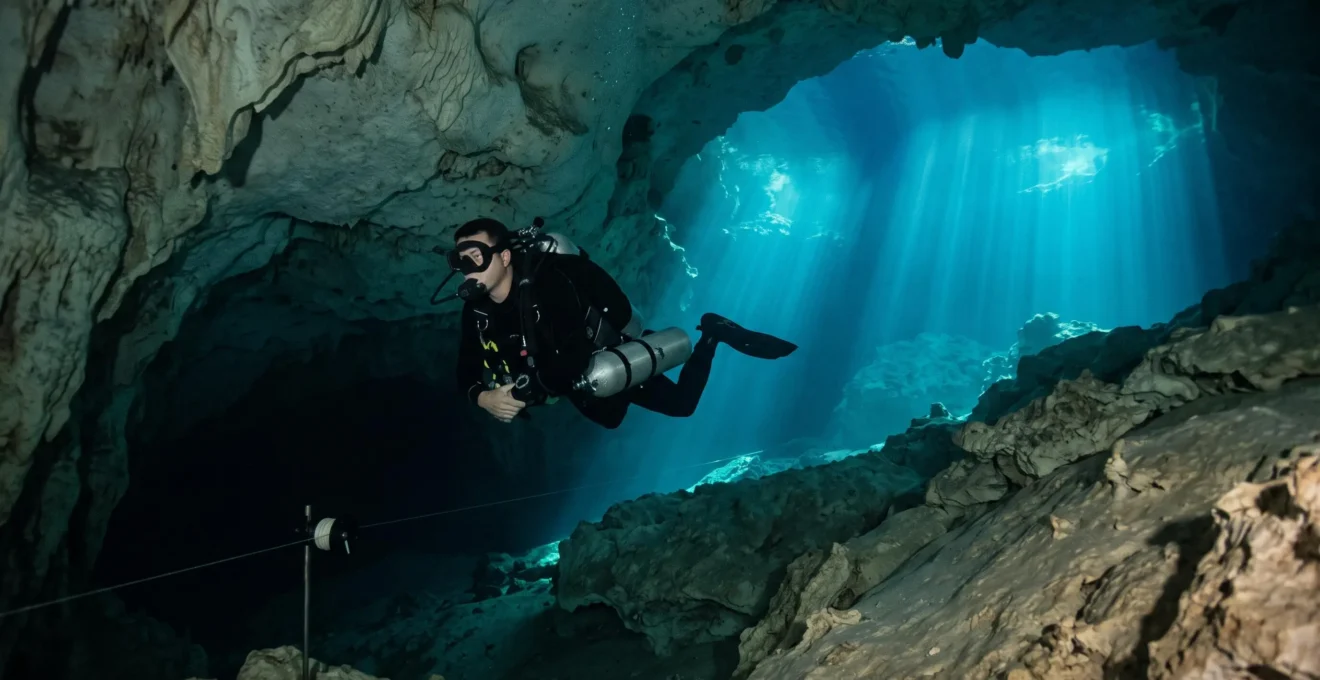
Your Open Water certification does not qualify you for Bayahibe’s cave systems; it marks the beginning, not the end, of the training required for overhead environments.
- Cavern diving, which remains within the « daylight zone, » may be accessible with a certified guide, but it is fundamentally different from cave diving.
- True cave diving requires extensive, specialized technical training focusing on skills your Open Water course never covered, such as guideline use and gas management rules.
Recommendation: Begin with a guided cavern dive at a recognized site like Padre Nuestro, but only after verifying your instructor’s specific cavern/cave credentials and discussing the dive’s strict limitations.
The allure of Bayahibe’s underwater caves is undeniable. The promise of crystal-clear freshwater, stunning geological formations, and a silent, otherworldly beauty tempts many divers visiting the Dominican Republic. As an open-water certified diver, you might look at these serene entrances and wonder, « Can I go in? » It’s a common question, born from a blend of curiosity and the confidence your certification card provides. Many assume that diving is diving, and that with good buoyancy, they can handle a short exploration.
This assumption, however, overlooks a critical safety distinction that is the bedrock of technical diving regulations. The transition from open water to an « overhead environment »—where a direct, vertical ascent to the surface is no longer possible—is one of the most significant in scuba. It introduces risks that open-water training is simply not designed to manage. The real question is not *if* you can enter, but *what you don’t know* about the protocols required to exit safely.
This is not a matter of gatekeeping; it is a matter of a fundamental safety gap. The skills that keep you safe in a coral garden are insufficient for a world without a visible surface. This guide is designed to bridge that knowledge gap. We will move beyond a simple « yes » or « no » to explain the systemic reasons behind cave diving’s stringent certification rules. By understanding the specific risks, the difference between cavern and cave diving, and the verification protocols for operators, you can make an informed and, above all, safe decision about how to approach these magnificent natural wonders.
This article breaks down the essential safety protocols, certification requirements, and environmental considerations for any diver considering an overhead environment in Bayahibe. Explore the sections below to understand the framework that keeps divers safe.
Summary: Do You Need Advanced Certification to Dive Bayahibe’s Underwater Caves?
- Why Do Some Bayahibe Underwater Caves Require Technical Cave Certification?
- Which Bayahibe Cavern Dive Is Safest for First-Time Overhead Environments?
- How to Verify Bayahibe Dive Shops Have Certified Cave Instructors?
- The Buoyancy Mistake That Makes Cave Diving Dangerous for Open-Water Divers
- When Does Bayahibe Offer Calmest Conditions for Underwater Cave Visibility?
- Why Do Oxybenzone and Octinoxate Harm Dominican Coral Reefs?
- The Safety Red Flag That 40% of Samaná Adventure Operators Ignore
- Which Reef-Safe Sunscreen Brands Actually Protect Caribbean Coral?
Why Do Some Bayahibe Underwater Caves Require Technical Cave Certification?
The requirement for technical cave certification is not arbitrary; it is a direct response to decades of accident analysis. The fundamental distinction is between a cavern and a cave. A cavern dive is considered recreational and involves staying within the ambient light of the entrance, always maintaining a clear, direct path to open water. A cave dive begins the moment you leave this daylight zone. It is here that the risks multiply exponentially, and where open-water training becomes dangerously inadequate. The protocols demanded by a cave environment are designed to manage three primary failure points: getting lost, running out of air, and exceeding depth/time limits.
Statistics starkly illustrate this necessity. While diving is generally a safe sport, entering a cave without proper training is one of its most lethal activities. According to expert analysis, the overwhelming majority of fatalities in underwater caves involve divers without cave-specific training. A landmark accident analysis project reviewing decades of fatalities found that every death could be traced back to one of three root causes. This research directly led training agencies to mandate protocols like the « Rule of Thirds » for gas management (one-third in, one-third out, one-third reserve) and the non-negotiable use of a continuous guideline to the surface—disciplines that are the core of cave training but absent from recreational courses.
The fatality rate in trained, certified cave divers is remarkably low.
– DiveVolk Diving (editorial team), Cave Diving Safety: Line Techniques, Emergency Protocols, and What Every Diver Should Know
This data confirms that it is not the environment itself that is lethally dangerous, but the lack of specific training to manage it. An estimated over 500 people have died in underwater caves since records began, with a staggering 80% or more being untrained divers. Certification is the system proven to mitigate these specific, known risks.
Which Bayahibe Cavern Dive Is Safest for First-Time Overhead Environments?
For an open-water diver looking to get a first, safe taste of an overhead environment, the key is to select a guided cavern dive at a site known for its accessibility and clear conditions. In the Bayahibe area, the most frequently recommended location for this purpose is Cueva Padre Nuestro. This freshwater cave system, located within the Parque Nacional del Este, is exceptionally well-suited for introductory cavern tours. Its accessibility is a major factor; a paved trail from the park entrance leads directly to the cave, making logistics simple and controlled.
What makes Padre Nuestro a safer choice for a first-timer is its well-documented layout and the established practices of local, reputable dive operators. The cavern zone is distinct, allowing guides to conduct tours that strictly adhere to the primary rule of cavern diving: maintaining sight of ambient light and a direct route to open water. A tour here should not be a deep penetration but a carefully managed circuit within the entrance area, often featuring a permanent guideline that delineates the safe zone. This allows you to experience the halocline (the shimmering layer where fresh and salt water meet) and see the stalactites and stalagmites without entering the true cave system.
Even at an accessible site like Padre Nuestro, your safety is contingent on the dive plan matching your certification level. Before booking, you must disclose your exact training and experience. A professional guide will select the site to match your skills, not the other way around. They should clearly explain the turnaround point and the exact route before anyone enters the water. Insisting on these safety briefings is your responsibility as a diver. The goal is a controlled experience, not pushing the limits of your training.
How to Verify Bayahibe Dive Shops Have Certified Cave Instructors?
Trusting a dive shop’s marketing is not a sufficient safety protocol when it comes to overhead environments. The single most important step you can take is to independently verify the credentials of the specific Divemaster or Instructor who will be guiding you. « Cave guide » is not an official rating; you are looking for a professional with active teaching status and specific certifications like PADI Cavern Diver Instructor or a technical cave rating from an agency like TDI, IANTD, or GUE. Fortunately, major agencies provide online tools for this exact purpose.
For PADI professionals, the definitive tool is PADI Pro Chek™. You should ask the dive shop for your guide’s PADI member number and verify it yourself. The process is simple: visit the official PADI Pro Check website, enter the number, and review their status. You need to confirm two things: that they are an « Authorized to Teach » professional in active status, and that their list of specialty instructor ratings includes Cavern Diver. If they are not authorized or do not hold the specific rating, they are not qualified to guide you in an overhead environment, regardless of their personal experience.
It’s important to understand the different verification tools available, as they serve distinct purposes. The table below clarifies the function of each primary tool, helping you use the right one to confirm an instructor’s status before you commit to a dive.
| Tool | Who Uses It | What It Verifies |
|---|---|---|
| PADI Pro Chek | Any diver, before a course or guided dive | Credential status of a PADI Divemaster, Assistant Instructor, or Instructor |
| PADI DiveChek | Dive centres and PADI Professionals | A recreational diver’s own certification history |
| SSI Find Certification | Any diver holding or verifying an SSI credential | SSI certification records via the official MySSI page |
This verification step is non-negotiable. An operator who is hesitant or unwilling to provide their guide’s professional member number for you to check should be considered a major safety red flag. A true professional will be proud of their credentials and transparent about their qualifications.
The Buoyancy Mistake That Makes Cave Diving Dangerous for Open-Water Divers
Excellent buoyancy is a point of pride for any experienced open-water diver, but the standards required for a cave environment are fundamentally different and more demanding. In open water, minor vertical fluctuations—a slight « yo-yo » motion—are often inconsequential. In a cave, they can be catastrophic. The single biggest mistake an open-water diver makes is underestimating how their buoyancy control will degrade under the task loading and psychological pressure of an overhead environment. The cave, as the saying goes, doesn’t care about your open-water experience.
The required technique in a cave is not just about being neutral; it’s about maintaining precise, horizontal « trim. » This flat body position, combined with specialized propulsion like the « frog kick » or modified flutter kick, is designed to keep your fins up and away from the floor. The floor of most caves is covered in fine silt, which, if disturbed, can reduce visibility to zero in seconds, causing immediate disorientation for the entire team. A diver with poor trim will inevitably kick up silt, creating the first link in a potential accident chain: losing sight of the guide, the guideline, and the exit.
This image perfectly illustrates the difference. The unstable diver, common in open water, is a hazard in a cave. The diver in perfect trim demonstrates the control needed to navigate without disturbing the fragile environment. Modern cave training is ruthlessly focused on preventing the three primary failure modes that decades of accident data have identified: running out of gas, losing the guideline, and exceeding personal skill limitations. A breakdown in buoyancy and trim under the stress of navigating, monitoring gas, and handling a light is often the trigger for this exact chain of events. Without hundreds of hours honing this specific motor skill, an open-water diver’s buoyancy is a liability, not an asset.
When Does Bayahibe Offer Calmest Conditions for Underwater Cave Visibility?
When planning a dive in Bayahibe’s underwater caves, divers often assume that the best conditions are tied to the dry season, much like ocean diving. However, the visibility within these freshwater systems is governed by a different set of rules. The primary factor influencing visibility and flow is not the time of year, but recent rainfall. The cave systems are part of a vast underground aquifer, and heavy rains on the surface can have a direct and sometimes delayed impact underground.
Significant precipitation can dramatically increase the flow of water through the passages. According to local cave diving specialists, even a well-known site like Padre Nuestro can experience a noticeable current after a period of rain. This flow can disturb settled silt in parts of the system, reducing the gin-clear visibility that makes these dives so spectacular. Conversely, a prolonged period of dry weather typically results in the calmest, clearest, and most stable conditions within the caves. The water becomes virtually current-free, allowing any suspended particles to settle completely.
Therefore, the « best » time to dive is less about choosing a month on the calendar and more about monitoring the local weather in the days leading up to your planned dive. This is where the expertise of a local, dedicated cave diving operator becomes invaluable. They dive these systems regularly and have an intimate understanding of how they react to different weather patterns. They can advise you if conditions are optimal or if a dive should be postponed. A professional guide will prioritize safety and the quality of the experience over simply getting you in the water, and they will be your most reliable source for real-time condition reports.
Why Do Oxybenzone and Octinoxate Harm Dominican Coral Reefs?
A responsible diver’s mindset extends beyond personal safety to the preservation of the fragile underwater world they are privileged to visit. The vibrant coral reefs surrounding Bayahibe are under threat from many factors, including chemical pollution from sunscreen. The two most notorious culprits, oxybenzone and octinoxate, are common UV-blocking agents in traditional sunscreens. While effective for protecting human skin, they are devastating to coral, even in microscopic concentrations.
Research has shown that these chemicals inflict harm in several ways. A widely cited 2016 study revealed a particularly insidious mechanism: oxybenzone causes deformities in coral larvae (planulae), damages their DNA, and encases them in their own skeleton, effectively preventing them from settling, growing, and repopulating the reef. This leads to what scientists call « zombie reefs, » which may appear to have adult coral but have no next generation to sustain them. The chemicals also induce coral bleaching, lower the temperature at which corals bleach, and disrupt their endocrine systems.
The concentration required to cause this damage is alarmingly low. Scientific studies confirm that just 0.042 parts per million of oxybenzone is enough to stress coral—an amount equivalent to a few drops in an Olympic-sized swimming pool. In a popular tourist area like Bayahibe, with thousands of swimmers and divers entering the water daily, these chemicals quickly accumulate in the semi-enclosed bays, creating a toxic environment for the very ecosystems visitors have come to see. As one expert notes, this chemical stress compounds other pressures like climate change, reducing the overall resiliency of the reef.
The Safety Red Flag That 40% of Samaná Adventure Operators Ignore
While this article focuses on Bayahibe, a safety principle observed in another Dominican adventure hub, Samaná, offers a universal lesson: the culture of an operator is the most important piece of safety equipment. Research and accident analysis in high-risk activities consistently show that the most significant factor in preventing incidents is not just the guide’s individual skill, but the operator’s overall culture of safety. This culture dictates whether rules are treated as flexible guidelines or as non-negotiable protocols. An operator willing to bend rules to make a sale—for example, by taking an uncertified diver into a cavern—is demonstrating a weak safety culture.
This is the ultimate red flag. As one safety commentator from the International Underwater Cave Rescue and Recovery (IUCRR) organization noted, « Unfortunately, the moment you tell some people they can’t do something is the moment that it becomes unsafe. » This happens when an operator prioritizes a client’s desire over established safety standards. A professional operator with a strong safety culture will say « no » and explain why. They understand that their primary job is risk management, not just providing a tour. This shift in mindset from customer service to safety enforcement is what has dramatically improved the safety record in technical diving over the decades.
Therefore, when evaluating a dive shop in Bayahibe for a cavern tour, you are not just assessing their equipment or prices; you are assessing their culture. Do they proactively ask for your certification and logbook? Do they explain the limitations of the dive upfront? Do they volunteer their instructor’s credentials for verification? Or do they seem a little too eager to promise you an « adventure » without asking the hard questions? A willingness to bend the rules on certification is a clear signal that they may be willing to bend them on gas management, equipment standards, and emergency procedures as well.
Key Takeaways
- Cavern is Not Cave: Your Open Water certification strictly limits you to the cavern zone (within sight of daylight). True cave diving is a technical discipline requiring separate, extensive training.
- Verify, Don’t Trust: Never take an operator’s claims at face value. Use official online tools like PADI Pro Chek to independently verify your guide’s specific and current cavern/cave instructor credentials.
- From Buoyancy to Trim: The horizontal « trim » and specialized kicks required for overhead environments are fundamentally different from recreational buoyancy control. Mastering this is a prerequisite for safety.
Which Reef-Safe Sunscreen Brands Actually Protect Caribbean Coral?
Choosing a « reef-safe » sunscreen has become a minefield of misleading marketing. Many brands label their products as « reef-friendly » while still containing chemicals harmful to marine life. A truly reef-safe sunscreen is a mineral-based formula, using non-nano zinc oxide or non-nano titanium dioxide as the active ingredients. These minerals create a physical barrier on the skin rather than a chemical one, and the « non-nano » particle size is crucial, as it ensures the particles are too large to be ingested by coral.
With an estimated between 6,000 and 14,000 tons of sunscreen washing off swimmers into reef environments annually, product choice has a massive collective impact. To make an informed decision, it’s best to rely on brands that have undergone independent testing or are transparent about their ingredients and particle size. Brands certified by the Haereticus Environmental Laboratory (HEL) with the « Protect Land & Sea » seal are considered the gold standard, as they are tested to be free from a comprehensive list of environmental pollutants.
The following table lists several brands that are widely recognized by independent reviewers and environmental groups for their commitment to genuinely reef-safe formulas, making them a reliable choice for your visit to the Dominican Republic.
| Brand | Active Ingredient | Independent Testing |
|---|---|---|
| Badger | Non-nano zinc oxide (often only 4 ingredients total) | Haereticus Environmental Laboratory (HEL) Protect Land & Sea Certification |
| Stream2Sea | Non-nano titanium dioxide | Certified reef-safe by Haereticus Environmental Laboratory |
| Thinksport | 20-23.4% non-nano zinc oxide | Meets Hawaii Reef Act 104 ingredient requirements |
Your Action Plan: How to Read a Sunscreen Label for Genuine Reef Safety
- Check Active Ingredients: Verify that the label lists only ‘non-nano zinc oxide’ or ‘non-nano titanium dioxide’ as the active ingredients. Avoid any chemical filters like oxybenzone, octinoxate, and octocrylene.
- Confirm ‘Non-Nano’ Status: Look for a specific « non-nano » claim on the packaging. If the brand’s website or packaging does not confirm the particle size, assume it may be nano and choose a different product.
- Avoid Aerosol Sprays: Choose lotions or sticks over aerosol sprays. A significant portion of spray-on sunscreen misses the skin and settles directly onto the sand and into the water.
- Prioritize Third-Party Certification: Whenever possible, opt for products with a credible third-party certification, such as the HEL Protect Land & Sea seal, which guarantees rigorous environmental testing.
To apply this safety-first mindset to both yourself and the environment, your next step is to research verified cavern instructors in Bayahibe and discuss your certification level and their environmental policies before booking any dive.