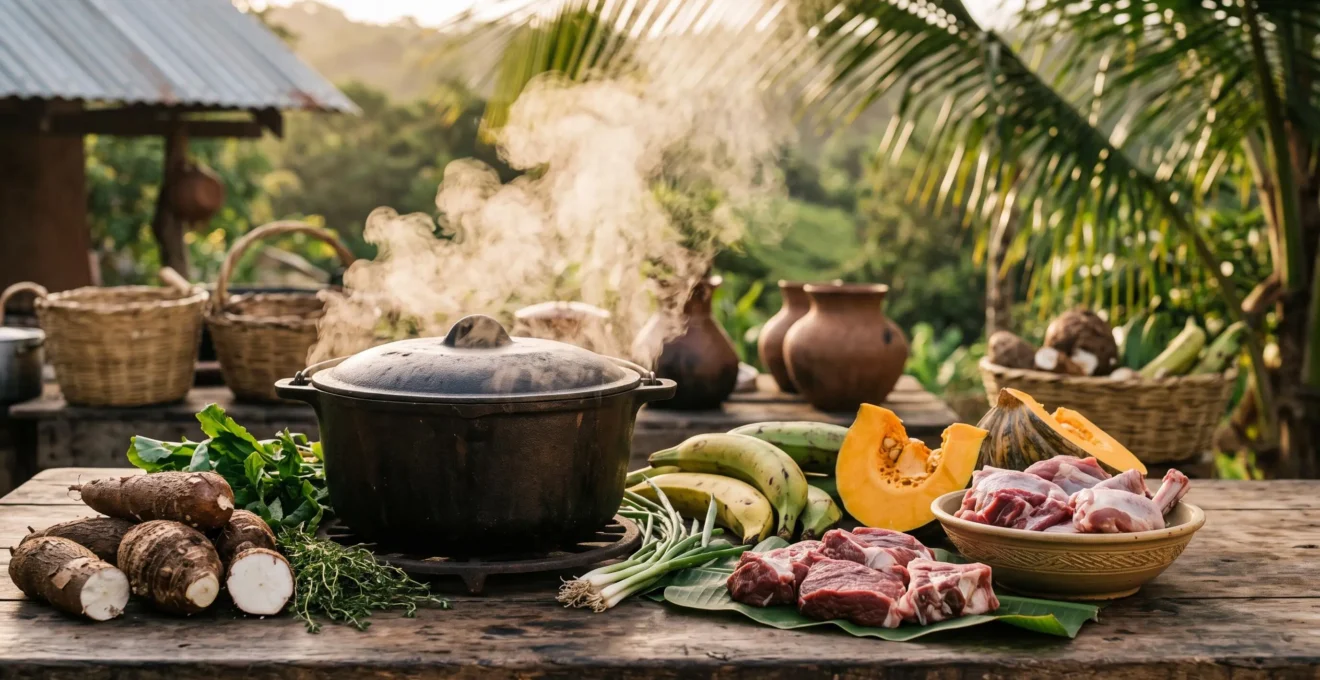
Sancocho is not just a hearty stew; it is a delicious, edible archive of Dominican identity, where every ingredient and ritual tells a story of cultural fusion and social complexity.
- The specific mix of meats and root vegetables (viandas) reflects social occasion, status, and a history stretching from Taíno roots to Spanish colonial influence.
- The true value of sancocho lies in the slow, communal preparation, a social theatre that strengthens family and community bonds far more than any restaurant meal can.
Recommendation: To truly understand sancocho, seek an invitation to a family’s Sunday gathering, observe the ritual, and appreciate the history simmering in the pot.
To the uninitiated traveller, sancocho might appear as just another hearty stew, a comforting but simple feature of Caribbean cuisine. It is a rich, thick broth, brimming with various meats and starchy root vegetables, perfect for a gathering. Most travel guides will label it the « national dish » and leave it at that. But this surface-level understanding misses the point entirely. To ask why sancocho is important is to ask what it means to be Dominican.
This dish is not a fixed recipe; it is a fluid, living text. It’s a form of culinary creolization, a simmering pot where centuries of history converge. In its depths, you find the legacy of Spanish colonisers, the resilience of African peoples, and the foundational flavours of the island’s indigenous Taíno. Understanding sancocho is an exercise in cultural anthropology. It requires us to look past the ingredient list and into the social functions, the unwritten rules, and the symbolic weight of every choice—from the number of meats to the day of the week it’s served.
This exploration will deconstruct sancocho, not as a chef, but as a cultural analyst. We will examine its component parts as symbols, its preparation as a social ritual, and its consumption as a statement of identity. We will then zoom out to see how the same complex forces that shaped this stew—colonial history and the intricate dance of ancestry—continue to define Dominican culture today. Forget the simple recipe; we are about to read the story in the stew.
This guide deconstructs sancocho to reveal its deep cultural significance, connecting its ingredients and rituals to the broader tapestry of Dominican history and identity. Explore the sections below to understand this edible archive.
Summary: Why Sancocho Is the Key to Dominican Culture
- Why Does Traditional Sancocho Contain Seven Different Meats?
- What Root Vegetables Are Non-Negotiable in Authentic Dominican Sancocho?
- Should You Eat Sancocho at a Family Home or a Traditional Restaurant?
- The Sancocho Ordering Mistake on Weekdays When It’s Not Fresh
- What Should You Serve Alongside Sancocho for an Authentic Dominican Meal?
- Why Do Many Dominicans Identify More Strongly With Spanish Than African Ancestry?
- What Ingredients Separate Dominican Sofrito From Puerto Rican Recaito?
- How Did Spanish Colonial History Shape Modern Dominican Cultural Identity?
Why Does Traditional Sancocho Contain Seven Different Meats?
The legendary ‘sancocho de siete carnes’ (seven-meat sancocho) is the dish’s most exalted form, but its existence is more symbolic than standard. The number seven is not arbitrary. While some folklore suggests it represents the Canary Islands, the supposed origin of the dish, the reality is a powerful social indicator. This grand version, a flavourful tapestry of 7 meats from 4 animal species—typically beef, goat, chicken, and various cuts of pork—is reserved for the most significant life events: a wedding, a christening, or New Year’s Eve. It is a declaration of abundance and celebration.
However, this is not the sancocho of everyday life. As Dominican home cooks know, a social hierarchy of stews exists. The ‘siete carnes’ is the pinnacle, but far more common are the simpler, yet no less beloved, versions made with just one or two meats, like a tough but flavourful old hen (‘gallina vieja’) or chunks of beef. This distinction is crucial for any culinary traveller to understand. The choice of meat is not merely about taste; it is an immediate signal of the occasion’s importance. A seven-meat sancocho is a feast, a performance of prosperity. A two-meat sancocho is family, comfort, and the satisfying nourishment of a regular Sunday.
Ultimately, the meat isn’t just an ingredient; it’s the headline of the event, communicating the social significance of the gathering before the first bowl is even served.
What Root Vegetables Are Non-Negotiable in Authentic Dominican Sancocho?
If the meats are the headline, the root vegetables, or ‘viandas’, are the heart and soul of the sancocho, providing its characteristic thickness, earthy flavour, and substantial body. While the exact mix can vary by household, a few are considered utterly essential. These are not the familiar potatoes or carrots of a European stew, but a trio of tropical starches: yuca (cassava), plátano (plantain, specifically green), and yautía (taro root).
Each plays a distinct role. Yuca offers a dense, slightly fibrous chew. Green plantain adds a subtle sweetness and holds its shape. But the true unsung hero is yautía. As one culinary expert notes, « Yautía is the quiet thickener in sancocho — it practically dissolves into the broth, » creating a velvety consistency that is the hallmark of a great stew. This ingredient is particularly significant as it forms a direct link to the island’s pre-Columbian past. Long before the Spanish arrived, the indigenous Taíno people were cultivating and consuming yautía, making it a foundational element of this edible archive.
Other viandas like ñame (yam) or auyama (a type of squash) often join the mix, adding layers of colour and texture, but a sancocho without yuca, plátano, and yautía is considered fundamentally incomplete.
Should You Eat Sancocho at a Family Home or a Traditional Restaurant?
This question probes the very essence of sancocho. While many traditional restaurants (fondas) serve a perfectly respectable version, they can only replicate the flavours, not the function. Sancocho’s true purpose is not merely to be eaten, but to be made. It is a tool for social cohesion, a delicious excuse for a day-long ritual of community and connection. As the team at Dominican Cooking aptly puts it, « the time it takes to prepare is the time that is best enjoyed with friends. » The process begins early, with a trip to the market for the freshest viandas and the best cuts of meat, and unfolds slowly throughout the day.
The large, bubbling pot, the ‘caldero’, becomes the centre of the household’s universe. It is a form of social theatre. Around it, stories are exchanged, drinks are shared, music plays, and generations connect. Children learn by watching their elders peel the viandas; teenagers are tasked with stirring the heavy brew; adults catch up on life as the fragrant steam fills the air. A restaurant can sell you a bowl of sancocho, but it cannot sell you this experience. It is in the home, surrounded by the laughter and industry of a family, that the dish reveals its true meaning.
To receive an invitation to a family’s Sunday sancocho is to be welcomed into the heart of Dominican culture, an honour a tourist menu can never bestow.
The Sancocho Ordering Mistake on Weekdays When It’s Not Fresh
Understanding the social rhythm of sancocho is key to avoiding a common traveller’s disappointment. Because the dish is so deeply entwined with celebration and weekend leisure, ordering it on a whim on a Tuesday afternoon can be a mistake. The Dominican Republic’s own Ministry of Tourism notes that « sancocho is made on special occasions, including Christmas and New Year’s Eve, » and, by extension, on most Sundays. It is a long, laborious process, ill-suited to the fast pace of a weekday lunch service.
A restaurant that lists sancocho on its menu every day of the week is often catering to tourist expectations rather than following local custom. The result can be a stew that has been sitting for days, its flavours muted, its meats dry, and its viandas mushy. It lacks the vibrancy and soul of a freshly made pot. True sancocho is an event, not a convenience. Dominican home cooks have developed methods to manage the extensive prep time for these events, which highlights why it’s not a dish to be whipped up daily. They perform the painstaking task of peeling and portioning the many root vegetables well in advance.
Home Cook’s Action Plan: Prepping Viandas for a Big Event
- Peel and portion: All root vegetables (viandas) needed for one full pot of sancocho are meticulously peeled and cut.
- Collect and sort: The measured viandas are placed into separate bowls or piles, sorted by type to ensure balanced distribution.
- Inventory for freezing: The assorted viandas are transferred into a large vacuum-seal bag in the exact quantity needed for the recipe.
- Assess readiness: The bag is then vacuum-sealed and frozen, creating a ready-to-go kit for the day of the event.
- Plan for integration: On cooking day, the frozen block of viandas is added directly to the simmering meat, drastically reducing on-the-day preparation time.
If you see it advertised as a « daily special, » be sceptical. The authentic experience is worth waiting for the weekend, when the pot is fresh and the atmosphere is festive.
What Should You Serve Alongside Sancocho for an Authentic Dominican Meal?
Sancocho is a meal in a bowl, but it is never served alone. The accompaniments are not optional garnishes; they are integral components of the meal, designed to complement, contrast, and complete the experience. The most critical partner to sancocho is a simple bowl of arroz blanco (white rice). The rice serves as a neutral canvas, ready to be mixed into the stew to absorb the rich broth or eaten alongside it. Many Dominicans spoon a bit of stew over their rice, creating a perfect, flavour-soaked bite each time.
Equally non-negotiable are slices of creamy, ripe avocado. The cool, buttery texture provides a perfect counterpoint to the hot, complex stew. A small plate of lime wedges is also standard, as a fresh squeeze of citrus juice right before eating brightens and sharpens all the deep, savoury flavours. But the true connoisseur’s choice, the detail that signals deep local knowledge, is the addition of concón. This is the crispy, toasted layer of rice that sticks to the bottom of the pot. A piece of concón with a little of the sancocho broth poured over the top (« un conconcito con el caldito por encima ») is a beloved delicacy, a crunchy, savoury treasure.
To complete the festive spread, you will often find tostones (twice-fried green plantains) for dipping, a bottle of hot sauce on the side, and as one source rightly insists, « plenty of rum and very cold beer. »
These accompaniments transform a simple bowl of stew into a communal feast, extending the meal and the conversation that flows around it.
Why Do Many Dominicans Identify More Strongly With Spanish Than African Ancestry?
Just as sancocho’s identity is a complex blend, so too is the identity of the people who created it. This culinary exploration opens a door to one of the most complex and debated aspects of modern Dominican life: racial identity. For the outside observer, the island’s population appears overwhelmingly Afro-descendant. Yet, the internal sense of identity tells a different story. A revealing national survey found that only 8% of Dominicans self-identify as Black, while a staggering 45% chose the term ‘Indio’ (Indian)—a historically complex term that distances from Blackness without claiming to be indigenous.
This self-perception stands in stark contrast to genetic reality. A comprehensive 2016 DNA study of the Dominican population found the average genetic makeup to be roughly 49% African, 39% European, and 4% pre-Columbian Taíno. Why the dramatic disconnect between DNA and identity? The answer is rooted in centuries of colonial history and a cultural narrative that has often, as the African American Registry notes, encouraged Dominicans to think « ‘less’ of their African side compared to the European. » This phenomenon, known as ‘blanqueamiento’ or whitening, is a social mechanism for upward mobility and a legacy of a colonial caste system that prized European lineage above all else.
The sancocho, with its mix of ingredients from three continents, is a perfect metaphor for this reality: a dish where African, European, and indigenous elements are undeniably present, even if they are not always equally acknowledged in the national story.
What Ingredients Separate Dominican Sofrito From Puerto Rican Recaito?
At the flavour base of sancocho, and indeed most Dominican savoury dishes, lies sofrito. This aromatic blend of herbs and vegetables is the starting point, the ‘mise en place’ of Caribbean cuisine. However, the term ‘sofrito’ is not monolithic. A key point of distinction within the region is between the Dominican version, often called ‘sazón’, and the Puerto Rican version, known as ‘recaito’. While they share a common purpose, their ingredients create distinct flavour profiles.
The primary difference, as noted by culinary experts, is that « Dominican sofrito, called sazón in that country, uses vinegar for a flavor punch and annatto for color. » The vinegar adds a sharp, acidic brightness that cuts through the richness of stews, while annatto (bija) imparts a signature golden-orange hue. Puerto Rican recaito, by contrast, is defined by its deep green colour and intense flavour, which comes from an abundance of culantro (recao), an herb with a more potent, earthy flavour than cilantro. The following table breaks down the key distinctions:
| Criteria | Dominican Sofrito | Puerto Rican Recaito |
|---|---|---|
| Base color | Muted yellowish-green | Deep dark green |
| Tomato content | Often includes fresh tomato or paste | Traditionally tomato-free |
| Key herb | Cilantro and oregano-forward | Culantro (recao)-forward |
| Common name locally | Sazón | Recaito |
| Typical use | Long-simmered stews like sancocho | Rice dishes like arroz con gandules |
This base flavour is the first layer of identity in a dish like sancocho, a distinctly Dominican foundation upon which all other ingredients are built.
Key Takeaways
- Sancocho is more than a dish; it’s an edible archive of Dominican identity, blending Taíno, Spanish, and African influences.
- The number and type of meats in sancocho signify the social importance of the occasion, from everyday meals to grand celebrations.
- The true sancocho experience is a social ritual of slow, communal preparation, best understood in a family home rather than a restaurant.
How Did Spanish Colonial History Shape Modern Dominican Cultural Identity?
To fully grasp the meaning of sancocho and the complexities of Dominican identity, we must look back to its origins as the first colony of the New World. The island of Hispaniola was the initial site of contact, conflict, and fusion between European, African, and American worlds. The very creation of sancocho is a story of this colonial encounter. The dish is believed to have evolved from a simple fish stew brought by Canary Islanders, which was then transformed by the ingredients available locally and the culinary traditions of the enslaved African population. This process of culinary creolization is a direct reflection of the broader cultural fusion happening on the island.
The demographic landscape of the colonial era laid the groundwork for today’s intricate social fabric. Detailed historical colonial census records show that by 1777, the colony’s population of roughly 400,000 was a complex mosaic of 100,000 Europeans/Criollos, 60,000 Africans, and a large majority of 260,000 mixed-ancestry people (mestizos, mulattos, and zambos). This long history of intermixture created a society where rigid racial lines were often blurred, yet a distinct social hierarchy, with European heritage at its apex, was strictly enforced. This colonial legacy directly informs the modern-day tension between genetic reality and racial self-identification.
From the caldero to the census, the island’s identity is a rich, complex, and sometimes contradictory sancocho of cultures, a legacy simmering for over five hundred years. To begin to understand the Dominican soul, one must start by appreciating the profound history in its most beloved dish.